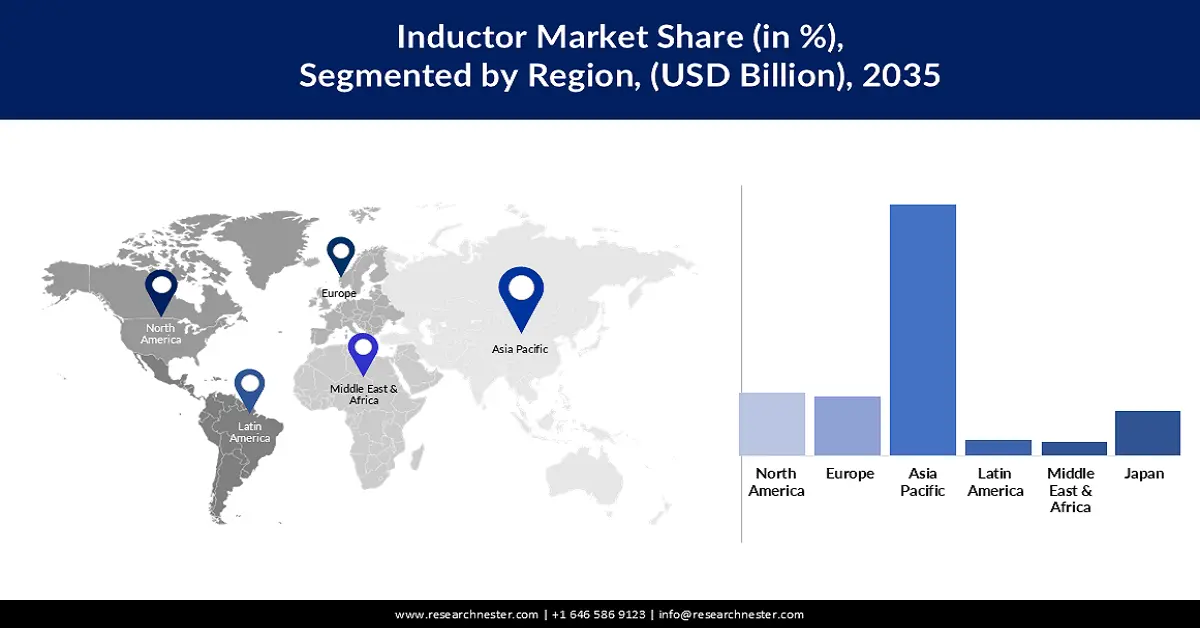
Inductor Market Regional Analysis:
Asia Pacific Market Insights
Asia Pacific industry is poised to account for largest revenue share of 56% by 2035. The increasing penetration of consumer electronics, developments in automotive technology, and investments in 5G infrastructure and Internet of Things applications contribute to the market's expansion. Between 2023 and 2030, telecom providers in the Asia Pacific region are expected to spend USD 259 billion on networks, most of which will go toward fifth-generation, or 5G, deployments.
The dominance of electronics manufacturing in China propels the inductor market. For instance, China exported USD 4,234.93 million worth of inductors to other countries in 2022. Also, the inductor sector in China is predicted to reach USD 1.95 billion by the year 2035.
The escalating investment in the consumer electronics and automotive industries in South Korea is poised to boost the inductor market growth in the region. Also, the region is technologically advanced, which is expected to fuel the market in many ways.
The growing use of consumer electronics and improvements in automotive technology are driving inductor market expansion in India. Additionally, the rising need for power and power management systems is a significant reason behind the growth of the sector in this region.
North America Market Insights
Inductor market size for North America region is projected to grow substantially till 2035. The market is expanding due to growing investments in smart grid technologies and renewable energy. American Clean Power Association on July 31, 2023, announced USD 270 billion in federal incentives for utility-scale clean energy projects and manufacturing facilities.
Strong demand for inductors in Canada is a hallmark of the market, which is fueled by substantial R&D expenditures and technological advancements. Automotive, consumer electronics, and industrial automation are the key users of inductors in the country.
The U.S. inductor market is predicted to witness revenue of USD 1.31 billion by the end of 2035. The adoption of high-speed broadband infrastructure and the growth of 5G networks in the country have made the use of inductors in communication equipment, such as base stations, routers, and switches, necessary.