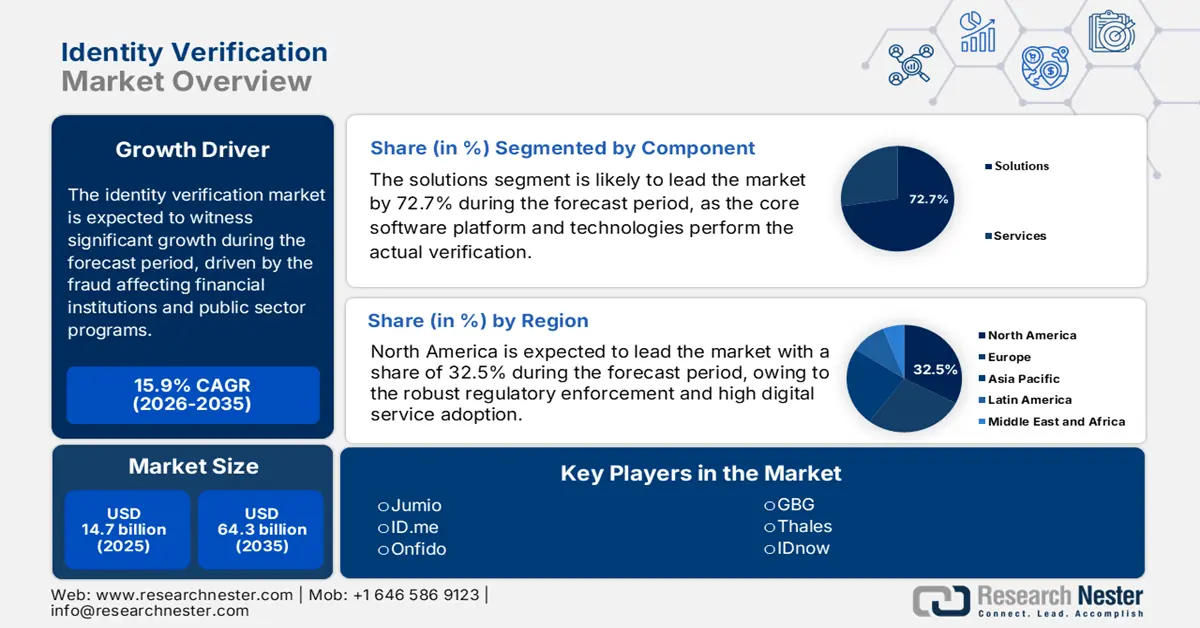
Identity Verification Market Outlook:
Identity Verification Market size was valued at USD 14.7 billion in 2025 and is projected to reach USD 64.3 billion by the end of 2035, rising at a CAGR of 15.9% during the forecast period, i.e., 2026-2035. In 2026, the industry size of identity verification is evaluated at USD 17.1 billion.
The market is driven mainly by the sustained growth in identity-enabled fraud affecting financial institutions, healthcare systems, and public sector programs. According to the Federal Trade Commission March 2025, identity-related fraud accounted for nearly 1.1 million reports in 2023, representing the largest category of consumer fraud in the U.S., with the reported losses across the fraud and identity misuse combined. Business facing exposure is significant. The FBI Internet Crime Complaint Center reported that the business email compromise and identity-driven account takeover schemes generated USD 2.9 billion in losses in 2024, heavily impacting banks, insurers, payroll processors, and government contractors. These figures are driving enterprises to embed stronger identity verification controls across onboarding account access and transaction authorization workflows to meet operational risk thresholds and regulatory expectations.
From a regulatory and compliance standpoint, public institutions are directly influencing enterprise adoption. The National Institute of Standards and Technology continues to mandate higher identity levels under the NIST SP 800-63, which is referenced across federal procurement, financial services compliance, and healthcare identity programs. Additionally, the U.S. Government Accountability Office data in March 2024 reported that the identity verification gaps are a contributor to improper payments, estimating USD 236 billion in improper federal payments in 2023, with identity weaknesses cited across unemployment insurance, Medicare, and disaster relief programs. On the healthcare side, the CMS links the patient misidentification to claim errors and fraud exposure, reinforcing payer and provider demand for stronger identity controls.