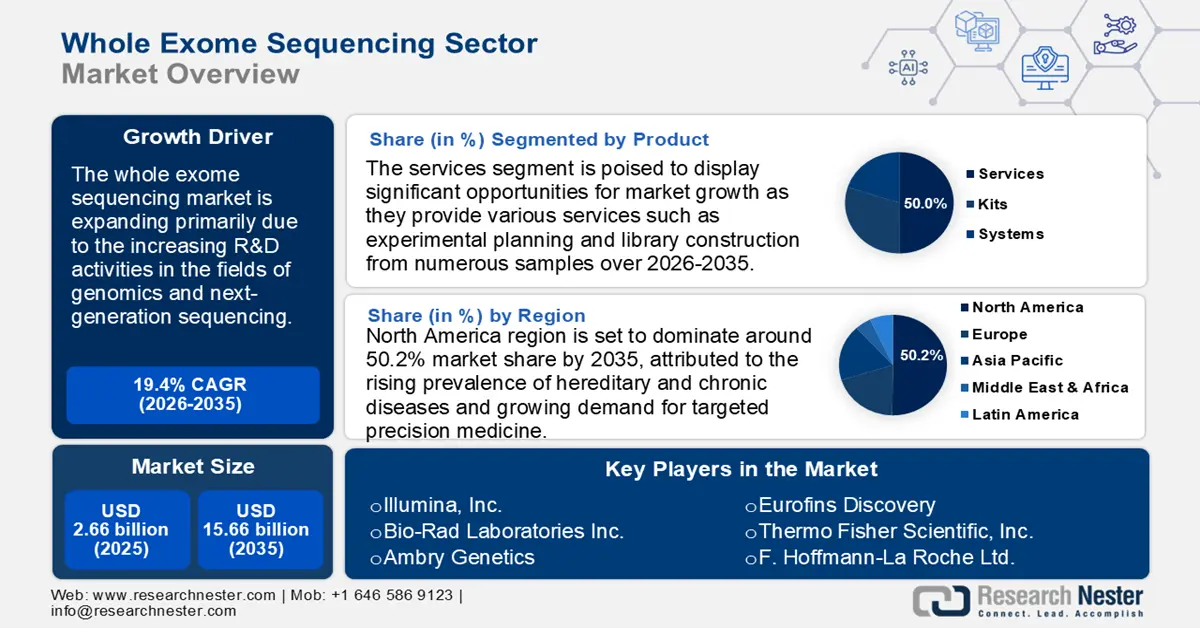
Whole Exome Sequencing Market Outlook:
Whole Exome Sequencing Market size was over USD 2.66 billion in 2025 and is poised to exceed USD 15.66 billion by 2035, witnessing over 19.4% CAGR during the forecast period i.e., between 2026-2035. In the year 2026, the industry size of whole exome sequencing is estimated at USD 3.12 billion.
The growth of the market can be attributed to growing number of people having genetic mutation. A mutation, often known as a change in a gene, is the cause of more than about 9000 human diseases. About 9 out of every 1000 persons are impacted. According to this, between approximately 60 million and 80 million people worldwide are afflicted by one of these illnesses. Hence, the demand for whole exome sequencing is estimated to increase. Exome sequencing has been proven to be able to identify genetic variants linked to developmental and birth abnormalities. Hence, exome sequencing may allow patients who have a family history of disease or are looking for a diagnosis to explain their symptoms to forego unnecessary diagnostic procedures.
Moreover, the market is also being driven by rising R&D in the fields of genomics and next-generation sequencing. For instance, in May 2022 NanoString Technologies, Inc. released a cloud-based process that enhances the spatial data analysis experience for users of the GeoMx Digital Spatial Profiler and Illumina NextSeq 1000 and NextSeq 2000 sequencing equipment. With the help of this integrated, push-button run planning tool, the geographical analysis of whole transcriptomes and proteome analytes has been made simpler. Hence, the whole exome sequencing market is anticipated to be driven by such advancements. Also, the government spending on R&D for whole exome sequencing is also growing which is also estimated to boost the growth of the market over the forecast period.