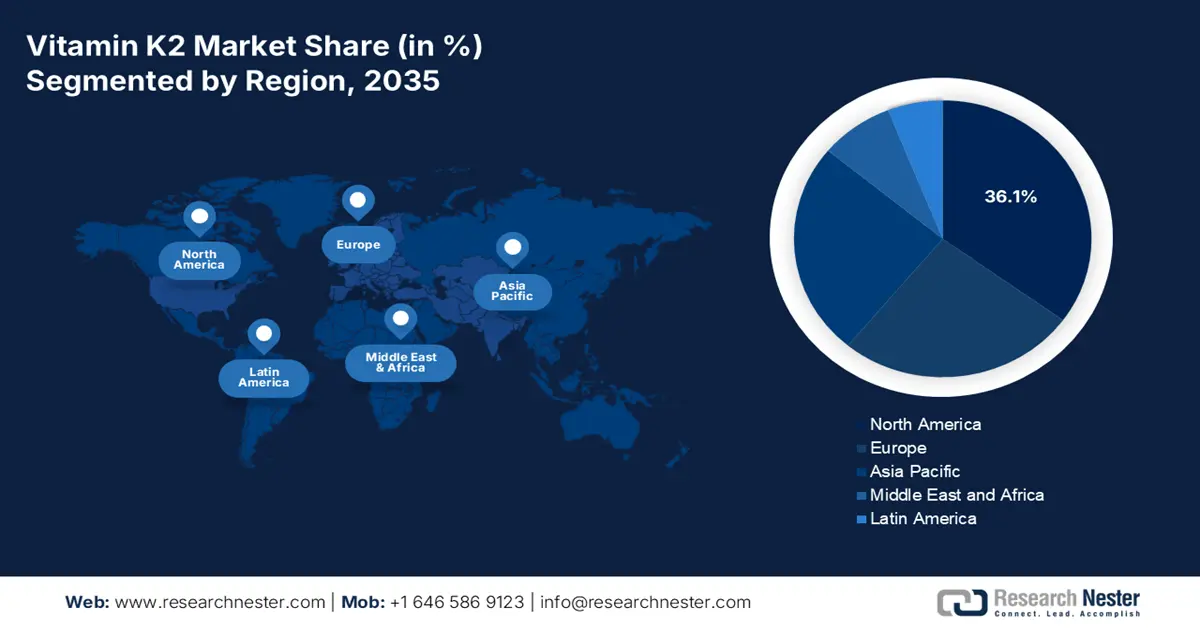
Vitamin K2 Market Regional Analysis:
North America Market Insights
The North America vitamin K2 market is projected to hold the largest market share of 36.1% by the end of 2035. The growth can be attributed to the increasing focus of consumers on health. According to the Centers for Disease Control and Prevention in 2024, early and classical VKDB is more common, occurring in 1 in 60 to 1 in 250 newborns, in the U.S. New babies are given vitamin K2 injections to prevent a serious disease called hemorrhagic disease. The factors are propelling the market growth in the region and creating lucrative opportunities. In Canada, there is a surge in cases of osteoporosis leading to increased demand for vitamin K2 supplements. According to data published by Amgen Canada in 2022, at least 1 in 3 women and 1 in 5 men will break a bone due to osteoporosis in their lifetime.
Asia Pacific Market Insights
Rising cases of heart-related problems are projected to give thrust to the market expansion. According to data published by the World Health Organization in 2023, cardiovascular diseases account for 3.9 million deaths in the South East Asia region every year. Doctors prescribe to take vitamin K2 to reduce arterial stiffness and slow down the progression of vascular and valvular calcification. Other than this, according to the International Osteoporosis Foundation, it is projected that more than 50% of all osteoporotic hip fractures will occur in Asia by 2050. Women are taking vitamin K2 to prevent fractures in the postmenopausal period.
According to the International Trade Administration in April 2021, Japan is the world’s 3rd largest dietary supplements market. A rapidly aging population and a surge in health consciousness are boosting the sector’s growth. Additionally, according to the International Osteoporosis Foundation in June 2022, an estimated 13 million people are living with osteoporosis in Japan and 240,000 patients experience hip fractures. In Japan and other parts of Asia, vitamin K2 is used as a treatment for osteoporosis. National Institutes of Health states that Vitamin K2 is considered vital in providing standard care in Japan and suggests that its supplementation improves lumbar bone mineral density and reduces undercarboxylated osteocalcin.