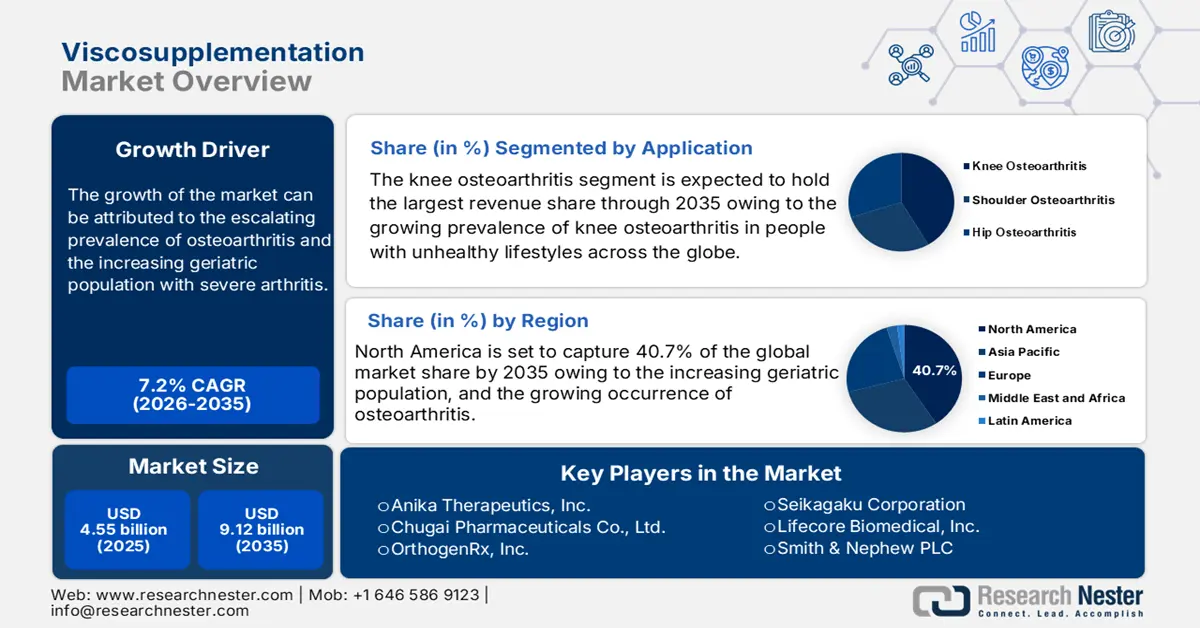
Viscosupplementation Market Outlook:
Viscosupplementation Market size was valued at USD 4.55 Billion in 2025 and is expected to reach USD 9.12 Billion by 2035, registering around 7.2% CAGR during the forecast period i.e., between 2026-2035. In the year 2026, the industry size of viscosupplementation is evaluated at USD 4.84 Billion.
The growth of the market can be attributed to the escalating prevalence of osteoarthritis across the globe, owing to the shift of the population towards unhealthy lifestyles and consumption of processed food which in turn is expected to foster arthritis cases. Arthritis is a condition in which people get swelling or inflammation in joints and more than 100 conditions are described by arthritis that affects tissues around joints and other tissues connected to it. For instance, in 2019, there were approximately 526.90 million osteoarthritides (OA) occurrences worldwide. The healthcare provider injects hyaluronic acid into the joints during viscosupplementation treatment to reduce swelling and any sort of pain in the joints.
Osteoarthritis patients have lower levels of hyaluronic acid in their joints, which causes pain. Therefore, a proper infusion of hyaluronic acid delivers optimum results in the elasticity of knee cartilage. It was observed in clinical research that, hyaluronic acid (HA) is a widely known high molecular weight natural glycosaminoglycan consisting of repeating units of D-glucuronic acid and N-acetylglucosamine disaccharide linked by biopolymer B-(1-4) and B-(1-3) glycosides. HA promotes cartilage matrix synthesis and improves cartilage elasticity and humidity. Several orthotic devices, casts, and splints are also utilized to treat the condition of osteoarthritis. It also prevents chondrocyte apoptosis and increases proteoglycan synthesis. As a result, HA is essential for avoiding cartilage erosion and reducing synovial inflammation. In OA patients, the rate of depolymerization and clearance of endogenous HA in joints is higher than normal, which lessens not only the density and molecular weight of HA but also the elastic viscosity of the synovial fluid.