Virtual Reality in Healthcare Market Outlook:
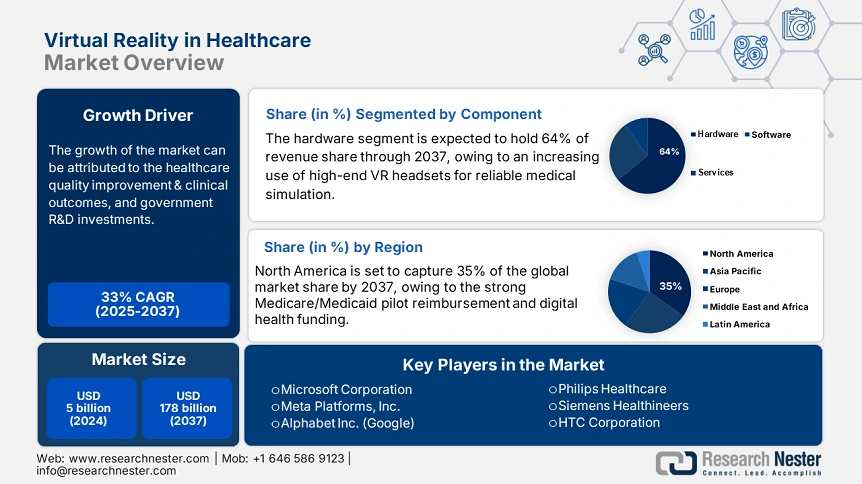
Virtual Reality in Healthcare Market size was valued at USD 5 billion in 2024 and is projected to reach USD 178 billion by the end of 2037, rising at a CAGR of 33% during the forecast period, 2025 to 2037. In 2025, the industry size of virtual reality in healthcare is estimated at USD 6.4 billion.
Government data indicate a developing clinical patient base, speaking to the use of VR technology. Additionally, there are other NIH-supported studies/examinations regarding the use of VR in inpatient treatments and for anxiety in brain tumor patients. In sum, these studies and programs demonstrate an expanding treatment-based user group that belongs to clinical systems.
The overall supply chain for VR healthcare products follows established trade practices for medical devices. As per the International Trade Administration, in 2019, U.S. exports of medical devices were more than USD 44 billion. In 2020, U.S. imports totalled USD 67 billion. This demonstrates the large two-way trade related to the assembly and distribution of medical devices worldwide. Although VR-specific parts (headsets, haptic sensors) are included in the larger category of medical devices, they are not reported separately in the PPI/CPI data. However, concerning Puerto Rico, export prices for medical equipment and supplies increased by 0.6 % year-over-year. Moreover, according to the Bureau of Labor Statistics (BLS) import prices decreased 0.1% as of April 2025.
Financing for VR research and implementation demonstrates regulatory and institutional support. The FDA's Digital Health Center of Excellence had approved 68 AR/VR-enabled medical devices by September 2024. The U.S. device manufacturers reinvest about 6 % of gross revenues in R&D. Trade-specific realities include several factors that require consideration for VR segment growth opportunities. This highlights the continuing dependence on cross-border supply chains to access sophisticated medical hardware.