Vertical Farming Market Outlook:
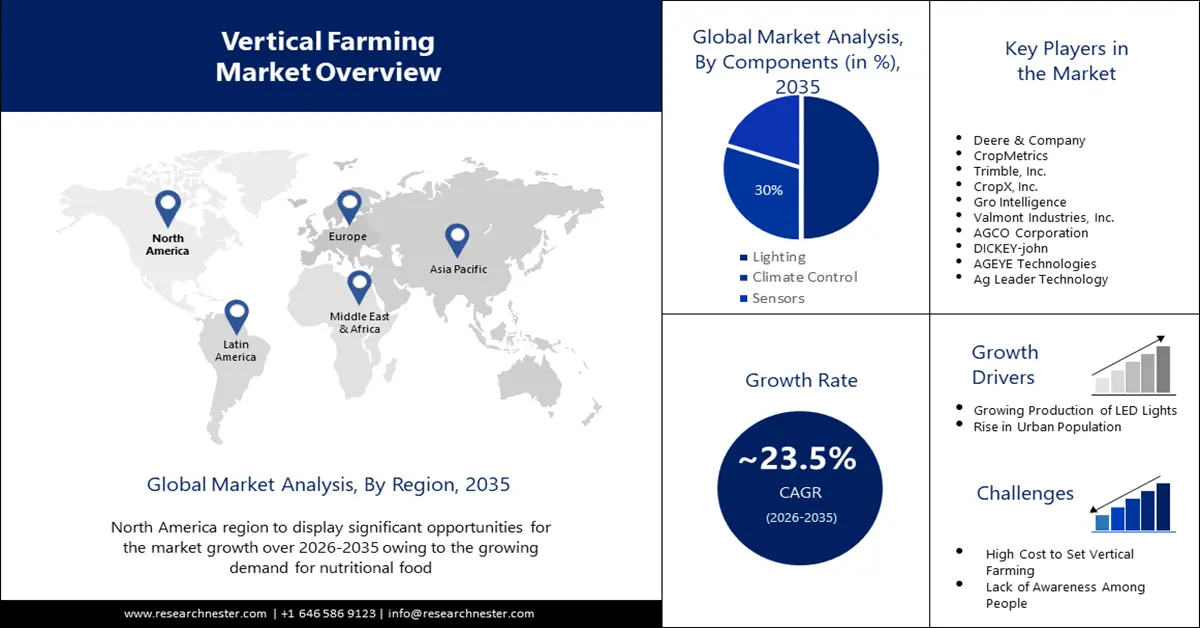
Vertical Farming Market size was valued at USD 8.32 billion in 2025 and is expected to reach USD 68.67 billion by 2035, registering around 23.5% CAGR during the forecast period i.e., between 2026-2035. In the year 2026, the industry size of vertical farming is evaluated at USD 10.08 billion.
The growth of the market can be attributed to growing demand for organic food owing to improved standard of living of the people and their concern towards health. For reasons related to their health, about 75% of adult bought organic food in 2022, in US. Hence, the demand for organic farming is estimated to increase. Producing crops of the highest quality while having the least negative influence on the environment is the goal of organic farming. In this, it is completely forbidden to use any dangerous synthetic chemicals, including pesticides, herbicides, fungicides, and other contaminants of the soil and water. On the other side, vertical farming represents a more contemporary approach to the established organic agricultural system.
Moreover, there has been growing scarcity of agriculture land which is why the demand for vertical farming is growing. Farmers may utilize about 98 percent less land and approximately 97 percent less water by using vertical agricultural techniques. Through constant or rolling harvesting throughout the year, they could produce agricultural yields that are about 239 times greater than those of conventional farms. Moreover, vertical farming delivers enhanced annual productivity and reliable year-round production. Just some seasonal fruits and vegetables were offered by convectional farming. Instead, with little reliance on weather or environment, vertical farms may grow a wide variety of crops all year round.