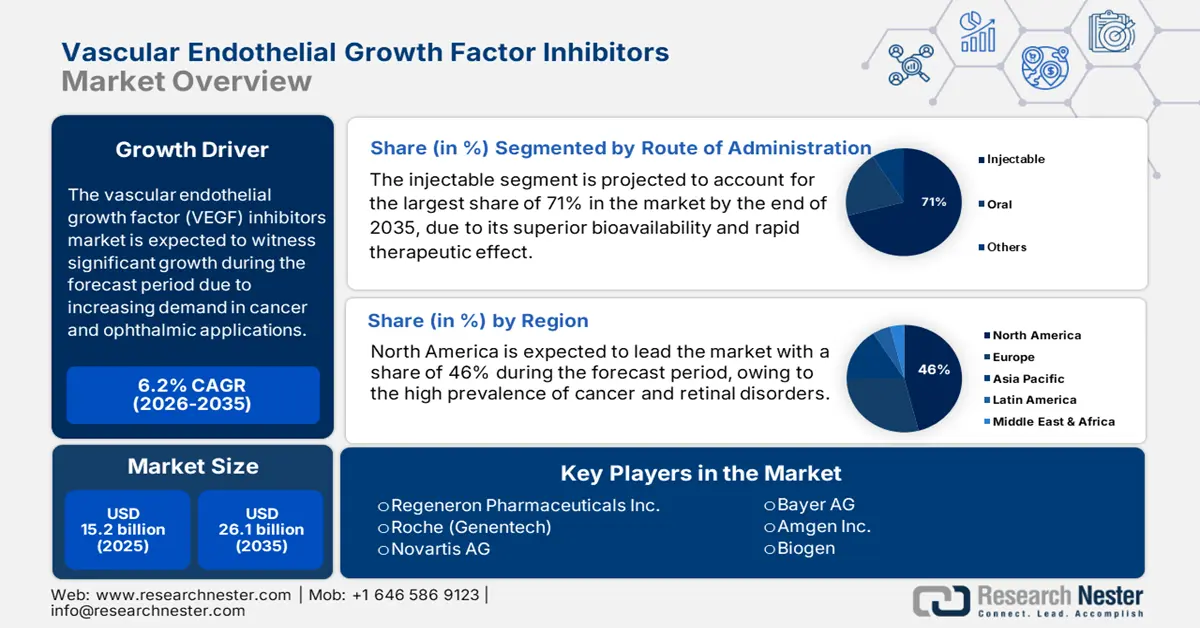
Vascular Endothelial Growth Factor Inhibitors Market Outlook:
Vascular Endothelial Growth Factor Inhibitors Market size was valued at USD 15.2 billion in 2025 and is projected to reach USD 26.1 billion by the end of 2035, rising at a CAGR of 6.2% during the forecast period, i.e., 2026 to 2035. In 2026, the industry size of vascular endothelial growth factor (VEGF) inhibitors is evaluated at USD 16.1 billion.
The global market is experiencing vigorous growth, driven by the increasing applications in oncology and ophthalmology. There is a rapid prevalence of cancer cases, such as lung, colorectal, and breast, coupled with retinal disorders, which exceptionally necessitate the VEGF inhibitors across all nations. According to a clinical study by the America Cancer Society in January 2024, 2,001,140 new cancer cases and 611,720 cancer deaths are projected to occur in the U.S., the equivalent of about 5480 diagnoses each day. Therefore, this increasing burden of disorders increases the demand for VEGF inhibitors, thereby propelling the market growth.
Generic drugs are essential to global healthcare systems, offering cost-effective alternatives to brand-name medications. As per a report by USP Quality Matters in April 2025, generic drugs come primarily from India. Generic drugs make up 90% of US prescription volume. China contributes 8% of the total volume of API, and 43% of branded pharmaceutical API comes from Europe. This global supply chain plays a critical role in the production of complex biologics, including vascular endothelial growth factor (VEGF) inhibitors. With rising demand for affordable cancer and ophthalmology treatments, the market is increasingly influenced by the availability of high-quality generics and biosimilars. Emerging markets are expected to play a larger role in manufacturing and consumption.