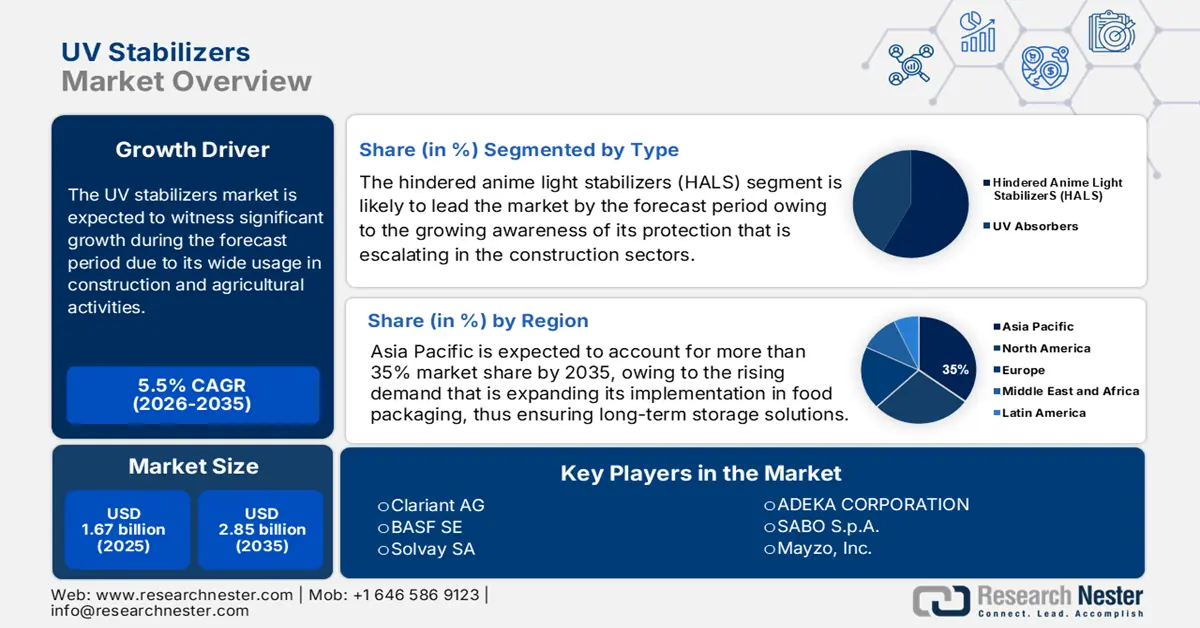
UV Stabilizers Market Outlook:
UV Stabilizers Market size was over USD 1.67 billion in 2025 and is projected to reach USD 2.85 billion by 2035, witnessing around 5.5% CAGR during the forecast period i.e., between 2026-2035. In the year 2026, the industry size of UV stabilizers is evaluated at USD 1.75 billion.
UV stabilizers or additives not only prolong polymer resistance to UV degradation but also offer antibacterial properties that may stop pathogens from spreading and stop microbially driven biodegradation. Using polyurethane formulations to create lacquer films, we added various UV stabilizers, such as a hindered amine light stabilizer (HALS), Tinuvin 770 DF and Tinuvin PA 123, or a hybrid HALS/UV-absorber, Tinuvin 5151, and evaluated their antimicrobial activity against methicillin-resistant and -sensitive strains of Staphylococcus aureus, Escherichia coli, and Candida albicans, according to Frontiers.
The most often utilized UV-stabilizer agents in polymeric materials are UV-absorbers and HALS. Benztriazoles, benzophenones, and hydroxyphenyl triazines are a few types of UV absorbers. HALS, on the other hand, works by preventing the autoxidation process and causing its parent amines to produce nitroxide radicals. By joining forces with alkyl radicals, these nitroxide radicals prevent the material's oxidative deterioration. BASF sells HALS under the brand name Tinuvin, which includes Tinuvin 770 DF, Tinuvin 5151, Tinuvin 326, Tinuvin 328, Tinuvin 1130, and Tinuvin PA 123. The supplier's technical data sheet states that Tinuvin 770 DF is approved for use in solvent-based adhesives (including acrylic and PUR), sealants (MS polymer), ethylene-vinyl-acetate (EVA) polymer systems, polyurethane (PUR), polyamide (PA), styrene-butadiene-styrene (SBS), and styrene isoprene-styrene (SIS). The biodegradation of polymeric materials has attracted attention in recent years because it may reduce the amount of microplastic that accumulates in ecosystems.
Certain UV stabilizers, such as compounds based on HALS, have been reported to possess both antioxidant and antibacterial qualities in addition to their primary purpose. Metal-based substances like zinc oxide (ZnO) and titanium dioxide (TiO2) are examples of antimicrobial UV-light stabilizers, as are non-metal substances (3,5-benzamide-2,4-dihydroxyphenyl) (phenyl) methanone (UV-CB). According to Trading Economics, Titanium surged 1 CNY/KG or 2.25% since the start of 2025, based on the contract for difference (CFD) that benchmarks the market for Titanium. Historically, Titanium reached a record high of 152.43 in May of 2022.
Top 5 TiO2-based Pigments & Preparations Global Exporters, 2021
|
Country |
Tradeflow Value (1000USD) |
Quantity (Kg) |
|
China |
3,685,779.29 |
1,325,470,000 |
|
The U.S. |
1,507,691.31 |
491,562,000 |
|
EU |
1,295,389.65 |
380,057,000 |
|
Germany |
1,272,521.13 |
359,846,000 |
|
UK |
654,205.74 |
219,436,000 |
Source: WITS