Urology Laser Market - Regional Analysis
North America Market Insights
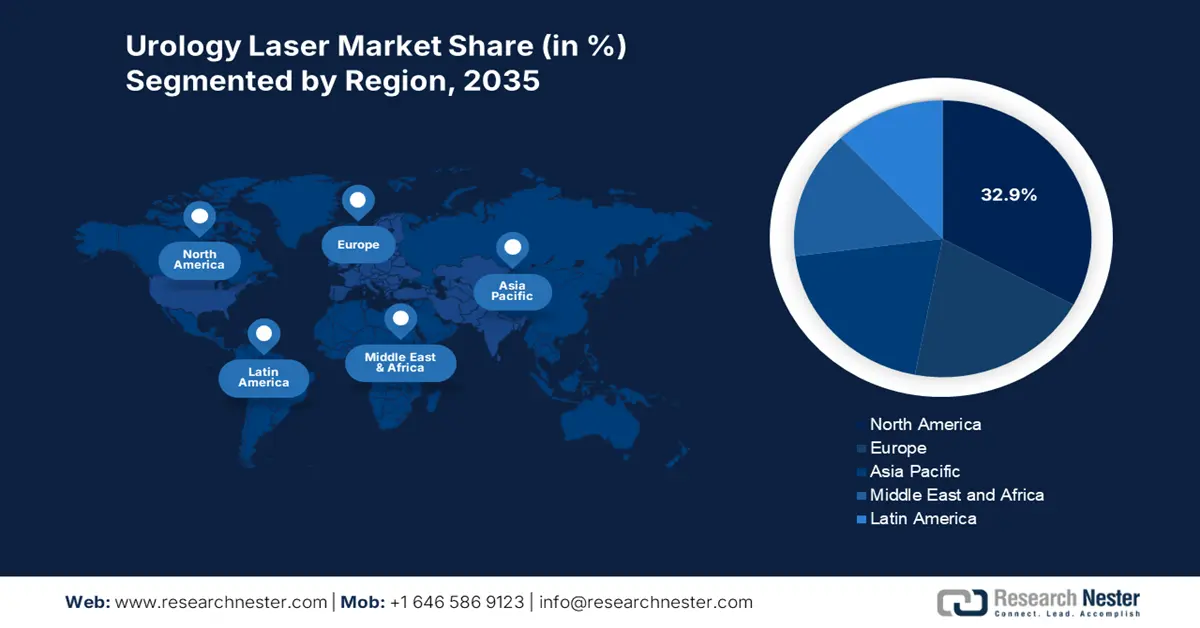
North America market is projected to register the highest share of 32.9%, rising at a CAGR of 5.7% during the forecast period. The region benefits from a vast consumer base, i.e., the patient pool affected by urological disorders, and the preference for these lasers as an effective solution. Besides, the federal agencies, such as the CDC and AHRQ, are extending their support with investments. Technological innovations and the presence of key market players further bolster growth in the region. Moreover, the reimbursement infrastructure in the U.S. and Canada is fully developed for payment of these advanced technologies. Furthermore, with the technological advancements and innovations made by international equipment manufacturers and global research institutions, urology laser systems continue to have enhanced precision, safety, and operability in their functionalities. As outpatient procedures and robotic-assisted surgeries gain increased prominence, hospitals and specialty clinics are adopting the system more and more.
The U.S. has the largest and most entrenched market for urology lasers due to the overall significant incidence of benign prostatic hyperplasia (BPH), kidney stones and prostate cancer. Specifically, the U.S. has a large and growing aged population with a very high expectation of minimally invasive procedures resulting in the fairly rapid acceptance of laser-based surgical treatment. The estimates by the Population Reference Bureau estimate the number of Americans aged 65 and over is on track to increase by 47% from an expected 58 million in 2022 to 82 million in 2050. In general, the U.S. benefits from large hospital networks with complex hospital networks, competitive insurance policies, etc.; real reimbursement authorization and A-class laser surgery technology in the hospitals which greatly simplifies and streamlines implementation. The fact that FDA approvals occur in a timely fashion and also represent innovative devices and robotic-assisted foods that allow reassurance and progress is just another beneficial factor.
The urology laser market has significant growth potential in Canada, with an expected CAGR of 5.9%, increasingly driven by advancements in the healthcare system, along with the growing prevalence of urological disease. Hospitals and urology centers in Canada use holmium and thulium lasers to performed incisions for tissue removal with great precision and safety. Investment in healthcare technology and overall digital transformation by the Canadian government is improving access to specialty care across regions and areas of care parameters and standards, both rural and urban. High levels of medical regulation, guidelines, and ethical responsibility ensure a high standard of surgical care across Canada; additionally, partnerships with U.S. or international companies are also driving access to cutting-edge laser systems.
APAC Market Insights
Asia Pacific market is the fastest-growing, holding a 22.4% share and growing at a CAGR of 8.9%. The growth in the region is primarily driven by increasing healthcare investments, a growing aging population, and ongoing advancements in medical technology. With its growing older population and increasing lifestyle-related health issues, the region of the Asia Pacific is seeing a rise in patient cases such as kidney stones and benign prostate hyperplasia. This is increasing the need for accessible and effective treatment options, such as better laser treatments. Besides the presence of countries such as Japan, China, India, and South Korea, the major factor for which the growth is attributed. South Korea has higher adoption rates towards the urology lasers, driven by its disease incidence; meanwhile, growth in India is attributed to the government's increasing healthcare budget.
The market in India is rapidly gaining speed with the growing infrastructure in the healthcare system in the country. The increased incidence of kidney stones, benign prostatic hyperplasia (BPH), and prostate cancer also necessitates the availability of new solutions in urology. Initiatives such as Ayushman Bharat and the National Digital Health Mission from the government's overarching guidance will facilitate that patients will have considerably more access to diagnostic tests and surgical procedures. Also, because India has a strong labor force, low cost of care, and has seen a rise in medical tourism; India has become a destination of choice for urological procedures. In fact, the India Brand Equity Foundation, estimated in 2024 that over 7.3 million medical tourists had visited India because of India's world-class healthcare facilities.
China is a major player, comprising a lucrative share of 98.6% in the Asia-Pacific market. The growth is supported by significant government support and an expanding healthcare system. Supported by national policies such as "Healthy China 2030," there is a tremendous focus on upgrading hospitals and access to specialty treatment facilities. Urbanized patients are beginning to demand the precise and minimally invasive procedures that urology lasers can deliver. China has many hospitals that have begun to target these urological lasers, an increasing trend supported by growing registration of surgical and diagnostic laser niche products, and favorable changes to regulatory processes. Therefore, given all of these elements, China is likely, and continuing to be, the most dynamic urology laser market in the region.
Europe Market Insights
Europe market is increasing significantly, thanks to the advanced healthcare systems in the region, high prevalence of urological disorders, and growing demand for minimally invasive surgical procedures. The aging population in several countries is leading to an increase in benign prostatic hyperplasia (BPH), kidney stones, and prostate cancer. This is leading to an increase in the need for laser treatments. European healthcare providers are early adopters of advanced technologies such as holmium and thulium fiber lasers, which provide urologists with more precision, less bleeding, and quicker recovery for patients. Favorable reimbursement, large clinical economies creating research infrastructure, and partnerships between hospitals and medical device companies are also helping create entry points for users of laser systems for routine urologic procedures.
Due to its advanced and sophisticated healthcare system, France is an important player in the increasing urology laser market in Europe. French urologists are increasingly choosing holmium and thulium lasers for their limited bleeding, considerable precision, and fewer complications post-operatively. In France, government funding and reimbursement practices also make it easier for advanced laser systems to be adopted by hospitals. Quality institutions in France share a history of clinical research and training; they continue to work with patients with a focus on the minimally invasive method. Collaborative public hospitals, research institutes, and device companies are aiding the upward growth in the market.
Germany is one of the largest and most sophisticated urology laser markets in Europe. Both prostate disorders and kidney stones regularly occur in Germany. In addition, a number of leading medical device companies are present, and there are many academic and research institutions in a strong collaboration network to support innovation and adoption. The country has a well-established healthcare reimbursement process to encourage minimally invasive procedures. There is also increasing demand for outpatient urology treatments, which are ideal for laser procedures. Taken together, Germany represents an important market central to the urology laser market's development and growth in Europe.