Unmanned Traffic Management Market Outlook:
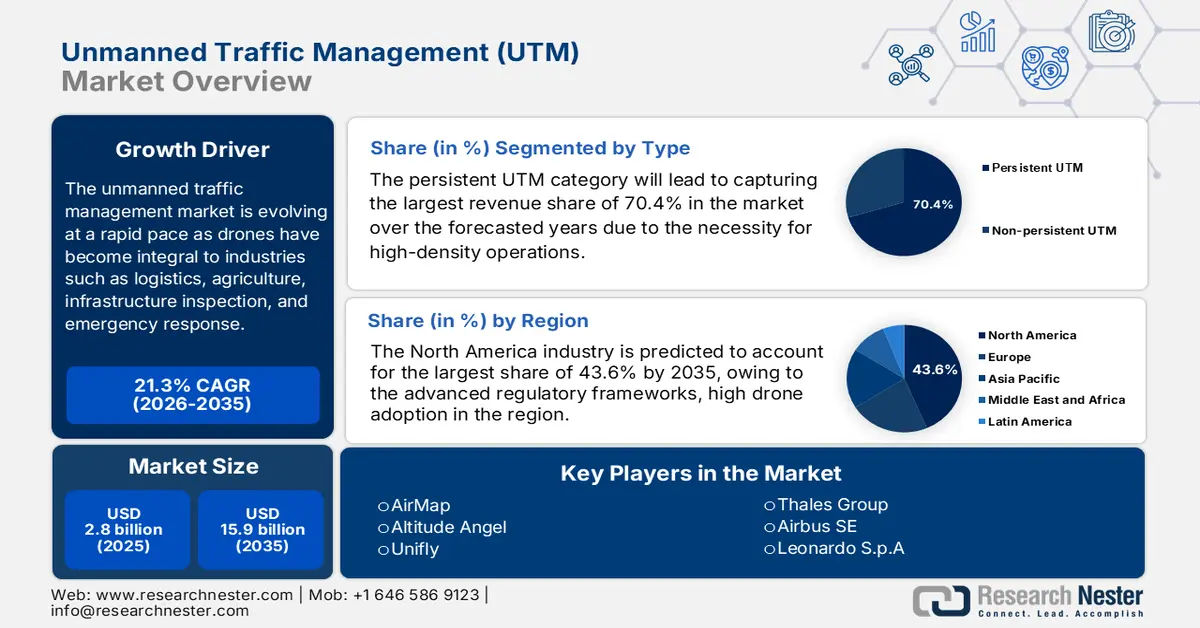
Unmanned Traffic Management Market size was valued at USD 2.8 billion in 2025 and is projected to reach USD 15.9 billion by the end of 2035, rising at a CAGR of 21.3% during the forecast period, i.e., 2026-2035. In 2026, the industry size of unmanned traffic management is evaluated at USD 3.4 billion.
The UTM market is evolving at a rapid pace as drones have become integral to industries such as logistics, agriculture, infrastructure inspection, and emergency response. In this regard, the FAA, in collaboration with NASA and industry, in November 2022, reported that it is developing and validating UAS traffic management concepts, systems engineering requirements, and operational capabilities to manage diverse beyond visual line of sight operations below 400 feet. It also mentioned the key drivers, which include the growing variety of UAS operations, the need for efficient management in complex airspace, and integrated information governance. Moreover, the outcomes are focused on creating an interoperable ecosystem with secure data exchange, enterprise services that support a unified information environment, and systems engineering designs that inform future policies, regulations, and standards.
Furthermore, there has been an increased adoption of beyond-visual-line-of-sight operations, the push for standardization, and integration with traditional air traffic management. The unmanned traffic management (UTM) market is poised for extensive growth in the upcoming years as UTM becomes essential for managing complex airspace, encouraging the pioneers to expand commercial drone operations. In September 2025, ANRA Technologies announced that it had expanded into Dubai after winning the Dubai UTM competition by establishing a regional hub to manage the Emirate’s next-generation UTM platform and support safe, scalable drone operations within the Dubai control traffic area. In addition, this expansion builds on ANRA’s FAA-approved UTM deployments in the U.S. and EASA-certified U-space services in Europe, reinforcing its global footprint. The Dubai office will facilitate collaboration with government, commercial, and defense partners by also advancing digital airspace solutions, advanced air mobility services, and vertiport management systems, hence positively impacting UTM market growth.