Underwater Robotics Market Outlook:
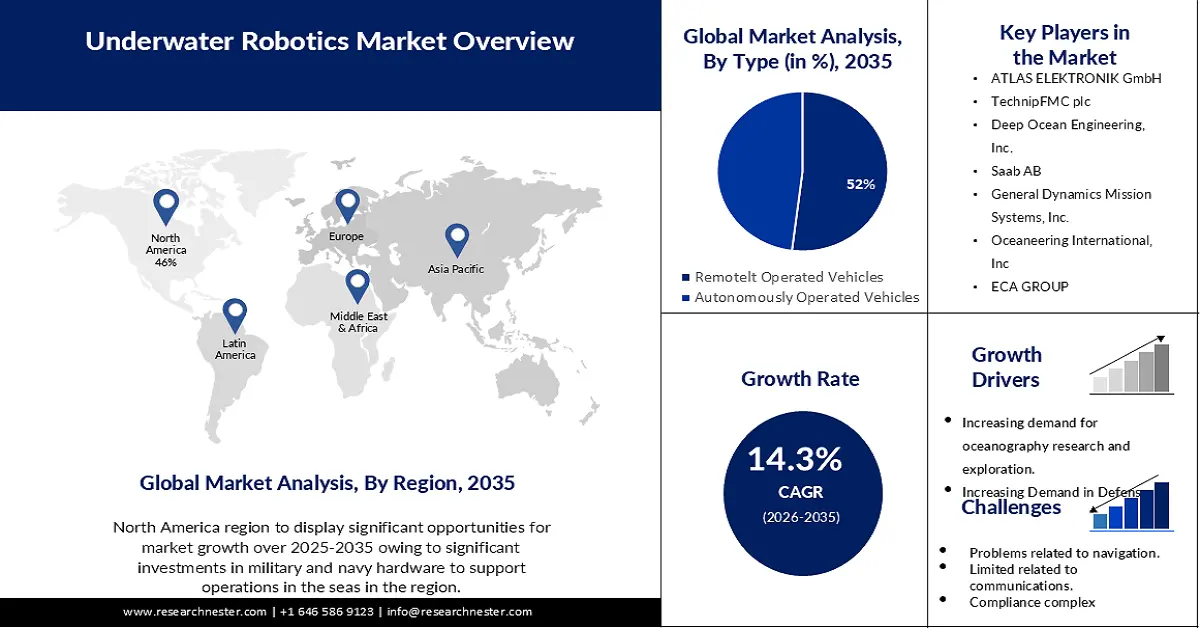
Underwater Robotics Market size was over USD 5.24 billion in 2025 and is anticipated to cross USD 19.94 billion by 2035, witnessing more than 14.3% CAGR during the forecast period i.e., between 2026-2035. In the year 2026, the industry size of underwater robotics is estimated at USD 5.91 billion.
The demand for underwater robotics is increasing due to growth of offshore oil and gas activities, which require underwater robots for exploration, drilling, and maintenance. The increasing demand for oceanography research and exploration is also driving the market expansion. With the help of these underwater robots, it was found that more than 138,000 smaller structures known as knolls (rising 500-1,000 m) and hills (rising < 500 m) and over 33,400 seamounts (raising 1,000 m or more from the seafloor) are thought to exist worldwide (Pitcher, 2007). An estimated 17.2 million km^2, or 4.7% of the world's ocean floor, is made up of seamounts. The mechanics of seamount-related currents result in oceanographic upwelling, which transports nutrients to surface waters and fosters the growth of organisms like sponges, corals, anemones, and featherstars.
Exploration of mineral resources located on the sea floor is being reinvigorated due to increased demand for minerals and metals, which are used in sectors such as technology. This has caused Increased demand for underwater robots for mining, oil & gas exploration, and environmental monitoring, which are driven by growing resources. Deep sea mining is predicted to be the new frontier of exploration, with rich unexploited resources on the horizon. However, there is also a high level of concern over the environmental impact of this emerging practice. Since July 2019, China has allocated a total area of 161,211.2 hectares for deep-sea mining exploration corresponding to 263 separate licences.