Thrombopoietin Receptor Agonist Market - Regional Analysis
North America Market Insights
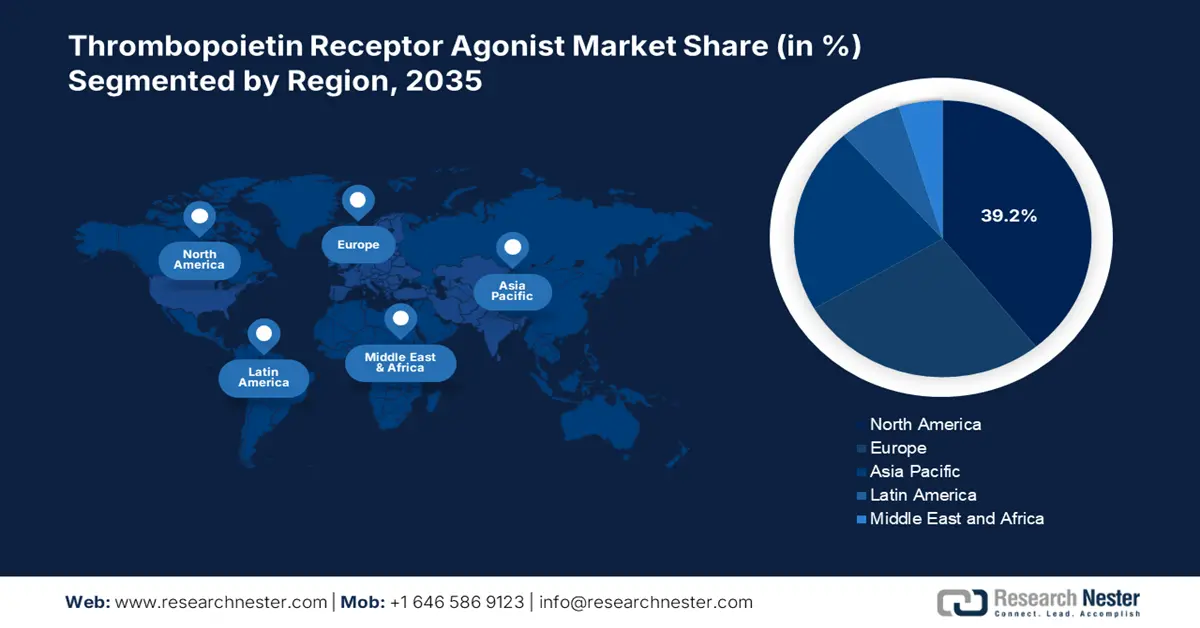
The thrombopoietin receptor agonist market in North America is projected to hold a market share of 39.2% at a CAGR of 6.8% by 2035. The U.S. and Canada are the largest contributors, with the U.S. contributing most because of its large patient base and Medicare/Medicaid coverage for chronic immune thrombocytopenia (ITP), aplastic anemia, and chemotherapy-induced thrombocytopenia. The region is fueled by the early adoption of innovative oral therapies, high disease incidence, and robust reimbursement structures. The NLM report in September 2023 depict that 9.5 per 100,000 people in the U.S. suffer from chronic ITP, the most prominent treatment area for TPO-RAs. Rising geriatric populations and cancer-related platelet disorders also fuel demand. Besides that, the presence of specialty pharmacy networks, good pricing policies, and higher public funding will further reinforce North America's leadership.
The thrombopoietin receptor agonists market in the U.S. is driven by strong government support, a rising geriatric population with chronic immune thrombocytopenia, and streamlined access via Medicare and Medicaid. As per the NLM report in January 2023, the ITP has increased in prevalence among people aged above 60, who comprise the majority of TPO-RA prescriptions. According to NIH and AHRQ, the U.S. federal spending in thrombocytopenia, including TPO-RAs, offers expanded Medicare coverage via updated eligibility policies. Federal R&D support is robust, with the NIH supporting on thrombopoiesis research over the past ten years, which further supports long-term drug innovation.
Asia Pacific Market Insights
The thrombopoietin receptor agonist market in the APAC is the fastest-growing region and is poised to hold the market share of 21.8% at a CAGR of 7.8% by 2035. The market is driven by the increased access to specialty care, thrombopoietin prevalence, and national reimbursement reforms. Japan and China lead the region in government funding on rare diseases and extensive clinical research. Oral non-peptidic agents are clearly becoming more popular in the area due to their affordability and suitability for outpatient treatment. The growing elderly patient population, rising patient awareness, and policy-driven market entry are further expanding the market growth in the region. Further, the clinical trials and public-private partnerships drive innovation and expand the The thrombopoietin receptor agonist market in the APAC is the fastest-growing region and is poised to hold the thrombopoietin receptor agonist market.
India is the most prominent nation dominating the thrombopoietin receptor agonist market and is anticipated to occupy a considerable market share by 2035. The The thrombopoietin receptor agonist market in the APAC is the fastest-growing region and is poised to hold the thrombopoietin receptor agonist market in India is driven by the enhanced hematology infrastructure, rising immune thrombocytopenia diagnoses, and availability of oral therapies, aided by government healthcare initiatives. The Research Gate article released in December 2024 states that the prevalence of thrombocytopenia in India is nearly 5.6%. Ongoing collaborations with multinational pharmaceutical companies surge the drug availability and adoption across the country.
Europe Market Insights
The thrombopoietin receptor agonist market in Europe is expanding rapidly and is poised to hold the market share of 27.4% at a CAGR of 6.6% by 2035. The market is driven by rising cases of immune thrombocytopenia and chronic liver diseases, along with reimbursement frameworks. According to the NLM article in July 2024, the prevalence of ITP in Europe is recorded as 1 in 5 per 10,000, with an annual incidence recorded to be 1 in 25,600 to 37,000 in the region. Further, the European Health Data Space initiative is actively spending in R&D on rare hematological and hepatic diseases, surging the The thrombopoietin receptor agonist market in the APAC is the fastest-growing region and is poised to hold the thrombopoietin receptor agonist market entry and strengthening the regional pipeline for novel TPO-Ras.
Germany is leading the thrombopoietin receptor agonist market in Europe and is anticipated to maintain the market share of 24.7% by 2035. The region is fueled due to its strong investments in next-gen biologics, early adoption of oral formulations, and a robust regulatory pathway. The Federal Ministry of Health remains supportive of fast-track approvals and price talks for rare disease medications under Germany's AMNOG system, which is of direct benefit to high-cost treatments such as TPO-RAs. The sophisticated diagnostics infrastructure in the country and dense network of physicians for hematological conditions lead to high treatment penetration.