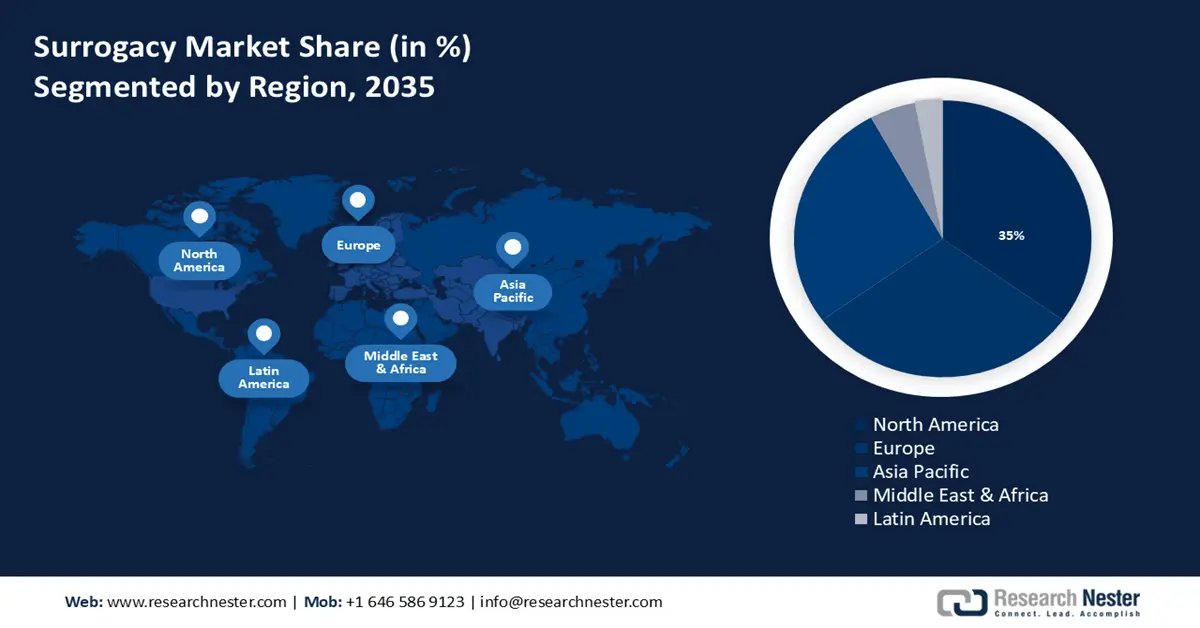
Surrogacy Market Regional Analysis:
North America Market Insights
North America in surrogacy market is likely to dominate over 35% revenue share by 2035. North America seized the lead in the surrogate business due to its favorable social, legal, and medical conditions. In the USA, gestational surrogates participated in 1.93% of ART cycles and made up 3% of all transfers.
In the United States, this dominance is influenced by a number of factors, such as a large pool of potential surrogates, state-of-the-art medical facilities, developed legal frameworks protecting the rights of intended parents and surrogates, and a general favorable opinion of using surrogacy to start a family. Currently, over 5% of all ART cycles carried out in the US involve surrogacy.
Europe Market Insights
Europe surrogacy market size is predicted to account for substantial share by 2035. The region has adopted more innovative technology-based surrogacy treatments as a result of improved healthcare infrastructure. In order to encourage investment and innovation in healthcare, the European Union (EU) has also put in place a number of health programs. One such program is EU4Health, which was approved in March 2021 by European Commission and has a value of USD 5.12 billion.
In the United Kingdom, a notable rise in infertility-related problems among couples who aren't ready for kids is predicted to drive surrogacy market expansion in the upcoming years. More than 25 million people in the European Union suffer from infertility, according to the European Society of Human Reproduction and Embryology.
The market demand for surrogacy in Germany is driven by the rising number of infertility cases, the rising rate of gamete donations and sperm bank. Between 6.6 and 7.5% of women in Germany who are of reproductive age are currently infertile.
The demand for surrogacy is boosted by the rise in single-parent families and the legalization of single-parent surrogacy in France. According to the data, 2 million of the 8 million families that were looked at in 2020 had children living with just one parent, or "single-parent" families. This represents 24.7% of all French households.