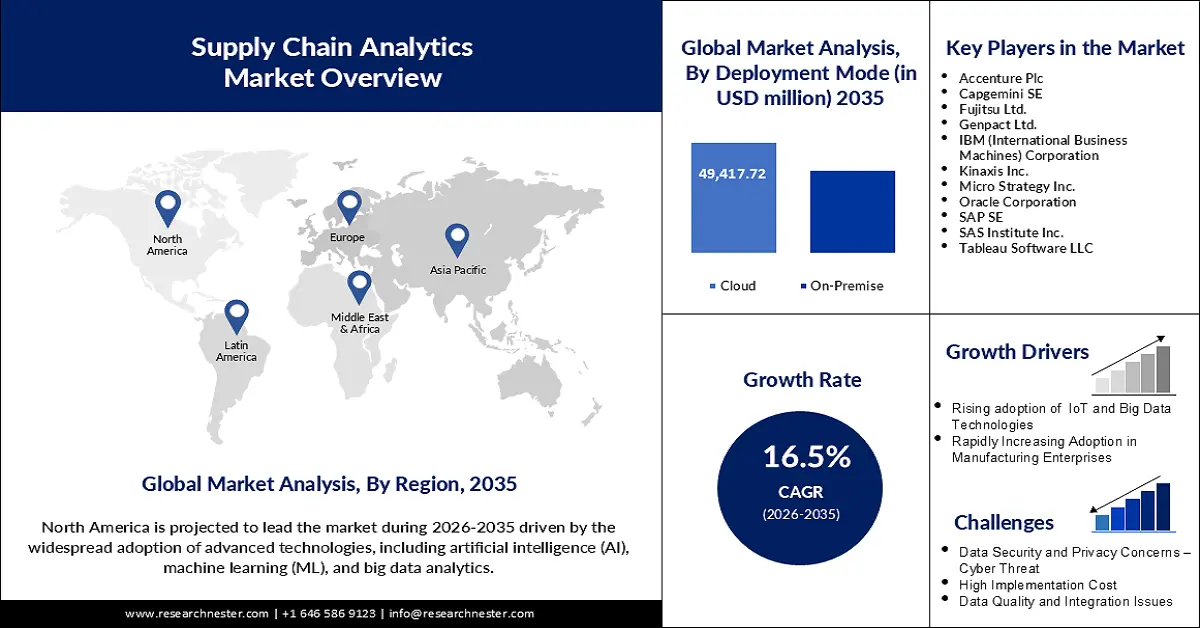
Supply Chain Analytics Market Outlook:
Supply Chain Analytics Market size was over USD 9.62 billion in 2025 and is anticipated to cross USD 44.3 billion by 2035, growing at more than 16.5% CAGR during the forecast period i.e., between 2026-2035. In the year 2026, the industry size of supply chain analytics is assessed at USD 11.05 billion.
The demand for supply chain analytics is expanding as companies are focusing on real-time visibility, predictive analytics, and decision-making with the help of artificial intelligence. Due to the increase in e-commerce, Industry 4.0, and globalization, organizations are implementing data analytics to improve their inventory control, sales forecasting, and risk management. In May 2024, IBM unveiled the IBM Sterling Intelligent Promising Premium, which is an AI-based solution for predictive analytics that can apply generative AI for order fulfillment in real-time. This advancement underlines the importance of AI and ML in the simplification of the supply chain process.
Government initiatives are also driving the pace of adoption of supply chain analytics to a higher level. Furthermore, as per the International Trade Administration (ITA), the B2B e-commerce market is expected to grow at 14.5% through 2026, which presents a growing need for logistics solutions based on data. In September 2024, Oracle released new AI features for Oracle Fusion Data Intelligence to help enterprises get the most out of their supply chain data. With increasing globalization, there is a need to improve supply chain agility and reduce risks through the adoption of AI and cloud-based analytics.