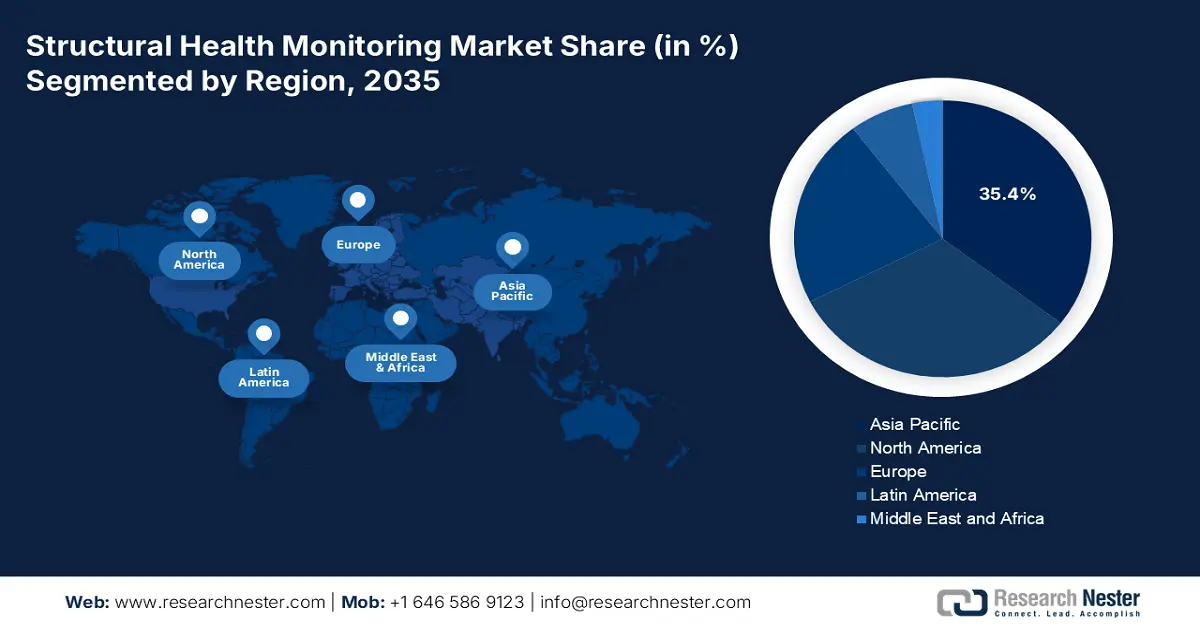
Structural Health Monitoring Market - Regional Analysis
APAC Market Insights
The Asia Pacific is anticipated to hold the highest share of 35.4% in the structural health monitoring market by the end of 2035. The market’s growth in the region is significantly driven by unprecedented infrastructure development, proactive government digitalization mandates, and increased urbanization. Moreover, India’s Smart Cities Mission, along with National Infrastructure Pipeline, and China’s Digital China, as well as new infrastructure strategies, are also creating a sustained demand for the market in the region. According to an article published by the UN-HABITAT Organization in 2025, 54% of the worldwide urban population, which is over 2.2 billion people, reside in the region. In addition, by the end of 2050, the regional urban population is projected to increase by 50%, accounting for an additional 1.2 billion people, thus creating a huge growth opportunity for the overall market.
India, in the structural health monitoring market, is growing significantly due to the confluence of huge public infrastructure investment, a robust policy push for disaster-based construction, and urgent urban digitalization. As per an article published by the IBEF Organization in October 2025, the country intends to boost its infrastructure and reach the USD 5 trillion target by the end of 2025. Regarding this, the demand for cement is predicted to remain strong, with a 7% to 8% growth rate within 2 years. Besides, as of March 2024, the Prime Minister unveiled connectivity projects, amounting to USD 18 billion, which is also uplifting the market in the country. Moreover, in terms of the NIP project, almost Rs. 25,00,000 crore (USD 292 billion) has been readily invested for 3,500 projects in different industries, based on which there is a huge growing scope for the overall market.
India’s Growth Index Industries (2025)
|
Industry Type |
Growth Index |
|
Coal |
192.0 |
|
Crude Oil |
75.4 |
|
Natural Gas |
75.9 |
|
Refinery Products |
139.7 |
|
Fertilizers |
133.5 |
|
Steel |
214.2 |
|
Cement |
197.4 |
|
Electricity |
208.6 |
|
Overall |
164.9 |
Source: IBEF Organization
China, in the structural health monitoring market, is also growing, owing to increased digitalization, expansion in huge legacy infrastructure and quality assurance, mitigating geological and seismic hazards, increased focus on smart city and digital twin city megaprojects, and ensuring industrial upgradation with the Made in China 2025 approach. As per a report published by the NUS in April 2022, RMB17.5 trillion (an estimated USD 2.4 trillion) is projected to be invested in the country’s 5G infrastructure by the end of 2025 from private and public capital. Moreover, the country at present boasts accessibility to 1.3 million 5G base stations, which cover 60% of the global stations. Besides, the Cyberspace Administration of China has declared a suitable plan for IPv6 and has already occupied 50% of the nation’s internet traffic as of 2023, and is poised to gain 70% by the end of 2025 across overall social and economic industries.
Europe Market Insights
Europe in the structural health monitoring market is projected to emerge as the fastest-growing region during the forecast duration. The market’s development in the region is highly propelled by the robust push for strategic digitalized transition and infrastructure safety, both of which are significantly supported by regional funding mechanisms, such as the Digital Europe Programme. As stated in an article published by the CEPSIS Organization in March 2025, the Europe Commission has readily allocated €1.3 billion under the Digital Europe Programme for 2025 and 2027, with the intention of strengthening the region’s technological sovereignty. Besides, the national adoption of the region’s Revised Construction Products Regulation (CPR) has mandated stringent sustainability as well as safety standards, which is also driving the market’s demand in the region.
Germany in the structural health monitoring market is gaining increased traction, owing to the presence of a huge industrial base, a strict regulatory framework, and unparalleled public investment in infrastructure modernization. The Transeuropean Transport Network (TEN-T) modernization program and the federal government’s Digital Strategy plan are considered primary catalysts, mandating the integration of smart monitoring solutions for waterways, railways, and bridges. As per an article published by the HEISE in November 2025, the Bundestag Budget Committee has readily approved EUR 4.4 billion for the Federal Ministry for Digital and State Modernization (BMDS). Moreover, with a core budget of an estimated EUR 956.2 million, there has been an expansion of the federal government’s IT infrastructure, which positively impacts the market’s upliftment in the country.
The UK in the structural health monitoring market is also developing due to the strategic national infrastructure, the levelling up agenda, critical safety mandates, aging asset base, the presence of data as infrastructure policy, digital twin mandate, and effective leadership in energy transition. According to an article published by the UK Government in July 2025, the infrastructure pipeline in the country is poised to provide update regarding 780 planned public and private sector projects. In addition, this particular pipeline has readily outlined £530 billion of programs and projects for the upcoming 10 years, which comprises £285 billion fund only for the public industry. Besides, as per the July 2023 UK Government article, the UK Infrastructure Bank has been successfully established with a capital funding of £22 billion to upgrade and decarbonize the overall economy, thus suitable for boosting the market’s exposure.
North America Market Insights
North America in the structural health monitoring market is expected to witness growth at a considerable rate by the end of the stipulated period. The market’s growth in the region is highly propelled by the presence of strict regulatory mandates, significant federal funding, and an aging infrastructure crisis. As per an article published by the Office of Operations in February 2025, the Infrastructure Investment and Jobs Act (IIJA) emerged as the ultimate law, along with denoting a long-lasting investment in the region’s economy and infrastructure by offering USD 550 billion as of 2022. This fund is regarded as the federal investment in facilities, such as broadband, resilience, water infrastructure, mass transit, bridges, and roads. In addition, this has been directly mandated and funded innovative monitoring technologies for longevity and safety. Therefore, this public investment is readily catalyzing the market’s adoption in the region’s private sector.
The structural health monitoring market in the U.S. is gaining increased exposure, owing to regulatory and safety factors, such as the Environmental Protection Agency’s (EPA) Risk Management Program (RMP) and the Occupational Safety and Health Administration (OSHA). Additionally, the presence of sustainability programs and federal funding is also responsible for the market’s upliftment in the country. For instance, as per an article published by the U.S. Department of Energy in January 2024, there has been an announcement of USD 104 million for energy conservation as well as clean energy projects. This is considered the latest strategy to effectively re-establish the federal government, and this also frequently supports projects by implementing smart monitoring and sensors for optimal process control, along with fugitive emission detection.
The structural health monitoring market in Canada is also growing due to extreme weather adaptation, climate resilience, transit investment, federal green infrastructure, and tactical focus on natural resources and energy transition infrastructure, along with bridge safety and aging core infrastructure. According to an article published by the Government of Canada in September 2025, the country’s government committed to more than USD 180 billion for over 12 years. This has readily benefited the country’s population, from trading ports to public transit, energy systems to broadband networks, and natural spaces to community services. Based on this plan, there has been an additional investment of more than USD 168 billion for more than 100,000 projects, of which 93% are completed. Therefore, with increased focus on introducing such strategies, there is a huge growth opportunity for the market in the country.