Stress Tracking Devices Market - Regional Analysis
North America Market Insights
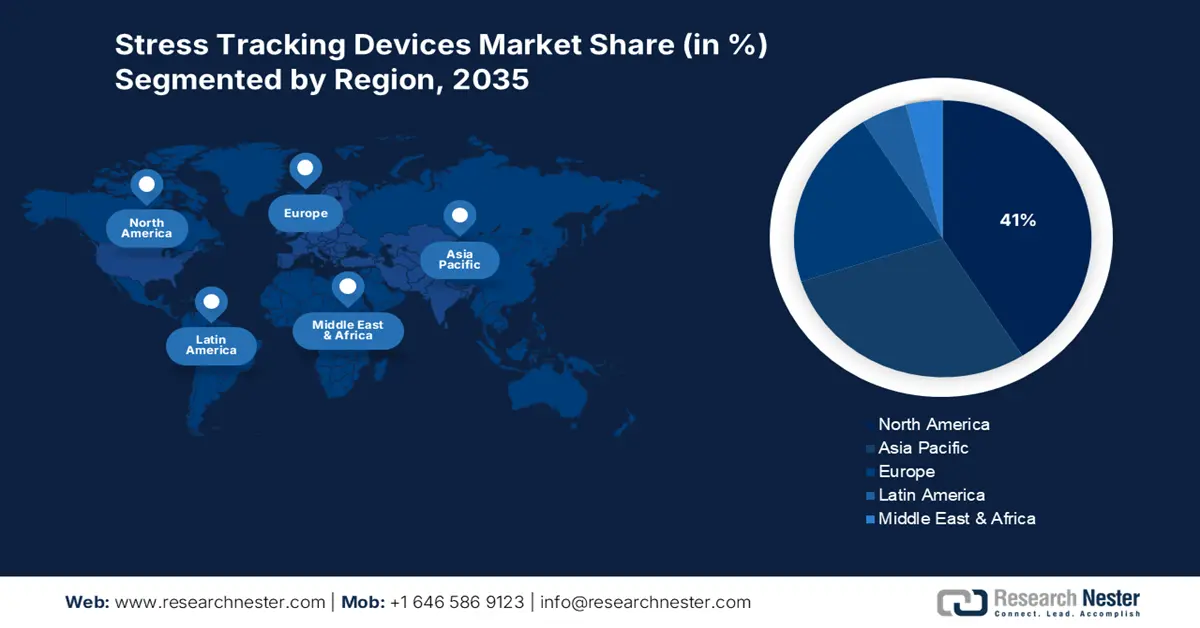
The stress tracking devices market in North America is expected to hold the highest-growing market with 41% market share within the forecast period due to rising awareness of mental health, widespread popularity of wearable technology, and strong healthcare infrastructure to promote innovation and accessibility. As per a report by NIH, September 2024, the highest prevalence of any mental disorder was observed in the 18 to 25 age group at 36.2%, followed by the 26 to 49 age group at 29.4%, and those over 50 at 13.9%. This is increasing the demand for easy-to-use, real-time stress monitoring solutions that can easily be integrated into everyday life. Additionally, employers and healthcare professionals are using stress monitoring technologies increasingly to support mental well-being programs and the prevention of stress.
The stress tracking devices market in the U.S. is expected to grow within the forecast period due to a rise in health conditions related to stress, consumer spending on health tech, and the growing adoption of AI and machine learning in stress tracking devices. As per a report by NIH in September 2024, an estimated one in five U.S. adults has a mental illness (59.3 million in 2022; 23.1% of the U.S. adult population). Growth in mental health campaigns and telemedicine services is also driving the wearable stress monitoring technology. Additionally, advancements in sensor technology and analytics have been helpful for customized and accurate stress management, which is also increasing the popularity.
The stress tracking devices market in Canada is expected to grow within the forecast period due to government efforts in mental health, better telehealth services, and consumer interest in preventing stress are driving growth. More people are encouraged by public awareness campaigns to regularly monitor and manage stress. Increasing use of digital health among the elderly is also boosting the market. Cooperation between doctors and technology providers is helping innovation and the availability of stress monitoring devices. This environment supports the use of these technologies in personalized health and wellness programs.
Prevalence of Serious Mental Illness Among U.S. Adults (2022)
|
Category |
Subcategory |
Percent (%) |
|
Sex |
Female |
7.1 |
|
Male |
4.8 |
|
|
Age |
18 to25 |
11.6 |
|
26 to49 |
7.6 |
|
|
50+ |
3 |
|
|
Race and Ethnicity |
Hispanic |
5.3 |
|
White |
6.5 |
|
|
Black or Africa America |
4.7 |
|
|
Asian |
4.1 |
|
|
Native Hawai or Other Pacific Islander |
3.5 |
|
|
America India or Alaska Native |
7.3 |
Source: NIH September 2024
Europe Market Insights
The stress tracking devices market in Europe is expected to be the fastest-growing within the forecast period due to established health care systems, rising interest in mental health programs, and supportive rates of adoption of wearable health technology from consumers. Governments in Europe are actively promoting mental health through initiatives the Horizon Europe program and nationwide campaigns, such as the UK's Every Mind Matters campaign. Such programs are enabling innovation and adoption of digital health solutions, such as stress-tracking devices. In addition, investment in telehealth centers and public awareness creates additional consumer adoption and integration of such technologies into day-to-day healthcare.
The stress tracking devices market in the UK is expected to grow within the forecast period due to government initiatives on mental health, rising use of fitness trackers with stress monitoring capabilities, and rising demand for overall well-being devices. As per a report by the Government of the UK, the NHS and government have shown strong innovation and collaboration, and they have invested an additional £500 million (USD 615 million) in mental health treatment. This is for a cross-government recovery plan looking to promote mental well-being. As such, the UK market for stress monitoring devices has the potential to grow due to increased awareness, government incentives, and utilization of digital health technologies to better manage stress and mental well-being.
The stress tracking devices market in Germany is expected to grow within the forecast period due to strong digital healthcare infrastructure, surging demand for personalized health monitoring, and rising investment in health technology startups. Moreover, increasing awareness of mental health and government initiatives making it easy for digital health solutions are helping the market grow. The integration of advanced sensors and AI-driven analytics within stress monitoring devices is attracting consumers as well as healthcare providers. Additionally, Germany's rising ageing population is driving demands for continuous health monitoring, further fueling demand for these innovative devices.
Asia Pacific Market Insights
The stress tracking devices market in the Asia Pacific is expected to hold a considerable share within the forecast period due to rapid urbanization, rising disposable income, and better awareness of mental health in both developing and developed countries in the region are driving growth. Additionally, government efforts to improve digital health infrastructure and mental well-being are creating a positive environment for the market. More workplace stress and lifestyle changes are pushing consumers to buy effective stress management devices. The rise of e-commerce platforms is also helping these devices reach a larger population.
The stress tracking devices market in China is expected to grow within the forecast period due to the government's focus on digital health, the rise in the usage of smart wearables, and expanding e-commerce platforms, bringing the product within reach. According to a report by the World Health Organization, 2025, there are 54 million people in China with depression and about 41 million with anxiety disorders. Over the past decade, China has made progress in removing barriers that stop people from getting a diagnosis and treatment. This progress is expected to boost demand for advanced stress monitoring technologies that help manage mental health.
The stress tracking devices market in India is expected to grow within the forecast period due to more smartphone use, awareness campaigns about mental health, and a growing middle class interested in wellness technology. As per a report by the Directorate General of Health Services in August 2025, strong government initiatives such as the Centers of Excellence in Mental Health program have strengthened 25 mental health institutes with significant financial support of up to Rs. 33.7 crore (USD 4 million) for each institute for infrastructure development, equipment, and faculty enhancement. These efforts will strengthen psychiatry and related mental health professions, increasing awareness and capacity building for mental well-being care.