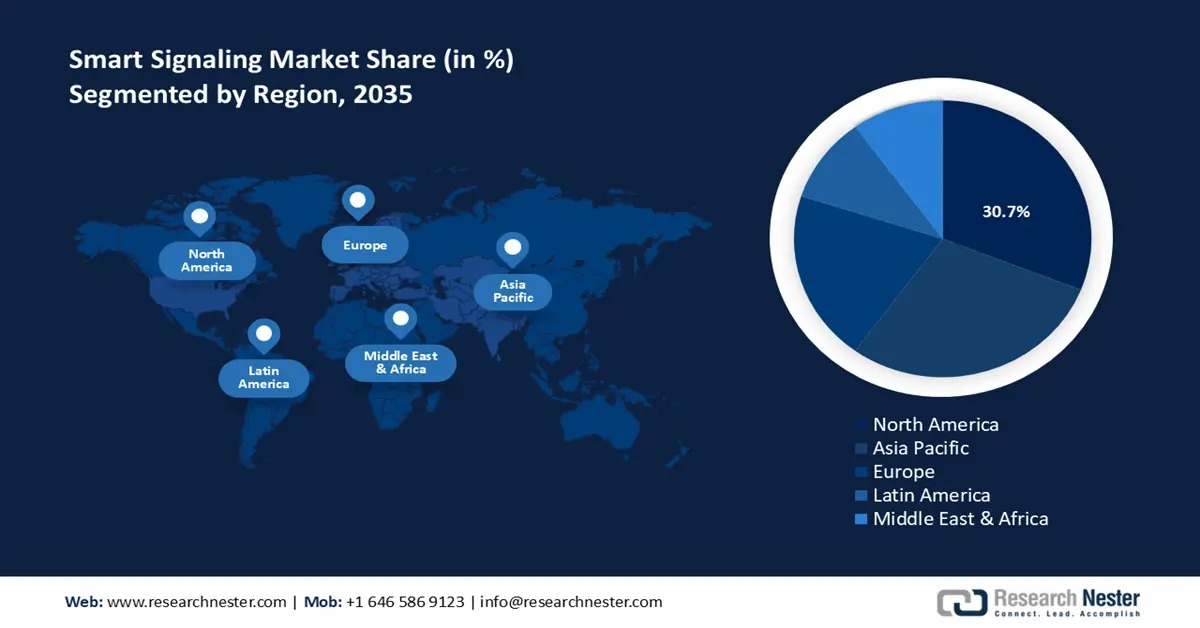
Smart Signaling Market - Regional Analysis
North America Market Insights
The North America market is projected to hold a dominant revenue share of 30.7% by the end of 2035. The regional market is favorably reinforced by the evolving demographic trends, and the rising investments in smart cities, creating ample opportunities for the deployment of smart signaling solutions. Additionally, a major driver regionally has been the regulatory harmonization between initiatives such as the Green and Inclusive Community Buildings program of Canada and the Smart Cities Program of the U.S. The demographic trends are leaning towards greater urbanization, heightening the demand for smart signaling systems that handle the surging traffic volumes. With sustainable urban planning set to become the backbone of urban infrastructure, the regional market is projected to maintain its revenue share throughout the forecast period.
The U.S. market is projected to maintain its leading share in North America. The market's growth is reinforced by a confluence of multiple factors, ranging from the rapidly evolving consumer behaviors and the impact of federal policies. For instance, the Infrastructure and Jobs act has created a cascading effect in the U.S. market by funneling over USD 100 billion into improving transportation systems. Such large-scale investments have heightened the scope of smart signaling deployments. Furthermore, the consumer behavior in the U.S. has exhibited a willingness for greater adoption of traffic analytics to improve safety. These trends are expected to ensure that the U.S. market remains dominant in North America.
Canada’s market is expected to increase at a high pace due to the country’s efforts to build digitally connected city infrastructure. Smart city projects are speeding up the use of smart signaling solutions. For example, in June 2024, Infrastructure Canada announced that the government committed about USD 222 million over 11 years to the Smart Cities Challenge through the Impact Canada Initiative. This directly represents Canada as the most profitable marketplace for key investors.
Asia Pacific Market Insights
The APAC smart signaling market is poised to maintain the fastest expansion throughout the forecast timeline. The surging investments in infrastructure development and improvements in local governance models have bolstered the scope of smart signaling solutions deployment. Additionally, a vital catalyst is the trade deals which have facilitated a steady flow of capital, bolstering the regional market’s growth. In this context, the APAC market presents a multifaceted growth opportunity, influenced by the top-down policy decisions and bottom-up demand for urban mobility solutions.
The India smart signaling market is estimated to capture high revenue share during the anticipated timeline. The market is shaped by a unique blend of nationwide digitalization along with opportunities arising from state-level fragmentation. The ongoing Smart Cities Mission seeks to overhaul urban infrastructures, driving the demand for smart signaling solutions. Additionally, the public-private partnerships (PPP) of India have supported a greater deployment of smart signaling systems. The PPP committee has appraised around 396 projects to date. The market also benefits from a mobile-first population, that bolsters the adoption rates of digital solutions for urban mobility. These trends are expected to expand the India market growth through 2035.
The China market is foreseen to be influenced by the supportive government polices and funding. The large-scale smart city investments are directly propelling the trade of smart signaling solutions. Further, continuous innovations in the consumer electronics has increased the application of advanced smart signaling solutions. The robust expansion of wireless communication networks is also creating a lucrative environment for smart signaling market players.
Europe Market Insights
The Europe market is anticipated to capture the second-largest revenue share through 2035. The region’s strong focus on sustainable mobility and road safety directly propels the application of smart signaling technologies. The stringent EU transportation and environmental policies also supports the increasing trade of smart signaling solutions. Many municipalities are integrating signaling systems into broader smart city platforms, driving the overall market growth.
The sales of smart signaling systems in Germany are estimated to be driven by its strong automotive sector and advanced urban mobility initiatives. The government-backed digitization programs are also contributing to the increasing adoption of smart signaling technologies. German automakers, along with tech providers are expected to lead innovations in the market.
The U.K. is another leading market for smart signaling in Europe, inflected by government’s supportive initiatives in road safety and net-zero transport goals. In March 2020, the government released its second Road Investment Strategy, covering April 2020 to March 2025. It announced plans to spend USD 34.8 billion to improve the country’s major road network. Thus, the investments under the National Infrastructure Strategy are set to directly advance adoption of adaptive signaling systems across major cities.