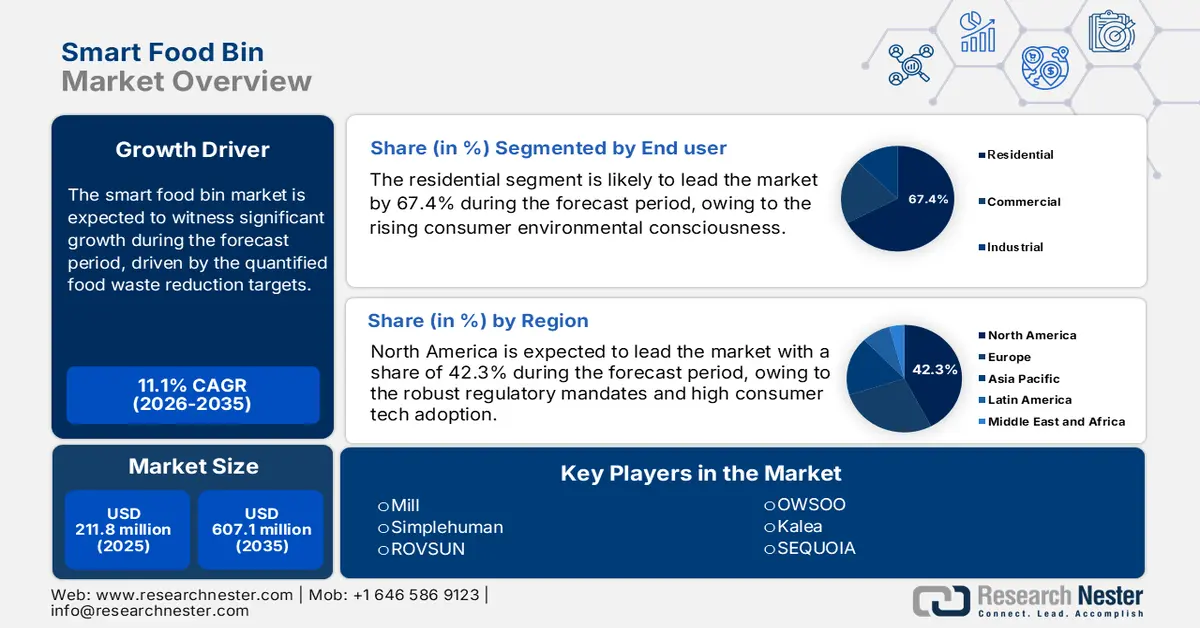
Smart Food Bin Market Outlook:
Smart Food Bin Market size was valued at USD 211.8 million in 2025 and is projected to reach USD 607.1 million by the end of 2035, rising at a CAGR of 11.1% during the forecast period, i.e., 2026-2035. In 2026, the industry size of smart food bin is estimated at USD 235.3 million.
The smart food bin market is being shaped primarily by regulatory pressure and quantified food waste reduction targets set by governments and intergovernmental bodies. As per the Food and Agriculture Organization report in September 2022, nearly 17% of the food is wasted by retailers and consumers, mainly in households. This efficiency carries an estimated annual economic cost, with the substantial environmental impacts linked to the methane emissions and unnecessary resource use. Further, the governments are increasingly mandating food waste measurement and reporting across commercial kitchens, institutional facilities, hospitality chains, and public sector food services. For example, the European Union's Waste Framework Directive demands that the member states quantify food waste at each level of the supply chain and promotes the digital monitoring tools as part of compliance reporting, hence directly encouraging business adoption of smart food bin systems in B2B environments.
The growth of the smart food bin market is further supported by the increasing investment in the circular economy infrastructure and waste characterization research. The public funding for organic recycling and waste prevention technologies is becoming more accessible via state grants and federal programs. For instance, the EPA’s Sustainable Materials Management program funds initiatives aimed at advancing waste reduction and diversion strategies. The need for accurate data is key for municipalities and waste haulers to design efficient collection systems and meet the diversion mandates. Organizations such as the World Resources Institute emphasize that what gets measured gets managed, highlighting the value of data acquisition in the food waste value chain. Smart bins, by providing granular household-level data on the food waste types and quantities, offer a potential source of this critical information for the waste management authorities and policymakers seeking to optimize systems and measure progress against the statutory targets, thereby creating a B2B and B2G value proposition beyond the direct-to-consumer channel.