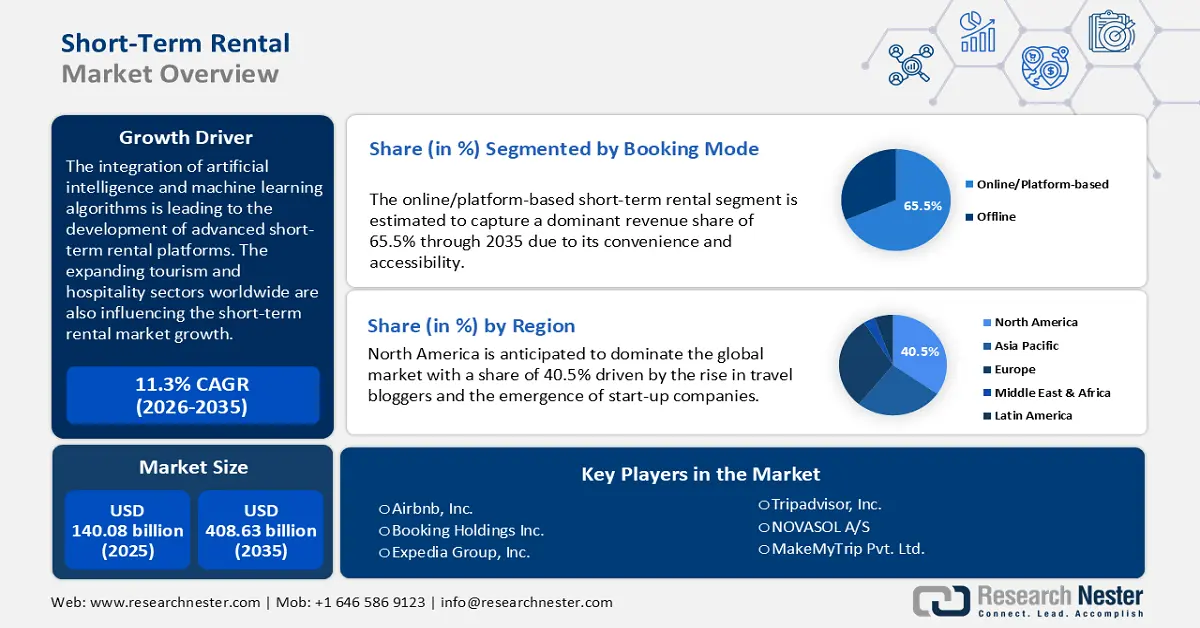
Short-Term Rental Market Outlook:
Short-Term Rental Market size was over USD 140.08 billion in 2025 and is poised to exceed USD 408.63 billion by 2035, witnessing over 11.3% CAGR during the forecast period i.e., between 2026-2035. In the year 2026, the industry size of short-term rental is estimated at USD 154.33 billion.
The primary growth driver of the short-term rental market is the increasing demand for diverse and personalized travel experiences. Travelers increasingly seek unique, home-like accommodations and local experiences that traditional hotels often cannot provide. Moreover, the proliferation of online booking platforms has made it easier for travelers to find and book short-term rentals and for hosts to list their properties. There is a growing preference for lodging away from home driving the short-term rental market. Short-term rentals offer a diverse array of property types from city apartments and suburban homes to unique stays. Travelers can immerse themselves in local neighborhoods and cultures, enhancing their overall experience.
The Consumer Price Index (CPI) which measures changes in the average prices paid by consumers for goods and services over time is a key indicator of inflation and can influence the short-term rental market. For instance, according to the U.S. Bureau of Labor Statistics, relative importance (percent of the CPI weight) was 1.338 as of December 2023 and the CPI for the current year is 189.209 (as of August 2024). Investors in short-term rentals may monitor CPI to gauge economic health and potential returns. A stable or low CPI might signal a favourable economic environment for investing in or managing short-term rentals.