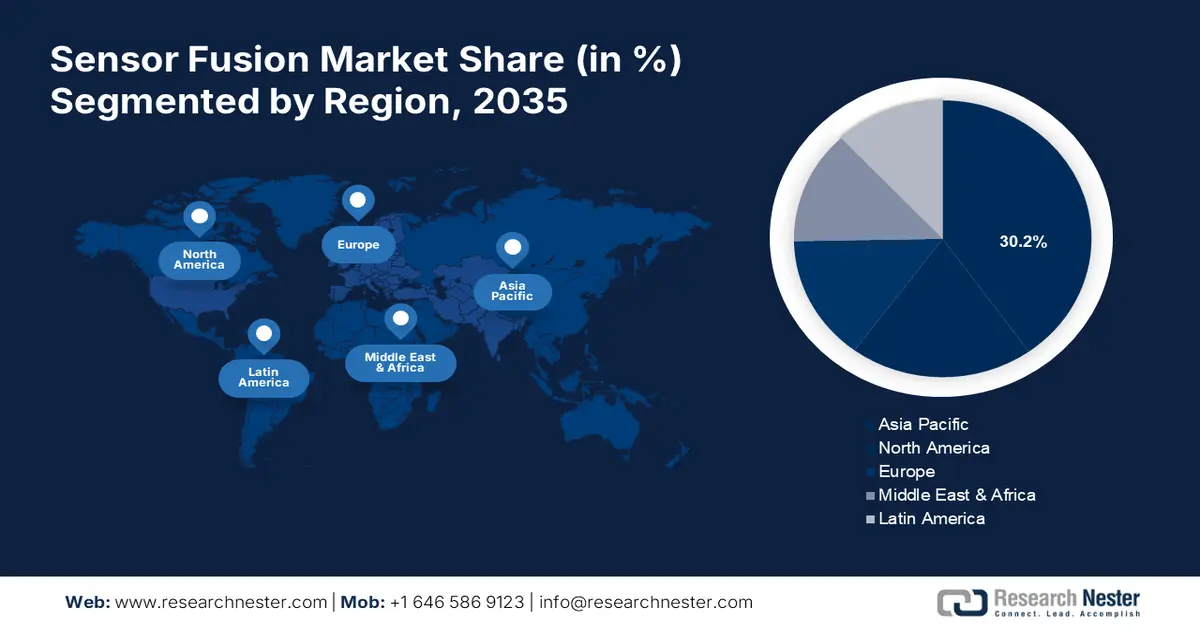
Sensor Fusion Market Regional Analysis:
Asia Pacific Market Insights
Asia Pacific industry is estimated to account for largest revenue share of 30.2% by 2035, owing to rising adoption of industrial automation, high demand for autonomous vehicles, and the growing need for well-established infrastructure aided by government initiatives and investments in IoT and AI. Additionally, the rise in concern for safety measures, demand for sustainability, and energy efficiency is enabling the market to flourish and expand significantly.
China is making a significant stride in the market owing to rising investments in its smart city projects and autonomous vehicles. The country is involved in investing in advanced sensor technologies such as LiDAR and radar to become a leader in autonomous driving. Key players are also investing in R&D activities to launch new sensor fusion devices and technologies. For instance, in 2022, Xiaomi entered into a partnership to launch smartphones with improved image-sensing capabilities by leveraging the advanced optical features of Leica, owing to the great demand for sensor fusion in consumer electronics.
In South Korea, the automotive industry is witnessing a surge within the market and is investing in ADAS, autonomous and electric vehicles. For example, in January 2024, TDK Corporation announced its newly designed product namely KLZ2012-A, a series inductor offering high durability, super inductance tolerance capabilities, applicable across several applications.
North America Market Insights
North America sensor fusion market is expected to rise considerably during 2026-2035 owing to increasing investments in advanced technologies, a strong industry ecosystem, and favorable business culture. It has a strong geographic location and strategic economic foundation that creates a lucrative environment for the market to thrive. Additionally, robust semiconductor manufacturing, the presence of research institutions, and easy access to funding enhance the avenue for technological development.
The U.S. and Canada are the leading hubs in the region. High demand in autonomous vehicles, consumer electronics, and smart cities with the existence of innovative players such as Apple, Google, and Microsoft in the U.S., fuels the market growth. For instance, Apple embarked on augmented reality by inducing ARKit 4 with a sensor fusion feature, active in iPhones and iPads which integrates video images and motion sensing data from the device’s camera, accelerometer, and gyroscope.