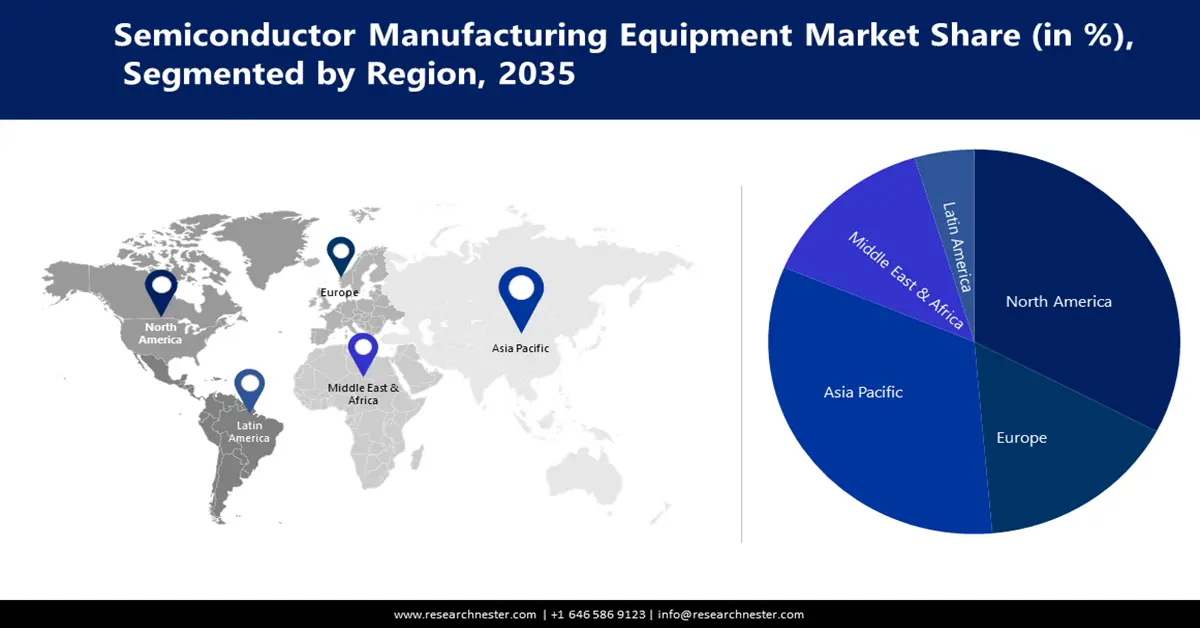
Semiconductor Manufacturing Equipment Market Regional Analysis:
Asia Pacific Market Insights
The Asia Pacific semiconductor manufacturing equipment market is expected to account for a share of 35% in 2035, due to the rising development efforts in advanced semiconductor packaging technologies. Countries including South Korea and Taiwan are significantly investing in 2.5D and 3D integrated circuit technologies as these methods help run high-performance computing systems and AI. The market is expanding as the equipment revolution necessitates next-generation front-end and back-end solutions.
The China semiconductor equipment market is rapidly expanding as its domestic chip design industry is increasing. Local companies that develop their own processors, memory, and AI chips are creating a rising demand for customized fabrication tools that deliver precise operation. The local manufacturers are making significant investments to strengthen both production facilities and local supply chains.
North America Market Analysis
The semiconductor manufacturing equipment market in North America is expected to account for a market share of 24% during 2026-2035. The market is experiencing massive growth due to the strong presence of chip manufacturers and equipment suppliers. Various companies are investing heavily in EUV lithography technology and advanced packaging owing to the rising requirement of highly specialized fabrication equipment. This expertise is generating innovation and increased demand for the cutting-edge industry equipment.
Supply chain resilience efforts and semiconductor production reshoring are standing as crucial determinants for the market growth. Public and private sectors are collaborating to maintain chip fabrication plant expansion, as part of plans to reduce foreign dependency on semiconductor products. The drive toward domestic production is fueling demand for front-end and back-end manufacturing equipment throughout the semiconductor industry.
The growth of the U.S. market is accelerating owing to rising partnerships between private and public entities that promote technological self-sufficiency. Such partnerships encourage innovation for chip design and fabrication while driving higher investments into advanced semiconductor equipment. Next-generation materials and tools are emerging from research collaborations between institutional groups and businesses, boosting the market growth.