Scaffold Free 3D Cell Culture Market - Regional Analysis
North America Market Insights
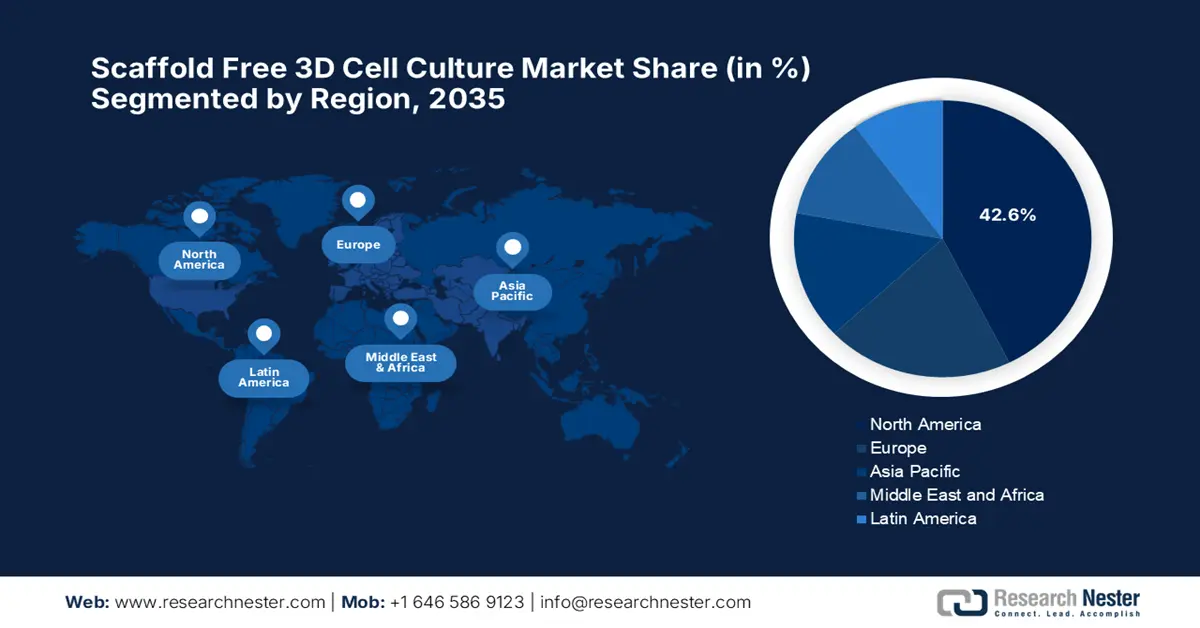
North America is expected to capture the largest share of 42.6% in the worldwide market. The dominance of the region is pledged to extensive R&D infrastructure, a strong presence of pharmaceutical & biotechnological industries, and regulatory support. For instance, in February 2025, Cellevate AB announced that it has launched Cellevat3d, which is a nanofiber-based cell culture system that especially focuses on faster bioprocessing, efficient scaling, and three tomes viral vector yield. Therefore, such moves mark profitable expansion into the North America’s market for advanced scaffold-free cell culture technologies, hence a positive market outlook.
U.S. is remarkably augmenting its leadership in the scaffold free 3d cell culture market on account of huge investments in biotechnology and regenerative medicine, rapid adoption of advanced in vitro models by pharmaceutical and academic institutions. In this regard, Fujifilm Corporation in April 2024 declared that it had additionally made an investment of USD 1.2 billion to expand its large-scale cell culture CDMO facility in Holly Springs, North Carolina, which makes it the total of USD 3.2 billion. Besides, this expansion will deliberately add 8 x 20,000L mammalian cell culture bioreactors by the end of 2028, enhancing FUJIFILM Diosynth Biotechnologies’ global manufacturing capabilities.
There is a huge opportunity for Canada in the scaffold-free 3d cell culture market, extensively facilitated by increasing investments in stem cell research and collaborative programs between academic institutions and industry. Therefore, in July 2025, Health Canada reported that Aspect Biosystems (Vancouver, BC) received funding as part of a USD 10.5 million contribution through Canada’s Advanced Manufacturing Cluster in September 2022. Besides, the firm specializes in bioprinting and tissue engineering with a prime focus on the creation of functional human tissues. Furthermore, this also supports 3d tissue constructs that are extensively utilized in drug testing and regenerative medicine.
Major Government Investments in Canada’s Biomanufacturing and Advanced Therapies
|
Organization |
Investment |
Year |
Type of Support |
|
OmniaBio & partners |
$34.8 million project |
2022 |
Advanced therapies, cell manufacturing |
|
CFI (Budget 2021) |
$500 million over 4 years |
2021 |
Research infrastructure |
|
VIDO |
>$100 million |
2021 |
Biomanufacturing & imaging tools |
Source: Health Canada
APAC Market Insights
Asia Pacific is predicted to represent the fastest growth in the scaffold free 3d cell culture market from 2026 to 2035. This became possible with the existence of rising demand for advanced drug discovery models and growing research activities in regenerative medicine across the region’s vast geography. In addition to government support, expanding pharmaceutical industries also propel growth. For instance, in April 2022, Mitsubishi Chemical Holdings Group declared that it invested in Myoridge, a Kyoto University spin-out specializing in innovative cell culture media and services to advance cell cultures with cost efficiency, leveraging ethical and stable solutions.
China represents huge dominance in the regional market that is readily facilitated by its strong research ecosystem in terms of biotechnology and regenerative medicine. In January 2025, the country’s first stem cell therapy, called Amimestrocel Injection, which was developed by Platinum Life Excellence Biotech, received conditional market approval to treat steroid-refractory acute graft-versus-host disease. The therapy extensively received support from Professor Du Yanan’s team at Tsinghua University, who developed an innovative 3D microcarrier-based stem cell culture technology, thereby lowering production costs while ensuring high quality and safety for clinical use.
India is gaining enhanced recognition in the Asia Pacific scaffold free 3d cell culture market due to the vigorous advancements in stem cell research and regenerative medicine. Besides, the country also benefits from increased government funding and a growing emphasis on personalized medicine and alternative testing methods. For instance, in July 2024, Bioserve India introduced advanced stem cell products from REPROCELL to boost scientific research and drug development in the country. The product line includes media and tools for stem cell culture, cell reprogramming kits, 3D cell culture systems, and cellular assays to support regenerative medicine and disease modeling; hence, such instances accelerate advancements in stem cell therapy.
Cancer Prevalence Metrics for 3D Cell Culture Research: APAC Region 2022
|
Cancer Site |
5-Year Prevalent Cases |
Proportion per 100,000 |
|
Lung |
2,058,202 |
44.3 |
|
Breast |
3,197,043 |
140.6 |
|
Colorectum |
2,784,388 |
59.9 |
|
Stomach |
1,230,467 |
26.5 |
|
Liver |
833,450 |
17.9 |
|
Thyroid |
2,075,961 |
44.7 |
|
Cervix Uteri |
1,186,812 |
52.2 |
|
Prostate |
1,116,947 |
47.0 |
|
Oesophagus |
538,504 |
11.6 |
|
Lip, Oral Cavity |
683,010 |
14.7 |
Source: Global Cancer Observatory 2022
Europe Market Insights
The scaffold free 3d cell culture market in Europe is poised for extensive growth during the discussed time frame, owing to the increased adoption of scaffold-free technologies such as spheroids and organoids. In addition, the region also benefits from the constant efforts of administrative bodies to reduce animal testing procedures. This can be testified by the report by the European Medicines Agency published in September 2021 that states that it is supporting 3Rs in animal use in medicine development through its Innovation Task Force (ITF). This initiative proactively promotes New Approach Methodologies (NAMs), such as organoids, organ-on-chips, and in silico models, aligning with the region’s animal protection laws.
Germany is gaining traction in the scaffold-free 3D cell culture market, highly attributed to the advancements in drug development. The country also benefits from an advanced biotechnological infrastructure and a focus on innovation, supporting the adoption of scaffold-free techniques. For instance, in October 2024, Evonik announced the launch of a Global Competence Network for Cell Culture Solutions to address the upstream challenges in cell culture. This network effectively unites experts from chemistry, cell biology, bioprocessing, and media optimization across Europe, hence benefiting the overall market growth.
The scaffold free 3d cell culture market in Switzerland is continuously thriving, highly subject to the presence of strong firms and academic institutions that are pioneers in developing advanced organoid and spheroid-based models. In November 2024, InSphero reported that it took a key role in the EU-funded UNLOOC Project that is aimed at advancing organ-on-chip technologies. Besides the €68 million initiative, which involves 51 partners from 10 European nations, focuses on industrializing organ-on-chip systems with advanced readouts using microfluidics, AI, and big data. Further, the firm also aims to develop cutting-edge analytical methods to enhance drug development and personalized medicine.