Satellite Internet Market Outlook:
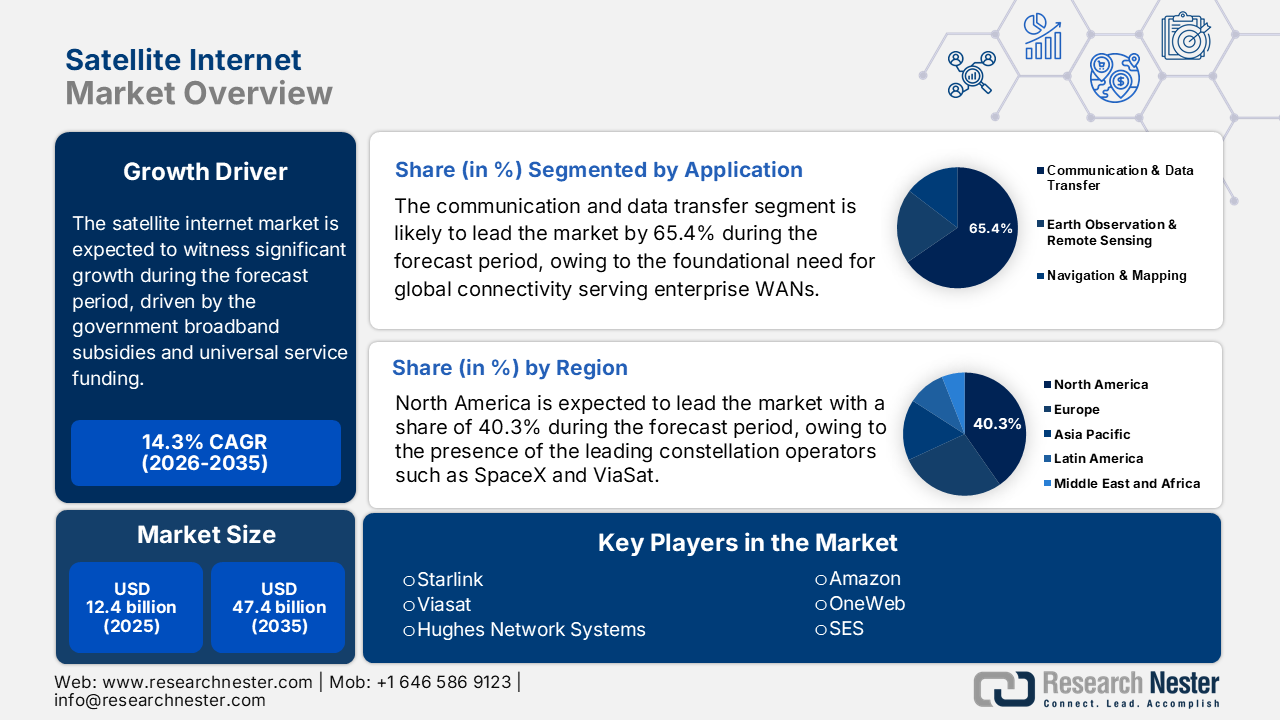
Satellite Internet Market size was valued at USD 12.4 billion in 2025 and is projected to reach USD 47.4 billion by the end of 2035, rising at a CAGR of 14.3% during the forecast period, i.e., 2026-2035. In 2026, the industry size of satellite internet is estimated at USD 14.2 billion.
The market represents a critical infrastructure segment focused on providing broadband connectivity to global regions where terrestrial networks are economically or geographically unfeasible. Government and intergovernmental data indicate that satellite internet remains a structurally important connectivity layer for enterprise, government, and critical infrastructure use cases, mainly where the terrestrial networks are economically or physically constrained. The data from the Country Health Rankings & Roadmaps 2025 has indicated that nearly 14.5 million locations in the U.S. lack access to fixed terrestrial broadband at benchmark speeds, with the rural and Tribal areas accounting for a disproportionate share of the gap, reinforcing institutional reliance on satellite-based services for continuity and coverage assurance.
The National Telecommunications and Information Administration further notes that satellite services are routinely incorporated into the federal connectivity strategies for emergency response maritime operations, aviation, and defense-related communications, where redundancy and geographic reach are prioritized over latency sensitivity. The ITU in November 2024 reported that nearly 2.6 million people remain offline, primarily in low-density or remote regions, positioning satellite internet as a necessary component of national broadband and universal service frameworks rather than a substitute for fiber or mobile networks. Further, the focus extends to space sustainability, with the Federal Communications Commission adopting its first-ever orbital debris mitigation rules in 2022 for the U.S.-licensed satellites, introducing new compliance parameters for operators. This regulation defines a market shift from niche applications to a core component of national and global broadband infrastructure.