Rotary Encoder Market - Regional Analysis
Europe Market Insights
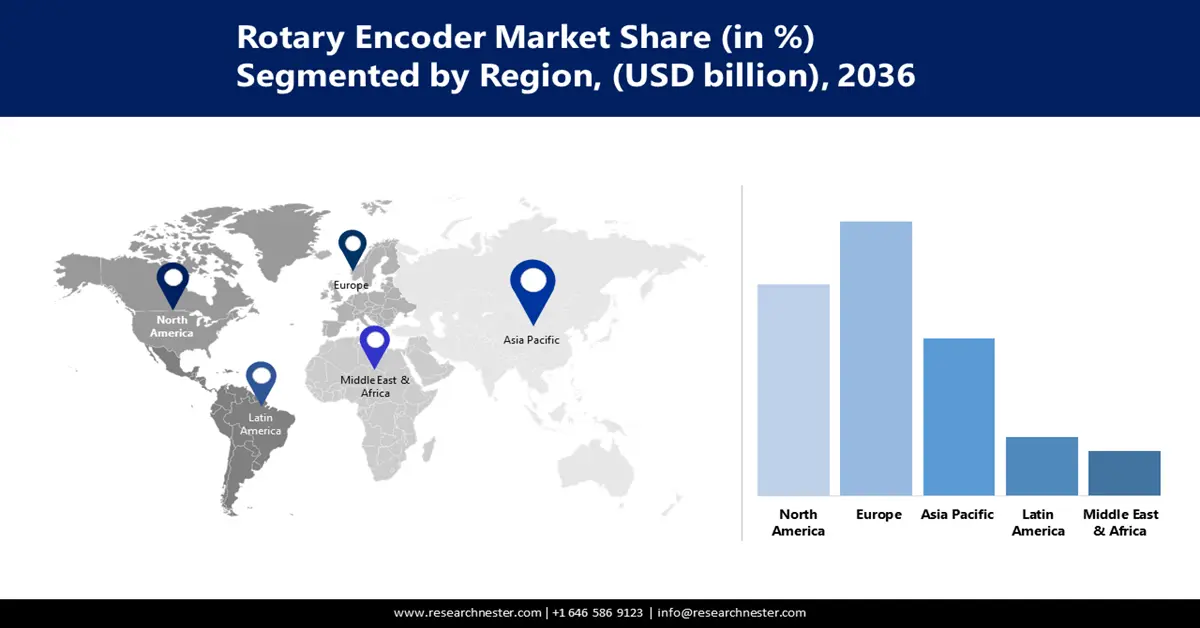
The rotary encoder market in Europe is poised to account for a revenue share of 34.6% by the end of 2036, owing to the rising adoption of automation and machine learning technologies across different business industries. The expansion of the automotive sector is another factor that is consistently increasing the use of rotary encoders. For instance, in May 2024, Wayve unveiled support from SoftBank in raising funds of more than USD 1 billion for the development of embodied AI products. This initiative was taken to enable automated driving, which fueled the need for smart rotary encoders.
Germany is expected to emerge as a rapidly expanding rotary encoders market in the coming years, due to growing preference for smart factories. Companies across Germany are increasingly investing in the establishment of smart factories, increasing the use of and demand for rotary encoders. For example, in December 2023, Bosch revealed its involvement in piloting generative AI and foundation models in enabling manufacturing. The plan of the business also included the development and scaling up of AI solutions for enabling optical inspection, influencing an acceleration in the use of rotary encoders.
France rotary encoder market is set to expand at a high CAGR between 2026 and 2036, as a consequence of the push from the government to optimize organizational operations. One such example is the launch of the France 2030 programme in 2021. Through this initiative, the government raised funding of USD 63.2 billion. The launch of the programme obligated companies, schools, and other organizations to undergo digital transformation, increasing the need for rotary encoders.
Asia Pacific Market Insights
The Asia Pacific market is poised to hold a high revenue share by the end of 2036, on account of the rapid industrialization and urbanization. As per UN-Habitat, urbanization in the Asia Pacific is likely to remain continuous, with the residence of 54% of the global urban population. With rapid urbanization, infrastructural projects are likely to be undertaken, which can fuel industrial growth and technology adoption. According to the International Trade Administration (ITA) 2024, industrial automation in emerging economies, including India, is at a fast pace, supported by government initiatives such as the Make in India policy, Smart Advanced Manufacturing and Rapid Transformation Hubs, or SAMARTH Udyog Bharat 4.0, and collaboration with the U.S. government.
Thus, the growing demand for advanced rotary encoders has resulted in rising trade activities. As reported by the Ministry of Commerce and Industry, the export of electrical machinery and equipment and parts, including rotary encoders, was USD 34,412.52 million in 2024 and is expected to reach USD 44,049.59 million in 2025, with a growth of around 28%.
The rotary encoder market in China is set to expand at a remarkable CAGR during the forecast period, as a consequence of the expansion of the automotive sector. As per the International Energy Agency, China is the global hub of EVs. The country accounted for over 70% of the global car production. This indicates the extent to which rotary encoders are in demand to be used as motion sensors in the automotive sector in China. The rapid development of robotics technology in China boosts the demand for rotary encoders significantly as well.
Japan is expected to emerge as an expanding market at an extensive CAGR between 2026 and 2036, due to a shortage of labor, increasing the need for deploying automated processes across various industries, ranging from manufacturing to automotive. As per the report by ASEAN+3 Macroeconomic Research Office (AMRO), published in May 2025, the shortage of labor is driven by the shrinking working-age population in Japan. Around 25% of the workforce in Japan is senior citizens. Thus, to remain sustainable in terms of productivity in different industries, the adoption of automation technologies is becoming integral for businesses in Japan, fueling the demand for rotary encoders.
North America Market Insights
North America rotary encoders market is anticipated to account for a remarkable revenue share by the end of 2036, as a consequence of the expansion of the automotive sector through the development of EVs and ADAS. Companies associated with the automotive sector are consistent in investment for the development of EVs and ADAS, accelerating the demand for rotary encoders. Rapid adoption of robotics technologies in different industries is also leading to an increased use and demand for rotary encoders, which is resulting in the development of rotary encoders that are compatible with robotics applications. For instance, in November 2023, Nikon announced the launch of MAR-M700MFA, the first multi-turn external battery-free absolute encoder with an all-solid-state battery. The encoder is effective in detecting the absolute values for robot-arm rotational displacement and relevant measurements.
The U.S. rotary encoder market is anticipated to expand at a rapid CAGR during the forecast period, owing to rapid industrial automation, increasing the demand for rotary encoders over time. Automakers operating in the U.S. are also active in the adoption of robotics technologies, indicating an increased use of rotary encoders. As reported by the International Federation of Robotics in May 2025, by 10.7%, the installation of industrial robots in the car industry increased and reached 13,700 units in 2024.
The rotary encoder market in Canada is poised to expand at an extensive CAGR, on account of the government initiatives to boost industrial automation, which fuels the demand for rotary encoders. With rapid industrialization. The demand for compact and high-performance encoders is likely to surge in Canada. Companies operating in Canada are also keen to supply such compact and high-performance rotary encoders. Global large companies involved in the production of rotary encoders are expanding their local presence across Canada, fueling the market growth.