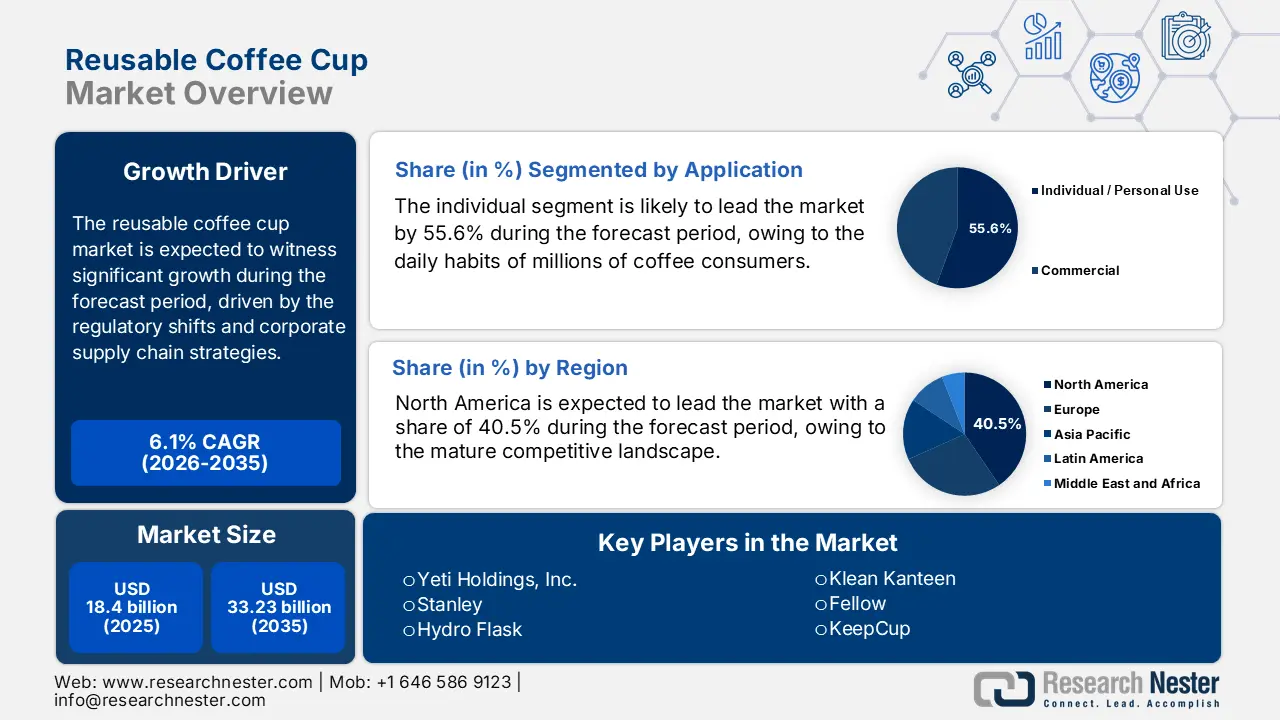
Reusable Coffee Cup Market Outlook:
Reusable Coffee Cup Market size was valued at USD 18.4 billion in 2025 and is projected to reach USD 33.23 billion by the end of 2035, rising at a CAGR of 6.1% during the forecast period, i.e., 2026-2035. In 2026, the industry size of reusable coffee cup is evaluated at USD 19.5 billion.
The global reusable coffee cup market is experiencing structural growth and is propelled by the regulatory shifts and corporate supply chain strategies. Governments are implementing strong policies to reduce plastic waste, creating a direct push from single-use alternatives. The U.S. Environmental Protection Agency's data in September 2025 reported that 292.4 million tons of solid waste were generated, including paper and paper-based products. This high volume depicts the potential for reusable alternatives to reduce the disposable costs for businesses, as reusable cups can reduce the landfill contributions when adopted in bulk programs. Major multinationals within the food industry and integrating reusable packaging systems into their core operations to address the objective and satisfy investor and consumer expectations.
The reusable coffee cup market expansion is supported by the economic mechanisms that incentivize the adoption across the business-to-business value chain. Extended Producer Responsibility schemes for packaging, operational in various jurisdictions globally, are fundamentally altering the cost-benefit analysis of packaging choices. These policies transfer the costs of waste management from municipalities to producers, with fees often modulated based on environmental criteria such as reusability. A recent report has indicated that the recycling rate in the U.S. was less than 7 percent initially during 1960 and has reached 32% today. This data has emphasized that many disposable paper and plastic coffee cups are difficult or costly to recycle, based on the U.S. Environmental Protection Agency report in November 2025. Further, the data directly promotes the use of reusable coffee cups as a preferred solution, business-to-business, decreasing waste and reaching sustainability targets in cafés, foodservice operators, workplaces, and public institutions.