Reusable Coffee Cup Market - Regional Analysis
North America Market Insights
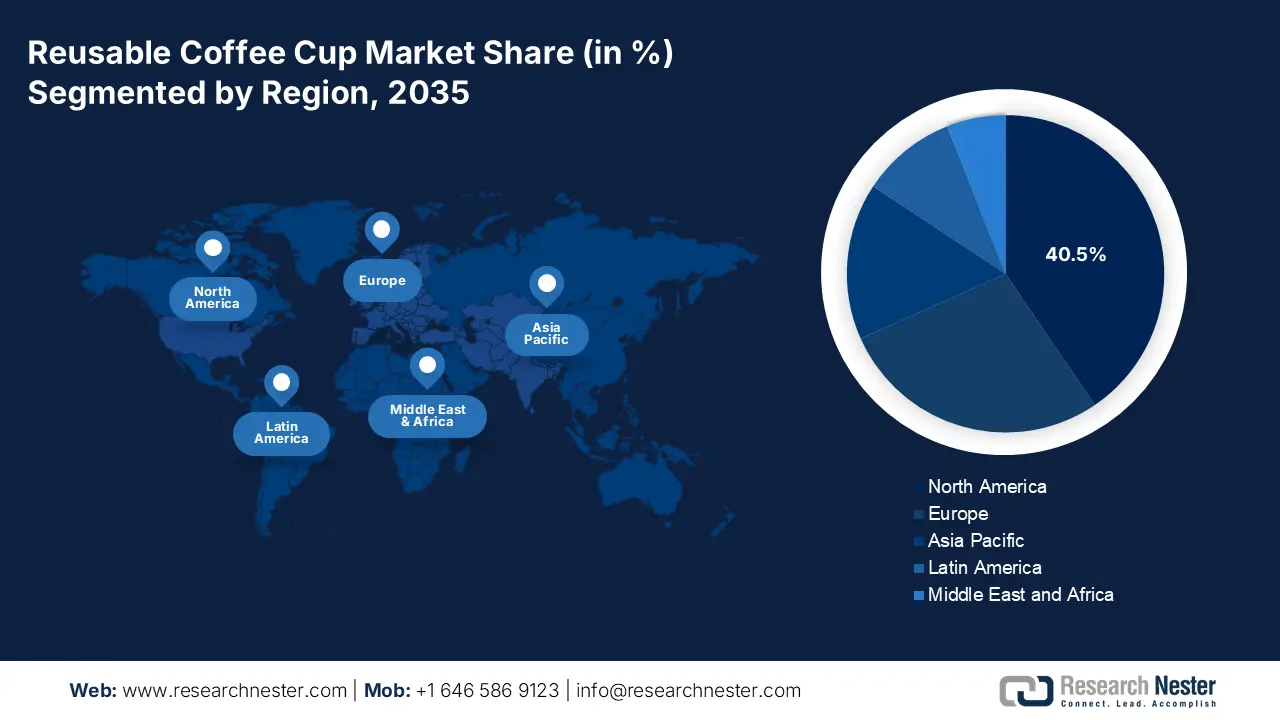
North America is dominating the reusable coffee cup market and is expected to hold the market share of 40.5% during the preferred time line 2026 to 2035. The market is defined by high consumer awareness and a mature competitive landscape. The growth is driven by the corporate sustainability mandates from the major coffee chains and the increasing regulatory pressure on municipal and federal single-use plastic bans. The key trends of the market include the integration of reusable cup systems within the quick service restaurants and a rise of tech-enabled return schemes. Brand differentiation focuses on material innovation, particularly in durable, lightweight composites, and lifestyle-oriented design to foster daily use and brand loyalty. The reusable coffee cup market is further strengthened by the advanced recycling infrastructure and widespread consumer willingness to pay a premium for sustainable, branded products.
The U.S. reusable coffee cup market is being shaped by the regulatory momentum and consumer cost sensitivity. The rising coffee consumption volumes have reinforced demand for the durable cup systems in the food service channels. The consumer price index for coffee is rising steadily, and in January 2024, it reached 128.7, showing the increase in the cost of retail coffee, according to the data published by the U.S. Bureau of Labor Statistics. The trends have further promoted the manufacturers to explore the reusable cup programs to reduce the waste handling expenses and align with sustainability mandates. The public institutions, universities, and transit hubs are increasingly embedding the reuse criteria into contracts in creating the predictable B2B demand clusters. Vendors that integrate washing logistics and standardized cup specifications are positioned to capture growth as compliance costs for single-use packaging escalate across U.S. jurisdictions.
Canada’s reusable coffee cup market is expanding due to the federal plastics regulations and provincial waste management mandates. The Government of Canada data in October 2025 states that nearly 5 million tons of plastic waste are thrown in Canada from our homes and businesses. The Government of Canada’s Single Use Plastics Prohibition Regulation restricts the distribution of Zero Plastic Waste Initiative supports the upstream waste prevention strategies, including the reusable packaging adoption. These measures collectively drive stable growth across university campuses, transit systems, retail chains, and workplace foodservice environments, positioning Canada as one of the strongest North American adopters of reusable coffee cup systems. Federal and provincial procurement guidelines further surge the institutional adoption, increasing the bulk purchasing of reusable coffee cups across public facilities and government-supported programs.
APAC Market Insights
The reusable coffee cup market in Asia Pacific is the fastest-growing market and is expected to grow at a CAGR of 10.2% by 2035. The market is defined by the rapid urbanization, rising consumption of café, and increasing governmental action against plastic pollution. The awareness of waste pollution is rising significantly among consumers in the region, and it is surging quickly, mainly among the youth demographics. The primary driver of the market is the robust national policy, illustrated by India’s ban on specific-use plastics. Further, corporate sustainability pledges from international coffee chains operating in the regions are creating foundational B2B demand. The key trends include the focus on the adoption of affordable, stylish designs and the emergence of local brands catering to regional aesthetic preferences. The market is poised for significant expansion as regulatory pressure intensifies and disposable incomes rise.
The China reusable coffee cup market is a dominant player in the APAC and is propelled by the rapidly expanding urban consumer base. The central government’s push for a circular economy is the primary driver creating a favorable regulatory environment for sustainable products. This is coupled with the massive scaling of domestic coffee chains such as Luchin Coffee that are incorporating sustainability into their operational models. A key trend is the focus on competitively priced mass reusable coffee cup market products to achieve widespread adoption. According to the BOFIT report in February 2024, China’s urban population reached 933 million in 2023, highlighting the immense and growing addressable market for daily-use consumer goods such as reusable cups in metropolitan areas. This demographic is increasing the per capita disposable income and creating a powerful growth engine for market penetration and volume sales.
Robust government regulation against single use plastics are driving India’s reusable coffee cup market. The nationwide ban on identified single use plastic items is effective from July 2022, is the most significant market catalyst pushing the change in consumer and vendor behavior. As per the PIB data in April 2025, the Central Financial Assistance (CFA) under SBM-U 2.0 for Material Recovery Facilities MRFs, composting units, C&D waste plants, and Waste-to-Energy facilities strengthens India’s structured waste management efforts. As municipalities expand these systems, policy focus shifts toward source reduction, increasing the adoption of reusable coffee cups to minimize low-value waste entering SWM infrastructure. Further, the coffee culture in some key areas provides an initial base for the challenges and opportunities that lie in creating an affordable solution for the vast and diverse population.
State-wise Details of CFA
|
States |
No. of projects |
Installed Capacity (in MWeq) |
Total CFA including Service charges (in Rs. Crores) |
|
Andhra Pradesh |
6 |
1.83 |
4.38 |
|
Goa |
1 |
1.00 |
3.03 |
|
Gujarat |
9 |
7.46 |
23.12 |
|
Haryana |
5 |
4.52 |
16.12 |
|
Karnataka |
3 |
5.35 |
14.02 |
|
Madhya Pradesh |
2 |
4.85 |
11.04 |
|
Maharashtra |
7 |
9.58 |
15.77 |
|
Tamil Nadu |
3 |
5.92 |
17.54 |
|
Telangana |
5 |
4.58 |
7.72 |
|
Uttar Pradesh |
8 |
8.63 |
33.40 |
|
Uttarakhand |
1 |
0.09 |
0.20 |
|
Total |
50 |
53.80 |
146.34 |
Source: PIB April 2025
Europe Market Insights
The Europe reusable coffee cup market is expanding rapidly and is driven by the stringent implementation of the EU’s single-use plastics. The regulatory framework has pushed the member states to pass the ban and reduction measures, creating a uniform push away from disposable cups. The primary trend is the rise of standardized tech-enabled deposit return schemes in metropolitan areas and at large café chains that address the convenience barrier for on-the-go consumers. For instance, in Germany, the UK partners with the retailers to create a seamless return infrastructure. Consumer demand is also shaped by a high level of market innovation, such as cups made from recycled coffee grounds or biodegradable composites, moving beyond basic stainless steel and plastic.
Germany is projected to hold the largest revenue share in Europe’s reusable coffee cup market by 2035. The market is driven by the strong packaging laws, mainly the Verpackungsgesetz packaging act, which enforces a robust Extended Producer Responsibility scheme. The law financially incentivizes reusable packaging over single-use options, making it a cost-effective choice for businesses. The Federal Ministry for the Environment notes that the principle of mandatory deposits on disposable beverage containers has successfully shifted consumer behavior, a model now being applied to coffee-to-go systems. According to the IWKOELN data in November 2023, Germany produces nearly 770 tons of takeaway disposable packaging waste every day, thereby demanding a strong reusable framework.
The UK will maintain a dominant position in the reusable coffee cup market and is driven by its own plastic tax and EPR regulations that mirror and in some cases exceed the EU standards. The key growth factor is the high concentration of the major international coffee chains and their corporate sustainability commitments. For example, the UK-based chains have publicly pledged to significantly increase the use of reusable packaging by 2030. Supporting this, the Wrap UK, a government-funded waste advisory body, actively facilitates the UK plastics pact, which is a collaborative initiative that brings together businesses to tackle plastic waste with a specific target to reduce problematic single-use plastic items and promote reusable alternatives, creating a cohesive national drive that fuels market growth.