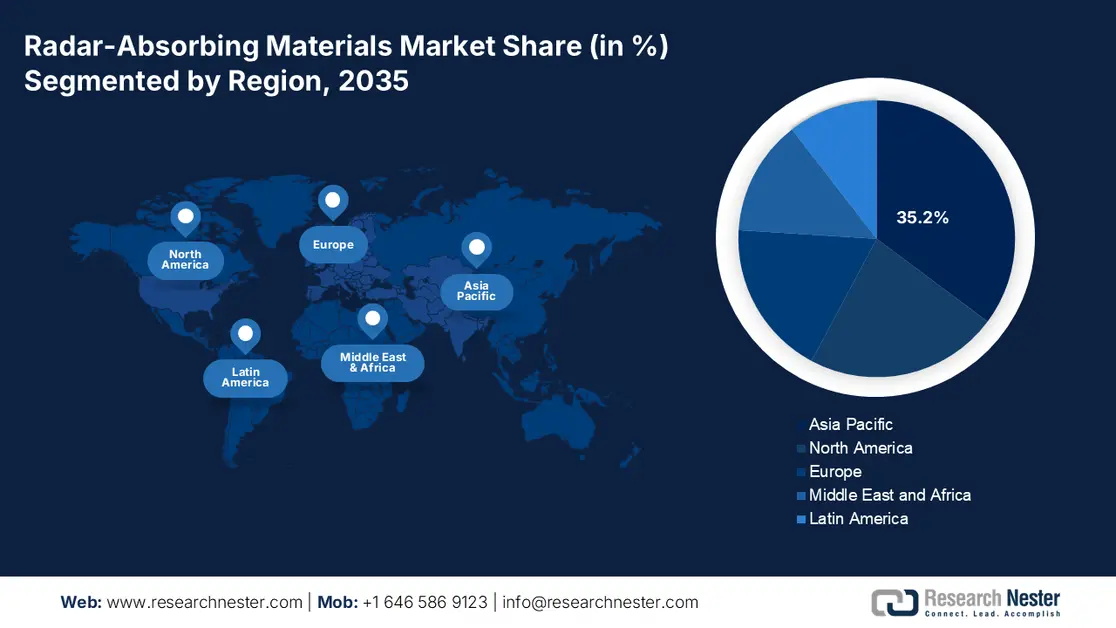
Radar-Absorbing Materials Market - Regional Analysis
Asia Pacific Market Insights
Asia Pacific radar-absorbing materials market is poised to hold revenue share of over 35.2% by the end of 2035, owing to the rapid expansion of the region's defense and aerospace industries, combined with increased investments in radar technology, has greatly increased demand for RAM, which plays an important role in improving stealth capabilities and minimizing radar detection.
India has had a major impact on the domination of the Asia Pacific radar-absorbing materials market. Radar system improvements and their vast defense upgrade programs have increased demand for high-performance RAM solutions. This increase is directly related to the growing demand for stealth technology in military applications, such as ground-based systems, aircraft, and naval vessels, underscoring the crucial role that radar-absorbing materials.
Using magnetic functional filler material, the Defence Laboratory in Jodhpur has created a polyurethane-based radar-absorbing paint that may be applied to strategic targets to reduce RCS. Radar Absorbing Paint's polyurethane resin technology is incredibly weather-resistant and able to tolerate extremely high and low temperatures. To achieve the best radar absorption qualities, a resin matrix containing magnetic functional filler material of a certain size and shape has been employed in the right proportion. Both airborne and ground-based strategic targets can be painted with the developed paint.
China has a strong manufacturing base and technological ability that make it easier to design and implement cutting-edge RAM solutions for a range of military and commercial uses. In addition, the region's strategic emphasis on improving military and national security capabilities has raised demand for advanced substances that absorb radar, driving investment in and innovation in RAM technologies. Asia Pacific is leading the world market for radar-absorbing materials, and this trend highlights the region's status as a major center for invention and manufacturing in this field. In November 2024, China asserted that its new stealth coating could blind anti-stealth radars on paper. The new coating is significantly thinner than previous coatings such as it uses metamaterials to accomplish the radar-hiding trick. The Chinese military claims that the new coating will revolutionize stealth technology by absorbing electromagnetic signals from a variety of angles. Certain electromagnetic frequencies employed by radar systems can be effectively absorbed by the materials currently available for stealth aircraft. The National University of Defense Technology (NUDT) in China created the novel substance. It is claimed that this substance can produce heat from electromagnetic waves with wavelengths between 70 cm (2.3 ft) and 20 cm.
North America Market Insights
North America is expected to experience a stable CAGR during the forecast period. The presence of significant aerospace and military industries in the region is the main factor contributing to the growth of the regional radar-absorbing materials market. Furthermore, the North America market is expanding due to the growing need for sophisticated radar-absorbing materials in both military and commercial applications.
The U.S. is anticipated to increase at the fastest rate during the prediction period. The primary cause of this region's growth is the rising defense budget. The market is expanding as a result of the growing need for radar-absorbing materials in the consumer electronics and automotive sectors. For many years, the U.S. Navy has led the way in developing stealth technology, concentrating on lowering the radar cross-section of its ships to make them harder for adversaries to detect. The F-35 Lightning II, created by Lockheed Martin, is nearly undetectable to radar due to its stealth technology. Its distinctive airframe design reduces radar cross-section, which contributes to its stealth qualities. In addition, a large portion of its surface is covered in materials that absorb radar. Another factor that enhances this jet's stealth profile is the internal weapons.
Canada is one of the top producers of materials that absorb radar, and the growing use of radar technology across a range of sectors, such as defense, telecommunications, and the automobile industry, is driving up demand for these materials. Low Profile Avionics Mount for Aerospace and Defense Uses, LORD AM-001 Series Parker for small, high-load, high-capacity isolators. Lord Low Profile Avionics Mounts (AM Series) are the industry standard. They are made to support and safeguard the avionics systems in all kinds of aircraft. Examples of uses for these mounts include radar components and inertial guidance, and navigation systems. Additionally, engine/aircraft components such as oil coolers, pressure sensors, and fuel controls are isolated using AM Series Mounts.