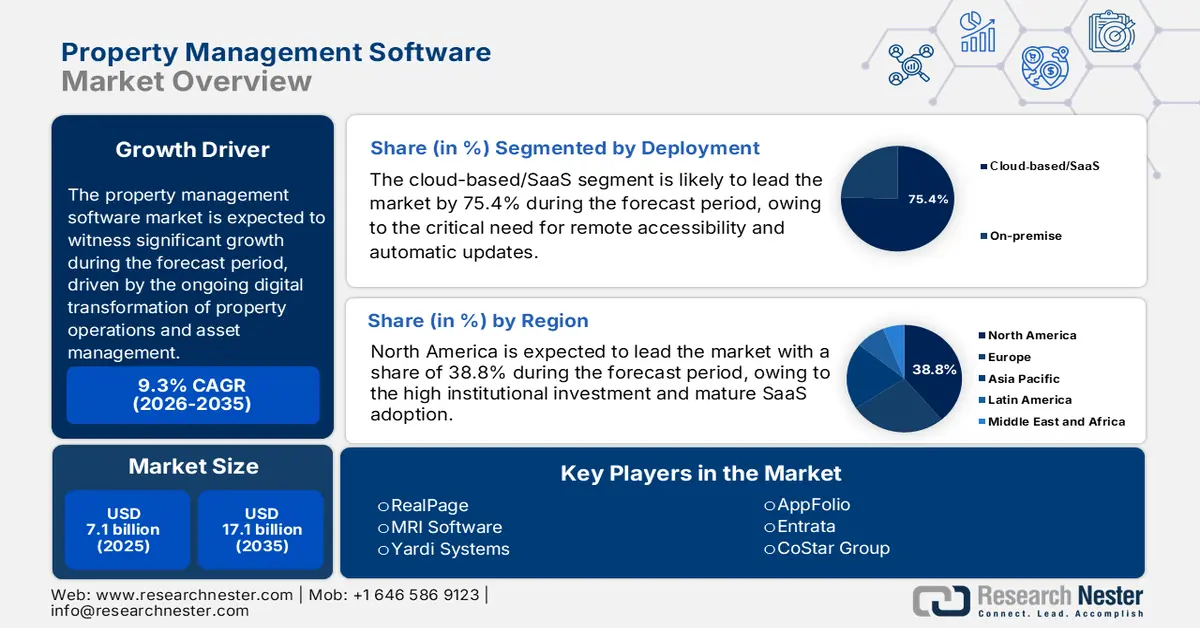
Property Management Software Market Outlook:
Property Management Software Market size was valued at USD 7.1 billion in 2025 and is projected to reach USD 17.1 billion by the end of 2035, rising at a CAGR of 9.3% during the forecast period, i.e., 2026-2035. In 2026, the industry size of property management software is assessed at USD 7.7 billion.
Based on the authoritative U.S. government and non-profit organization data, the property management software market is a significant and expanding sector within the broader real estate technology landscape. The market’s expansion is fundamentally driven by the ongoing digital transformation of property operations and asset management, a trend stimulated by the pandemic’s impact on remote work and tenant interaction models. This growth is the substantial scale of the managed real estate sector itself; for instance, the report from the Data.gov report in March 2024 indicates that the federally assisted multifamily housing portfolio encompasses over 1.4 million housing units, representing a vast operational base requiring compliance and management tools. The growth of the market is also driven by the stricter regulatory oversight and expanding public-sector digital modernization mandates.
Besides, the U.S. Department of Housing and Urban Development allocated USD 70.07 billion in 2024 toward rental assistance, public housing operations, and housing voucher programs, based on the NAHB March 2024 data, all of which require standardized reporting, income verification, and audit-ready documentation functions that favor digitized property management workflows. Similar things are witnessed in Europe, where some EU households live in rented dwellings, with the urban rental density highest in Germany, France, and the Netherlands, reinforcing the demand for scalable property administration platforms across the portfolios. These public-sector funding mechanisms and high-density rental economies create a stable, policy-driven demand floor for specialized software that ensures compliance and operational efficiency at scale.