Power-to-Gas Market Outlook:
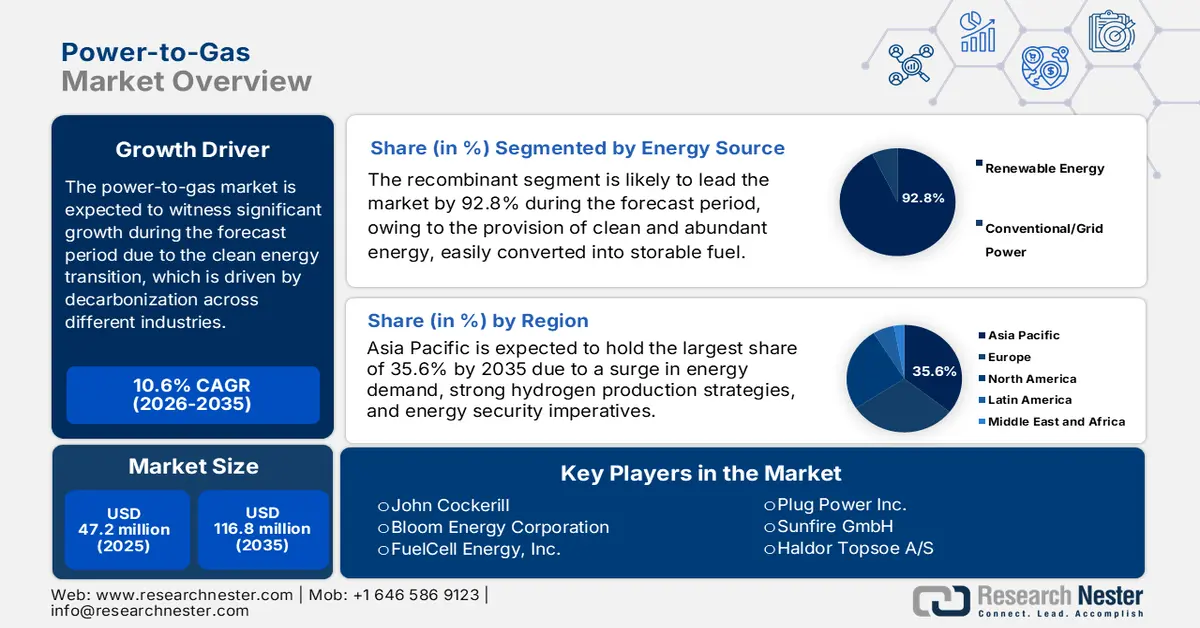
Power-to-Gas Market size was over USD 47.2 million in 2025 and is estimated to reach USD 116.8 million by the end of 2035, expanding at a CAGR of 10.6% during the forecast timeline, i.e., 2026-2035. In 2026, the industry size of power-to-gas is estimated at USD 52.2 million.
The international power-to-gas market is gradually transitioning from a niche technology to a centralized pillar of the clean energy transition, which is fueled by the imperative to decarbonize hard-to-abate economic industries. This particular evolution is readily characterized by a tactical shift from pilot-based demonstration to commercial and integrated projects. According to a data report published by the IEA Organization in 2024, there has been a surge in gas demand by 2.7%, further catering to 115 billion cubic meters as of 2024. This denotes an increase by 2% between 2010 to 2019, as well as by 1% from 2019 to 2023. In addition, developing markets and emerging economies, particularly in Asia, account for almost 40% of additional gas in the same year. Therefore, with an increase in the natural gas demand, there is a huge growth opportunity for the overall market globally.
Yearly Modifications in Natural Gas Demand Regionally (2000 to 2024)
|
Regions |
2000-2010 (EJ) |
2010-2019 (EJ) |
2019-2023 (EJ) |
2024 (EJ) |
|
Europe Union |
0.23 |
-0.13 |
-0.65 |
0.02 |
|
U.S. |
0.03 |
0.87 |
0.38 |
0.62 |
|
Russia |
0.28 |
- |
0.51 |
0.80 |
|
Middle East |
0.67 |
0.60 |
0.47 |
0.45 |
|
China |
0.29 |
0.74 |
0.78 |
0.99 |
|
Other Developing Asia |
0.46 |
0.18 |
0.06 |
0.50 |
|
Rest of the World |
0.84 |
0.44 |
0.03 |
0.50 |
Source: IEA Organization
Furthermore, the gigascale project development, technology optimization and diversification, value chain vertical integration, along with modularization and standardization, are also driving the market’s growth across different nations globally. Regarding technological diversification, as per the October 2025 Energy Conversion and Management: X article, the Solid Oxide Electrolyzer Cell (SOEC) technology has gained densities that exceed 2.87 A/cm2, along with power outputs of 1.68 W/cm2 at 650 degrees Celsius, and ensures stabilized electrolysis operation at 1.42V, while maintaining almost 1005 efficacy. In addition, high currency density (HCD)-based SOECs have significantly displayed hydrogen production rates, accounting for 0.076 g/s with efficient energy for almost 78.2% and 77.6% of exergy efficiencies, thereby boosting the market’s expansion internationally.