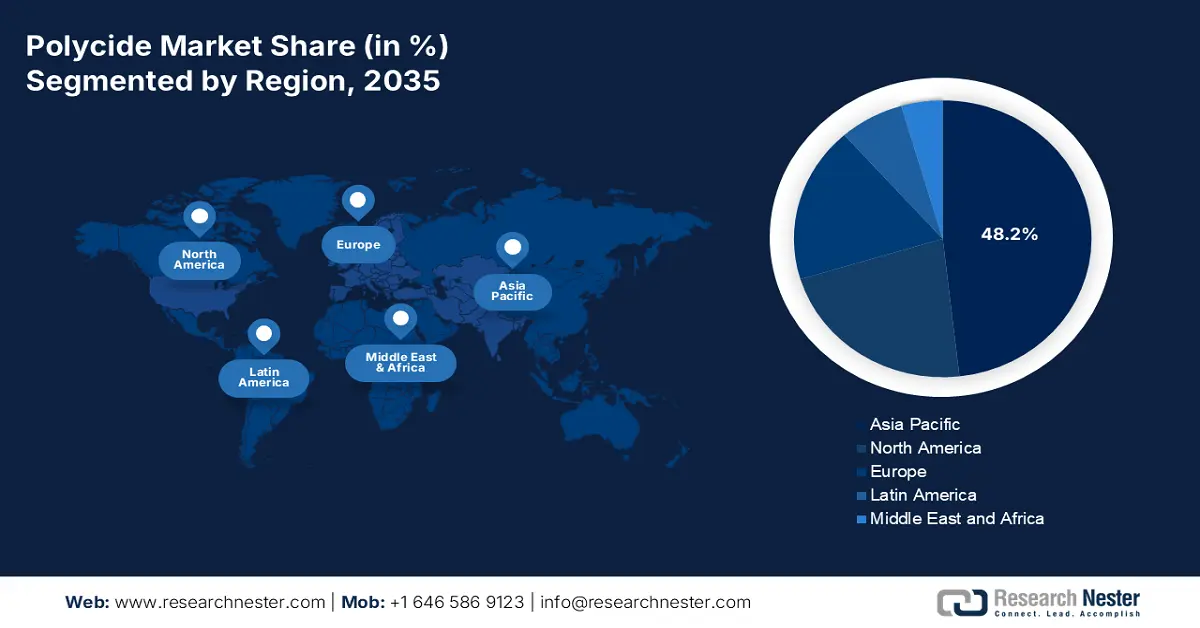
Polycide Market - Regional Analysis
APAC Market Insights
Asia Pacific in the polycide market is anticipated to garner the largest share of 48.2% by the end of 2035. The market’s growth in the region is highly attributed to an increase in the demand for high-frequency semiconductors, a rise in the implementation of polycide transistors in medical imaging, and support through government-funded initiatives in Japan, China, India, South Korea, and Malaysia. For instance, according to a data report published by the PIB Government in January 2022, the National Policy on Electronics (NPE) 2019 has successfully set a target of achieving USD 300 billion for electronics production between 2025 and 2026, which denotes a massive growth opportunity for the market in the overall region.
The polycide market in China is significantly growing, owing to the presence of huge electronics manufacturing output, along with the Made in China 2025 industrial policy. Besides, as per an article published by the CSIS Organization in May 2023, the USD 21 billion National Integrated Circuit Industry Fund, commonly known as China’s Big Fund, has been readily renewed since its initiation with an additional USD 35 billion. This plays a pivotal role in successfully implementing the central government's semiconductor policy, along with the localized government establishing 15 semiconductor funds for investments, with a valuation of USD 25 billion, thus making it suitable for uplifting the market in the country.
The polycide market in South Korea is also growing due to the government’s K-Semiconductor Strategy which constitutes the provision of huge tax incentives, as well as infrastructure support, with the intention of facilitating private investment for developing mega clusters to increase polycide consumption. Besides this, domestic companies are also making a relevant contribution to boost the market’s growth in the country. For instance, in October 2025, Samsung Heavy Industries, Samsung C&T, Samsung SDS, Samsung Electronics, and OpenAI has deliberately notified their tactical partnership to escalate innovation in global AI and initiate technological innovations in semiconductors, and other data centers, thus uplifting the market in the country.
Europe Market Insights
Europe in the polycide market is expected to emerge as the fastest-growing region during the projected timeline. The market’s development in the overall region is propelled by its robust industrial and automotive industries, along with tactical approaches to diminish semiconductor dependency. As per an article published by the Europe Commission in February 2022, the EU Chips Act mobilized over €43 billion of public and private investment, and it has successfully set measures to overcome, prepare, anticipate, and rapidly cater to future supply chain disruption. Therefore, this has directly fueled the need for progressive materials, such as polycides utilization in sensors, power electronics, and microcontrollers, thus boosting the market demand.
The polycide market in Germany is gaining increased exposure, owing to the existence of both industrial and automotive manufacturing sectors, direct support, and the country’s Zukunftsfonds (Future Fund), which are aligned with the EU Chips Act. According to the 2025 Federal Ministry for Economic Affairs and Energy article, the Economic Affairs Ministry has operated a funding programme, known as ELECTRIC POWER II: Electric Mobility, by providing almost €29 million to a overall of 13 research and development projects. Besides, the German Federal Ministry for Economic Affairs and Climate Action also initiates active funding to boost technological sovereignty, thus bolstering the market in the country.
The polycide market in France is also developing due to regional strategies to create a resilient semiconductor ecosystem, the France 2030 investment plan, the development of the latest research and production infrastructure, and governmental commitment. For instance, the Important Projects of Common European Interest (IPCEI) on microeconomics readily provides support to the French leadership in FD-SOI technology, which is a process that significantly uses polycide materials. Besides, the French 2030 approach constitutes the objective to double the electronic production components by the end of 2030, thereby creating a sustained and direct need for advanced materials.
North America Market Insights
North America in the polycide market is projected to grow steadily by the end of the forecast duration. The market’s development in the overall region is highly driven by a robust semiconductor facility, a solid digitalization mandate in healthcare, and an integrated advanced ecosystem. Besides, as per an article published by Semiconductors Organization in July 2025, the manufacturing grant incentives, along with the Advanced Manufacturing Investment Credit (Section 48D), have initiated generous investments in the U.S., accounting for more than 130 projects across 28 states, resulting in over USD 600 billion in the form of private investments.
Semiconductor Supply Chain Investments in North America (2025)
|
Company |
Project Type |
Category |
Technology |
Project Size |
Jobs Expected |
|
Absolics |
New facility |
Materials |
Substrates |
USD 343 million |
1,200 |
|
Air Liquide |
New facility |
Materials |
- |
USD 250 million |
- |
|
Akash Systems |
New Facility |
Semiconductors |
Diamond cooling devices, systems, and substrates |
USD 121 million |
400 |
|
AMD |
New facility |
Chip design |
Design and validation of mixed-signal integrated circuits and processors packaging |
USD 3.3 million |
165 |
|
Applied Materials |
New facility |
R&D facility |
- |
USD 4 billion |
2,000 |
|
ASML |
Expansion |
Equipment |
- |
USD 200 billion |
1,000 |
Source: Semiconductors Organization
The U.S. polycide market will be able to grow robustly due to more government funding, sophisticated biomedical research, and a growing need for semiconductor technology to build new diagnostics. According to an article published by NIH in February 2025, the NIH made an investment of over USD 35 billion as of 2023, on nearly 50,000 competitive grants, as well as over 2,500 medical schools, universities, and other research institutes across 50 states. Of this fund, an estimated USD 26 billion catered to direct expenses for research, and USD 9 billion was readily allocated through the organization’s indirect cost rate. Therefore, this appears to be suitable to conduct effective research on polycide in the country.
The polycide market in Canada is also growing, owing to the existence of federal initiatives, which are aimed at achieving a suitable position in the overall region’s semiconductor ecosystem. In addition, a notable trend in the market’s upliftment is the effective focus on specialized fields, such as packaging technologies, photonics, and compound semiconductors. In this regard, the Government of Canada, as of July 2024, readily supported the commercialization and manufacturing of semiconductors by investing USD 120 million in a more than USD 220 million project, which is led by CMC Microsystems. This denotes a huge contribution towards uplifting polycide implementation in the overall country.