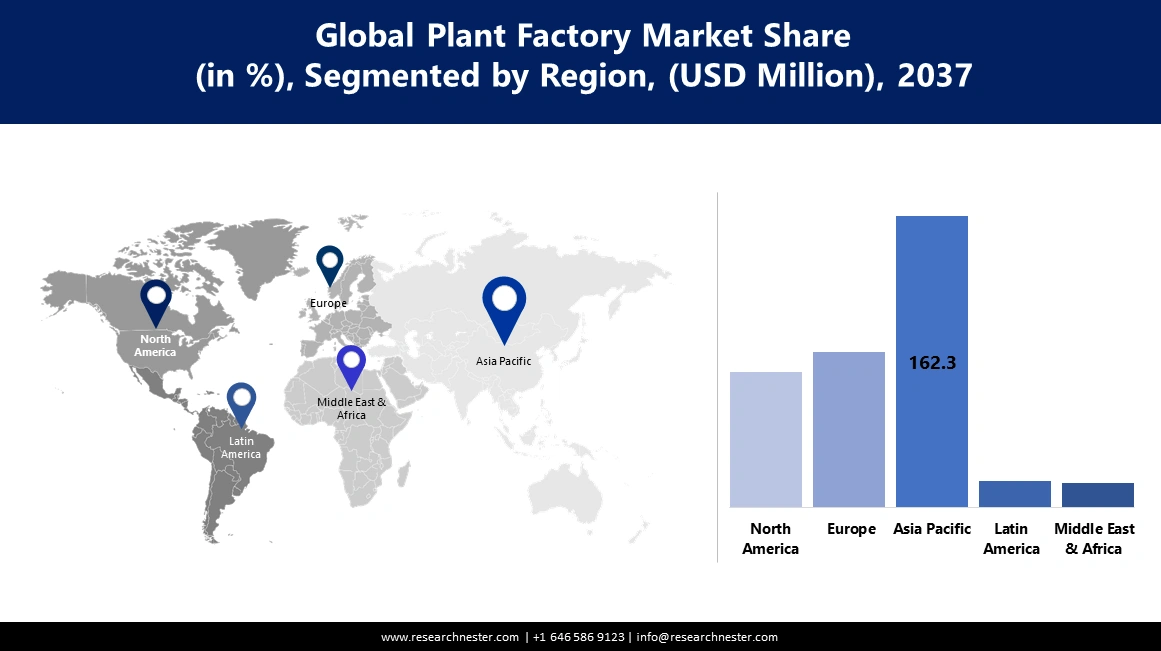
Plant Factory Market Regional Analysis:
Asia Pacific Market Insights
Asia Pacific in plant factory market is expected to dominate around 35.4% revenue share by the end of 2035, due to urbanization, food security measures, and policies and incentives. According to the FAO, to achieve SDG 2 (Zero Hunger), more than 3 million people in the region need to be lifted out of hunger each month by December 2030. This calls for the need to come up with a solution that can feed the world’s growing population through large-scale production like vertical farming and plant factories.
India Production Linked Incentive (PLI) Scheme is significantly encouraging investment in agriculture, and the country is now well-equipped to feed consumers. The PLI scheme has been announced with INR 1.97 lakh crore (more than USD 26 billion) for 14 core manufacturing sectors, such as controlled environment agriculture. This kind of financial support is likely to promote the advancement of vertical farming in India and transform the food production system by minimizing the impact of climate change on traditional agriculture.
China is at the forefront of the use of automation in plant factories using artificial intelligence to improve yields. In February 2024, the Institute of Urban Agriculture (IUA) and the Chinese Academy of Agricultural Sciences (CAAS) introduced robots that can produce and harvest lettuce in 35 days with the help of an artificial intelligence control system. This state-of-the-art automation technology helps in continuously monitoring the environment and control of the conditions that are required for the growth of plants in vertical farms in order to enhance productivity. Due to these factors, China is anticipated to lead in high-tech farming innovations due to its increasing rate of innovations in Agri-Tech.
North America Market Insights
North America region is poised to witness substantial growth through 2035, due to the rising plant factory investments and consumption of green food. The increasing utilization of controlled-environment agriculture (CEA) is responding to issues of climate change, food scarcity, and increasing urbanization. Governments and private investors are investing in high-tech vertical farming solutions to increase the food supply chain and production all year round.
The U.S. continues to lead the global plant factory investments as the country seeks to cultivate more crops in controlled environment structures in response to the growing consumer appetite for locally grown crops that are free from pesticide residues. In February 2024, the largest real estate investment trust (REIT), Realty Income, dedicated USD 1 billion to vertical farming investment, demonstrating high levels of belief in indoor farming. AI climate control and LED-based lighting of plant factories are helping to increase efficiency and crop yields, thereby enhancing plant factory market growth in the U.S.
Canada is experiencing the rising trend of vertical farming due to climate change and high dependence on imported foods. Efforts have been made by the government and private sectors to improve agricultural technology for an efficient plant factory in the urban and rural regions. The consumer’s increased concern for fresh and locally grown produce has led to the growth of plant factories using hydroponic and aeroponic systems for the production of plants. For these reasons, plant factories are turning into a viable solution to the challenges resulting from climate change for Canada agricultural sector.