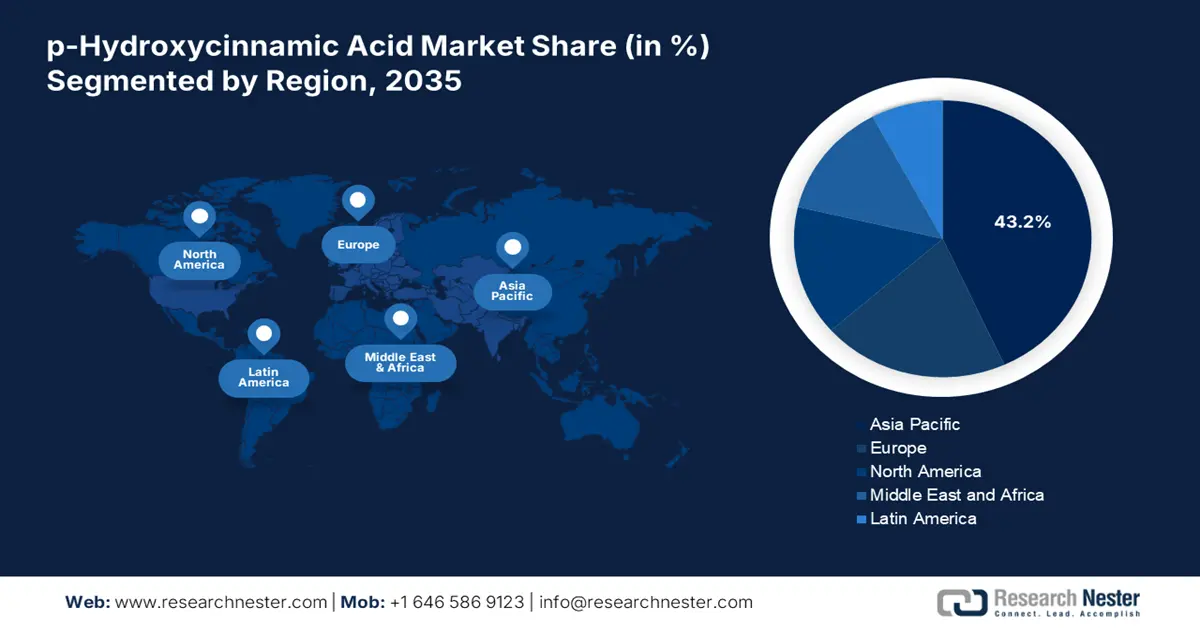
p-Hydroxycinnamic Acid Market - Regional Analysis
Asia Pacific Market Insights
By 2035, the Asia Pacific market is expected to hold 43.2% of the market share due to increased demand in cosmetics, food preservatives, and pharmaceuticals. The market is anticipated to grow at a CAGR of 7.9% (2026 to 2035). Favorable trends include high R&D investments and growth in chemical production in China and India.
China is the largest in the Asia Pacific p-HCA market, projected to grow at a CAGR of 7.8%. China has significant advantages with strong capabilities in chemical synthesis, government support of cosmetic exports, and a large pharmaceutical base. China’s Ministry of Industry and Information Technology (MIIT) has reported substantial growth in the chemical industry. In 2022, the sector saw strong expansion in both investment and exports, with organic chemical exports reaching USD 80.7 billion, a 17% year-on-year increase, while inorganic chemical exports rose 68% from 2021 to USD 39.4 billion.
India's p-HCA market is also rapidly growing due to demand from nutraceuticals and UV-absorbing cosmetics. The Government Production Linked Incentive (PLI) schemes actively promote domestic manufacturing in the specialty chemicals and pharmaceutical sectors. This, coupled with strong Foreign Direct Investment (FDI), fuels growth. The specialty chemicals sector in India demonstrated robust expansion, with an 11.8% year-on-year growth recorded in FY2023.
Europe Market Insights
The European market is growing due to rising demand for natural antioxidants being used as cosmetics, nutraceuticals to support health, and food preservatives, along with the EU's sustainable chemicals strategy (sustainable sourcing). The growth prospects for bio-derived phenolic acids are particularly favorable. The opportunities should continue to grow as governments enforce regulations like the REACH regulation and the Green Deal policies.
Germany's p-hydroxycinnamic acid (p-HCA) market is expected to grow at a CAGR of 6.5% during 2026-2035. The substantial pharmaceutical, cosmetics, and personal care industries, the support of the Federal Ministry for Economic Affairs and Climate Action (BMWK), and supportive regulations for bio-based chemicals (including the German Bioeconomy Strategy 2030) enhance the chances for sustainable sourcing of p-HCA and other bio-sourced phenolic compounds.
France's p-HCA market is expected to grow at a significant rate during the forecast period. The French Ministry for Ecological Transition is encouraging the adoption of plant-based ingredients in the personal care and food sectors, enhancing both demand for p-HCA and value to consumers. Research collaborations with France Chimie and the CNRS aim to advance the eco-sustainable extraction of aromatic compounds, as well as improve the understanding of home-grown bio-sustainable solutions for bio-derived materials, like p-hydroxycinnamic acid.
North America Market Insights
The North American market is expected to hold 15.2% of the market share from 2026 to 2035. Growth is fueled by demand in cosmetics, food preservatives, and pharmaceutical formulations. Investment in biobased chemicals or natural sources, together with supportive regulatory frameworks such as the FDA's and USDA's support for natural ingredients, favors the adoption of natural ingredients. Imports from the Asia-Pacific are also influencing regional supply.
The U.S. market is expected to grow at a significant rate during the forecast period. Demand will be primarily driven by increased usage of p-HCA in anti-aging and UV-absorbing formulations in COSMETICS. The FDA’s recent approval of p-HCA as a safe ingredient for food applications has also furthered the market demand for p-HCA. Domestic U.S. production of p-HCA is limited, with the nation relying heavily on imports. China is the largest single supplier, providing over 30% of U.S. imports of key p-HCA precursor chemicals, according to U.S. International Trade Commission data.
U.S.’s p-Hydroxycinnamic Acid - Exports and Imports (2025)
|
Exporting Country |
Value (USD Million) |
Importing Country |
Value (USD Million) |
|
Canada |
2.25B |
Ireland |
4.78B |
|
Italy |
2.18B |
India |
1.75B |
|
Germany |
2.07B |
Canada |
1.57B |
|
Mexico |
1.82B |
Belgium |
1.57B |
|
China |
1.52B |
Germany |
1.53B |
Source: OEC
By the year 2035, it is anticipated that Canada will account for roughly 15-20% of the p-hydroxycinnamic acid market in North America. This growth is expected to be propelled by an increasing demand for clean-label products, bioactive compounds in functional foods, and natural ingredients in cosmetic formulations. Support from regulatory bodies such as Health Canada, along with heightened research into plant-based sources, may encourage local production.