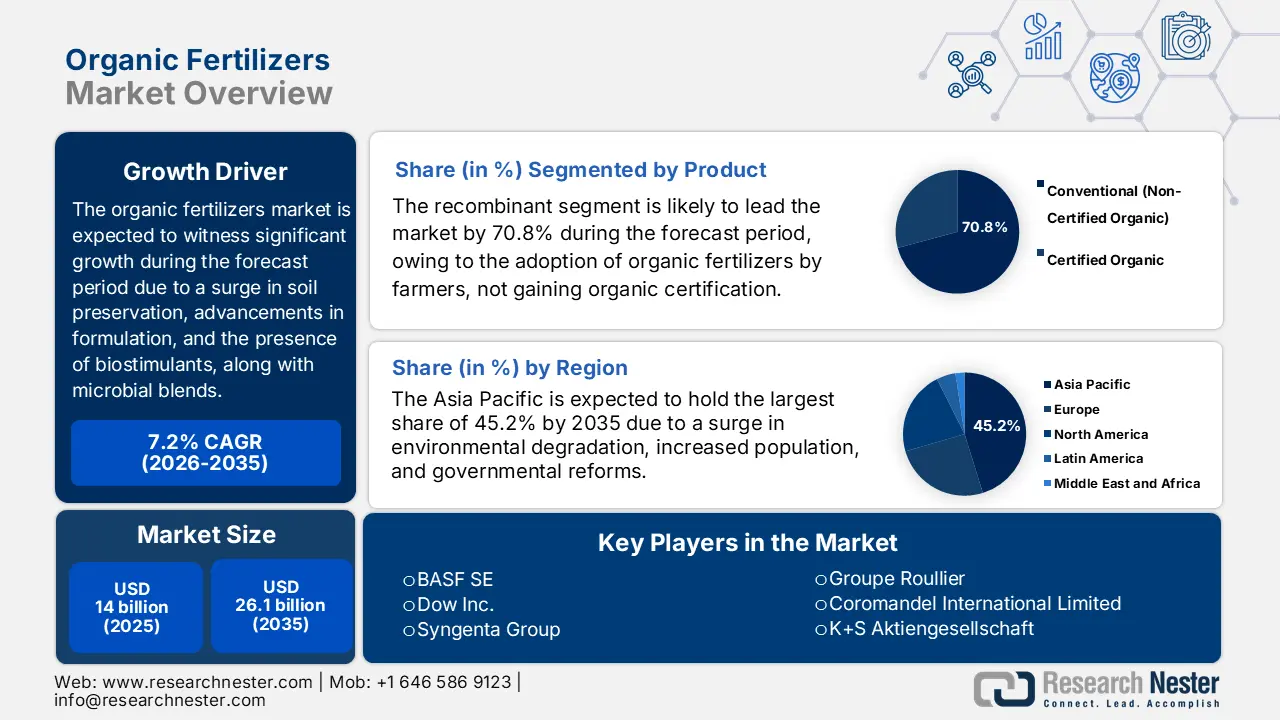
Organic Fertilizers Market Outlook:
Organic Fertilizers Market size was over USD 14 billion in 2025 and is estimated to reach USD 26.1 billion by the end of 2035, expanding at a CAGR of 7.2% during the forecast timeline, i.e., 2026-2035. In 2026, the industry size of organic fertilizers is estimated at USD 15 billion.
The worldwide organic fertilizers market is currently undergoing a profound transition by evolving from a niche segment into a centralized pillar of sustainable and modernized agriculture. This shift is merely driven by customer preference, along with an aggressive convergence of strict government policies, which is a critical demand for soil preservation and compels economic imperatives for farmers. According to an article published by Earth Organization in September 2023, the organic fertilizer sector is projected to account for USD 27.4 billion, along with an 11.3% growth rate by the end of 2030. Besides, in Europe, there is a separate 30% budget allocation for its very own Common Agricultural Policy (CAP) rural growth program to support and promote organic farming. Likewise, in North America, 82% of families purchase organic food regularly, with annual organic food sales reaching almost USD 40 billion.
Moreover, precision-based organics, the presence of circular economy models, biostimulant and microbial blends, advancements in formulation, and consumer and branding education are other factors that are propelling the organic fertilizers market growth. As per an article published by the GAP Organization in May 2025, as international agricultural systems witness increased pressure to ensure continuous production with few resources, precision agriculture is emerging as the ultimate pathway to gain sustainable productivity to cater to target 2% yearly growth rate by the end of 2050. In addition, over 50% of farms in the Midwest states use this particular technology, which is readily contributing to the market’s upliftment. Besides, as per the October 2025 EWG article, there have been 14.9 million acres of ongoing corn in Wisconsin, Minnesota, Iowa, and Illinois, thereby representing 20% of the overall 73.5 million harvested cropland, which is contributing to the market’s growth.
Continuous Harvested Crop and Corn Acres Analysis in the U.S. (2025)
|
State Name |
Continuous Corn Acres (Millions) |
Harvested Cropland Acres (Millions) |
Continuous Corn and Share of Harvested Cropland |
|
Illinois |
3.2 |
21.6 |
15% |
|
Iowa |
5.8 |
23.5 |
25% |
|
Minnesota |
2.9 |
19.7 |
15% |
|
Wisconsin |
3.1 |
8.8 |
36% |
|
Total |
15 |
73.5 |
20% |
Source: EWG Organization