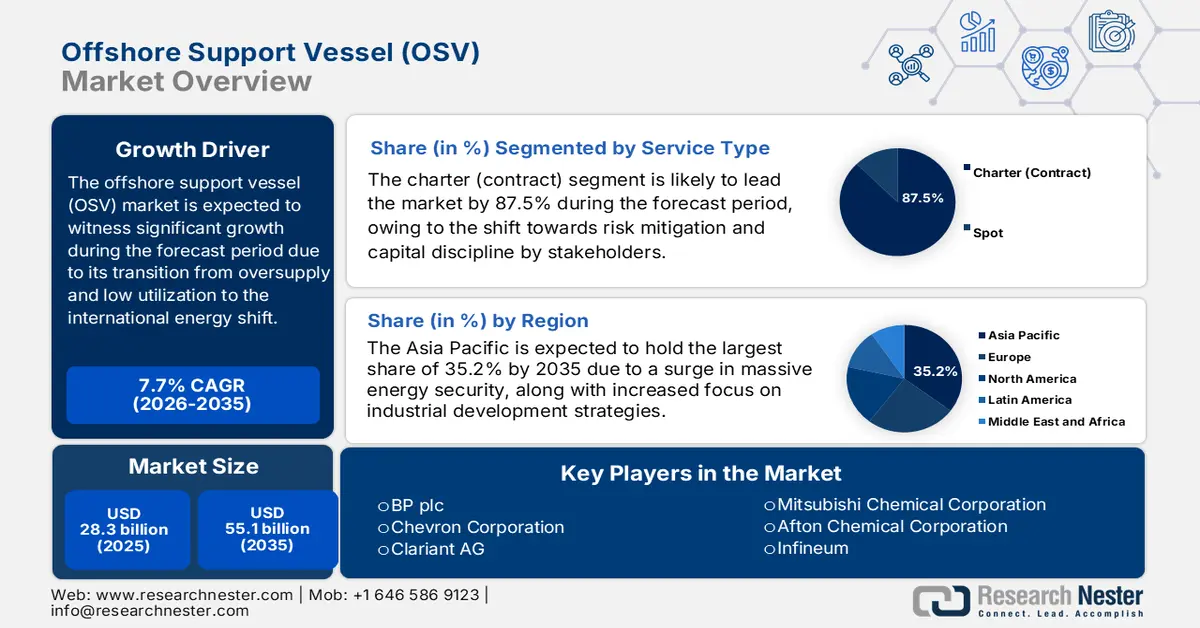
Offshore Support Vessel (OSV) Market Outlook:
Offshore Support Vessel (OSV) Market size was over USD 28.3 billion in 2025 and is estimated to reach USD 55.1 billion by the end of 2035, expanding at a CAGR of 7.7% during the forecast timeline, i.e., 2026-2035. In 2026, the industry size of offshore support vessel (OSV) is assessed at USD 30.4 billion.
The offshore support vessel (OSV) market is witnessing a definitive resurgence as well as structural transformation, and emerging from a long-lasting period of low utilization and oversupply. While gas and oil exploration continue to remain the ultimate demand pillar, the overall market’s future is being readily rewritten by the international energy transition. For instance, according to a data report published by the IEA Organization in 2025, the growth in international oil demand is subject to increased consumption by 0.8% and reaching 193 EJ after jumping by 1.9% in 2023. On the contrary, there has been an increase in natural gas demand by a 2% growth rate and almost 1% as of 2023. Therefore, with the co-existence of both natural gas and oil, there is a huge growth opportunity, and these aspects are projected to ensure continuous growth in their sales in the upcoming years.
Oil and Natural Gas Growth Demand by Sector and Region (2025)
|
Oil |
Natural Gas |
||||
|
Year |
Sector |
Demand Growth (mb/d) |
Year |
Regions |
Demand Growth (EJ) |
|
2021 |
|
|
2000-2010 |
|
|
|
2022 |
|
|
2010-2019 |
|
|
|
2023 |
|
|
2019-2023 |
|
|
|
2024 |
|
|
2024 |
Rest World |
|
Source: IEA Organization
Furthermore, the Green and Dual-Fuel technology integration, specialization for offshore wind, fleet scrappage and modernization, and integrated and digitalization services are other factors that are significantly driving the offshore support vessel (OSV) market globally. As per an article published by the Atmospheric Environment: X in January 2025, maritime transport caters to 80% to 90% of international trade and is deliberately responsible for 3% of international carbon dioxide emissions. Therefore, to keep control, liquefied natural gas (LNG) is adopted since it is a sulfur-free fuel and its overall combustion produces 90% to 99% less sulfur oxide as well as 90% less particulate matter. In addition, based on the capability to reduce carbon dioxide emissions, LNG is primarily composed of methane, which emits less carbon dioxide, and meanwhile its combustion produces almost 20% to 25% less carbon dioxide in comparison to heavy fuel oil.