Office Furniture Market Outlook:
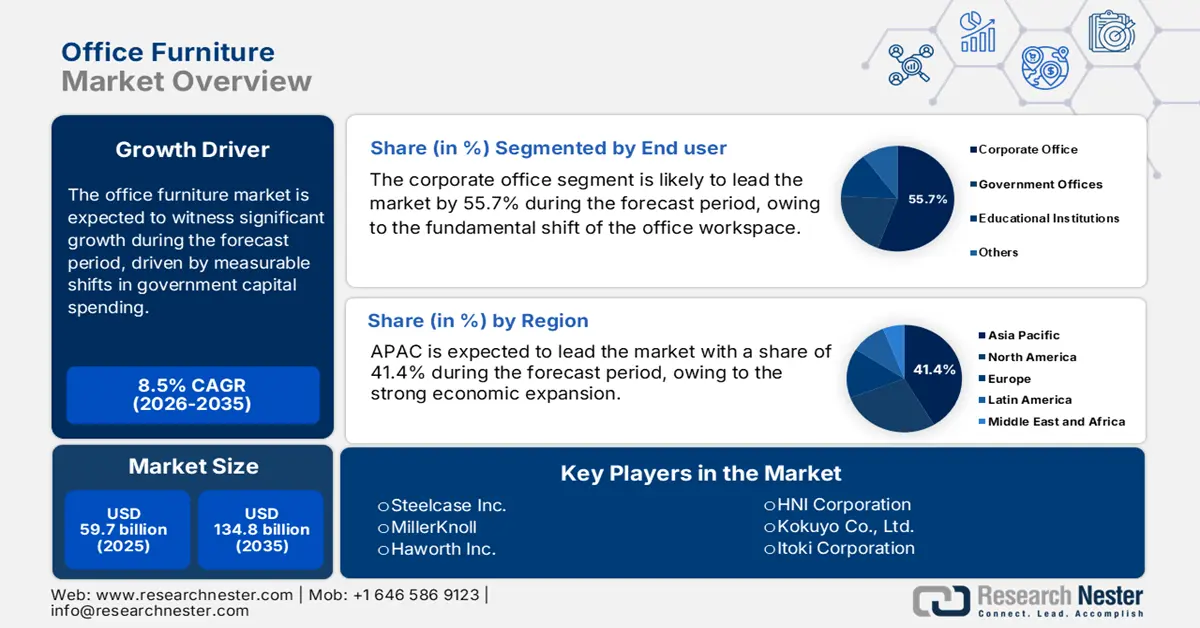
Office Furniture Market size was valued at USD 59.7 billion in 2025 and is projected to reach USD 134.8 billion by the end of 2035, rising at a CAGR of 8.5% during the forecast period, i.e., 2026-2035. In 2026, the industry size of office furniture is assessed at USD 64.7 billion.
The office furniture market is forecasted to have steady growth due to the measurable shifts in the government capital spending, institutional procurement patterns, and public sector workplace modernization initiatives. The government highly invests in new administrative facilities and office upgrades, driving the steady procurement volumes. As per the Government of Goa report on Economic Survey 2024 to 2025, the reimbursement of expenditure on furniture and furnishings was a maximum of ₹ 2.00 lakh, which was purchased only from the vendors empaneled with the Department of Handicrafts, Textiles, and Coir, Government of Goa. The demand for modular furniture, acoustic solutions, and ancillary pieces supports activity-based working. The market’s foundation remains the corporate sector, with its demand closely aligned with the professional employment levels, commercial real estate development, and corporate profitability.
Regulatory and procurement standards are actively shaping the product development and the competitive dynamics. The government further mandates the corporate ESG policies that make sustainable attributes, which are a baseline requirement for suppliers. On the other hand, the recycled content, adherence to certifications such as BIFMA level, and end-of-life product management are now a critical request for proposal processes, mainly for large corporate and public sector contracts. The U.S. Environmental Protection Agency’s framework on Sustainable Materials Management provides a foundation for these procurement policies, promoting a circular economy approach. In order to stay compliant and competitive, manufacturers must make large investments in R&D and supply chain transparency due to this regulatory climate and the requirement that furniture promote employee well-being, as stated by organizations such as the CDC's NIOSH.