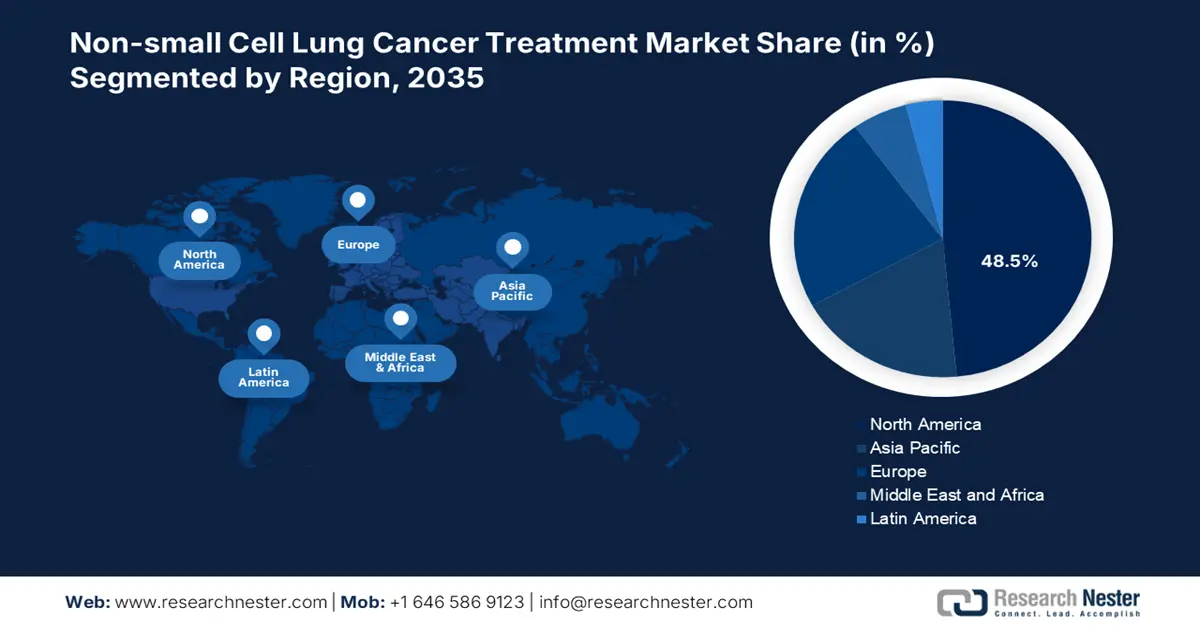
Non-small Cell Lung Cancer Treatment Market - Regional Analysis
North America Market Insights
North America is poised to accumulate the largest market share of 48.5% by 2035 within the global market of non-small cell lung cancer treatment market. Availability of better research and development environment has flourished in the North American market to achieve dominance in the concerned market. Leading innovative biopharma companies have their headquarters in the North America region. Expanded rate of reimbursement leveraged the market accessibility and raised demand for non-small cell lung cancer treatment. According to the report published by the Centers for Disease Control and Prevention, lung cancer is the second most common health risk factor that results in higher levels of patient growth and dominant performance of the concerned market.
In the U.S. market, the adoption of immunotherapy accelerated the growth of the non-small cell lung cancer treatment market. The NSCLC treatment market in the United States is expanding due to high lung cancer incidence rates and rapid adoption of advanced therapies such as immunotherapy and targeted treatments. The presence of a strong biopharmaceutical industry and continuous R&D investment has led to frequent FDA approvals of novel drugs, improving survival rates and broadening treatment options. Precision medicine is becoming a standard, supported by widespread use of genetic testing to guide therapy decisions. Public and private healthcare coverage ensures access to cutting-edge treatments, and a large number of active clinical trials continue to push innovation. Increasing awareness and early detection programs also contribute to the growing number of diagnosed and treated cases.
The oncology market for non-small cell lung cancer treatment in Canada has been developing steadily for the last five years, due to rising cancer rates and the increasing use of novel cancer therapies. Support from government-sponsored cancer care and Canada's public healthcare system has led to an increase in innovative cancer therapies entering the market more quickly than in other countries. Cancer screening programs continue to develop nationally and at the provincial level, which has further enabled earlier diagnosis. Partnerships between research institutions in Canada and the pharmaceutical industry have fostered research and development to improve patient access to the next-generation therapies and therapies that can be used in combination with existing therapies.
Asia Pacific Market Insights
The Asia Pacific market is expected to accelerate with a market share of 18.5% by 2035. The growing rate of incidence of lung cancer and better diagnostic infrastructure are the driving factors to make the region an emerging region within the global market of non-small cell lung cancer treatment. According to the report of the World Health Organization, demographic shift in Asia Pacific is one of the primary factors contributing to the growth of lung cancer. Adoption of targeted therapies and immunotherapy gained a higher rate among the patients in the Asia Pacific. Clinical trial regulations are developed and made low-cost cost which has turned the region to be the hub of global clinical trials. Government spending through varied schemes like the Ayushman Bharat Program in India and many more ensured a better reimbursement rate to reduce inequality in accessibility within the concerned market.
The non-small cell lung cancer treatment market in China has the highest regional market share. The recent growth in the NSCLC treatment marketplace in China has outpaced past years, largely due to the large lung cancer burden and high incidence. Access to NSCLC treatment has been and will continue to be improved by broader public health insurance coverage for cancer care, quicker government approvals of innovative drugs, and more advanced treatment options. The speed with which China's domestic pharmaceutical sector has progressed and the willing investment in biotechnology have accelerated the development and usage of advanced therapeutics. Routine early lung cancer screening and public awareness have dramatically increased lung cancer detection and understanding.
The cancer treatment industry in India is flourishing, largely due to the rising burden of lung cancer. The multitude of factors impacting lung cancer rates in India, including smoking, pollution, and urbanization, is driving the demand. Higher and greater healthcare awareness is demonstrating the downstream effects of differences in early diagnosis, and as patients become more aware and are intent on seeking treatment, there are going to be imposed differences. The government is facilitating the development of cancer care infrastructure, and private oncology centers/profiles continue to grow, which allows for better access to advanced treatment. Investment in clinical trials and partnerships with better-known therapeutic corporations continues to support the expansion in options for newer therapies that reach the market in India. Overall, the long-term opportunities for sustained growth in NSCLC treatment is one that continues to be focused on currently.
Europe Market Insights
The evolution of Europe's non-small cell lung cancer treatment market is led by the growing lung cancer burden, increases the demand for effective therapies. There have been numerous advances in precision medicine, which improve the diverse patient population's treatment outcomes relative to the historic treatment plan. The rise of advanced diagnostic tools also enables actionable intervention by promoting faster and more accurate testing. Furthermore, as the European health care system invests more and more into cancer, this translates into greater endorsement of the use of innovative therapy by way of increased funding, reimbursement, and access programs. The European Commission estimates that the number of cancer cases is expected to rise by 24% by 2035, making it the leading cause of death in the EU.
The NSCLC treatment market in France is growing as lung cancer incidence continues to rise due to smoking and environmental factors. Personalized medicine has also improved the survival and quality of life of patients through targeted therapies and immunotherapies. The French healthcare system supports patients via public subsidies and reimbursement that allow for greater access to innovative treatment opportunities. Further, the country is increasing lung cancer screening and boosting early diagnosis initiatives to provide a larger patient demographic for treatment.
The growing NSCLC treatment market in Germany remains driven by an aging population and the growing and increasing number of lung cancer cases. The broad acceptance of precision medicine strategies has shifted treatment paradigms and led to better clinical outcomes. In Germany, an established healthcare framework and extensive health insurance coverage have translated into opportunities for the patient population to receive excellent treatment. Additionally, lung cancer screening initiatives and heightened early detection studies have yielded higher diagnosis rates. There are also still investments in oncology research, but the ongoing collaboration between academic and pharmaceutical companies is also a contributing factor.