Nasal Implant Market - Regional Analysis
North America Market Insights
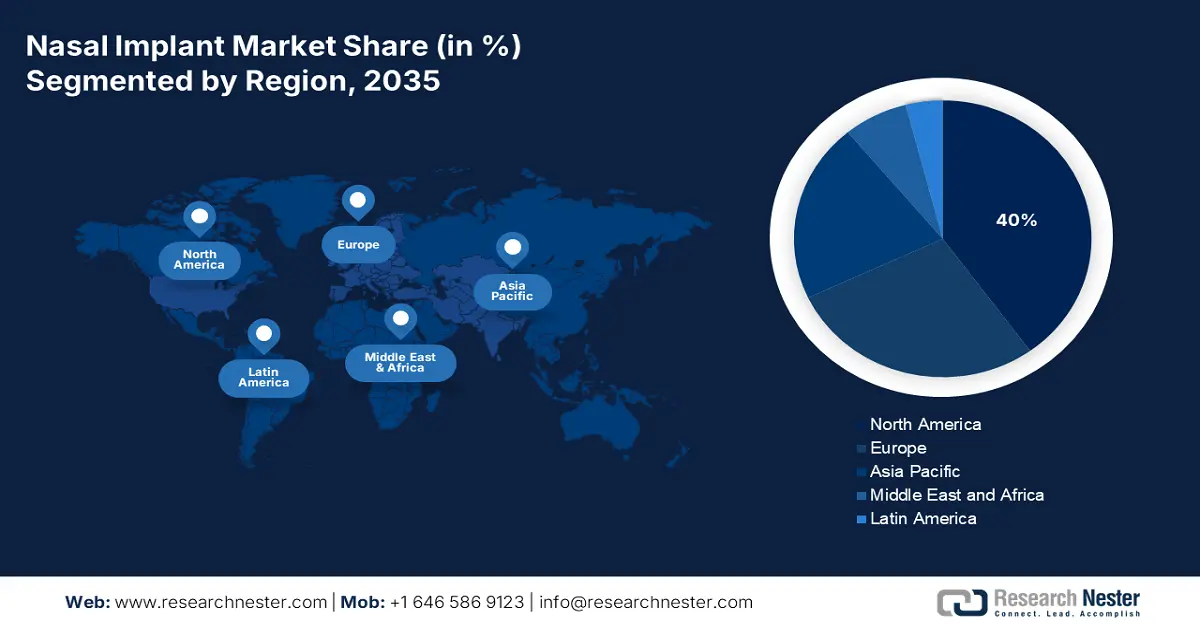
The nasal implant market is dominated by North America, which is expected to expand with a market share accumulation of 40% by 2035. Leadership of the region in the global market is achieved based on key factors like demand for cosmetic surgery, reimbursement policies, adoption rate for innovations, and many more. The Cleveland Clinic report in March 2022 states that more than 345,000 cases of rhinoplasty are conducted annually, which showcases the high demand for the nasal implant in North America. Accessibility of the market is raised through the expansion of the Medicare budget and private insurance.
The U.S. market is dominating the nasal implant market in North America. Demand for cosmetic surgery is high in the U.S., and it is reported that men get 20% of rhinoplasty surgeries each year, based on a report from the Cleveland Clinic in March 2022. The expansion of Medicare spending, with an estimated valuation of approximately USD 918 billion in 2022 on a normal basis, gained higher patient access in the market, based on the Medpac report in 2022. Reduction of the approval period through the FDA’s fast-track ensured better market penetration and high growth. FDA clearance also advocated for the fast adoption of the bioabsorbable implant and created high demand for the nasal implant.
Cost of Rhinoplasty Surgery
|
Country |
Cost |
|
U.S. |
USD 7,637 |
|
Canada |
USD 4,000 and USD 5,000 |
Source: American Society of Plastic Surgeons 2025, The Landings Surgical Center 2025
Asia Pacific Market Insights
The nasal implant market in the Asia Pacific is exhibiting a high potential factor that makes it an emerging market and is expected to grow with a considerable market share by 2035. The rise in medical tourism is one of the primary growth drivers that has created high opportunities for the market to elevate its revenue-generating ability. For instance, South Korea and Thailand are the leading regions in the global market, and 1 million rhinoplasty surgeries were performed in 2024 in the regions, based on the ISAPS report in 2024. Enhanced rate of government investment in the elevation of healthcare infrastructure and R&D has advocated the growth of nasal implants.
China is the dominating country in the Asia Pacific region in the market, which is poised to expand with a regional market share. Local manufacturing is considered to be the most prominent factor that has elevated the market performance in China. Collaborating with the domestic raw material suppliers controlled the cost of production and enabled the market to provide affordable products to the patients. Government investment encourages local production via allocation of funds, accelerating the market growth of nasal implants. According to the report of the National Medical Products Administration, various nasal trauma cases were diagnosed in 2023, which escalated the market demand for nasal implants.
Europe Market Insights
Europe is the second largest region in the nasal implant market and is driven by the high prevalence of ENT disorders, a rising aging population having functional corrective surgeries, and demand for cosmetic rhinoplasty. Technological advancements in biodegradable and patient-specific 3D-printed implants, provide better biocompatibility and results, are the main factors propelling the market. A robust reimbursement framework for the required procedures in Germany and France ensures patient access, sustaining steady market growth across the region.
Germany is the largest country holding the maximum share in the nasal implant market in Europe. Germany is the world's largest market for medical devices, including those used in implant procedures, with yearly sales of USD 44 billion (EUR 38 billion), according to a report released by the International Trade Administration in August 2025. Germany's leadership is further reinforced by its favorable reimbursement policies and advancements in medical innovations. Further, the nation holds its leading position in the market due to its effective regulatory framework, providing a quick adoption of advanced implant technologies.