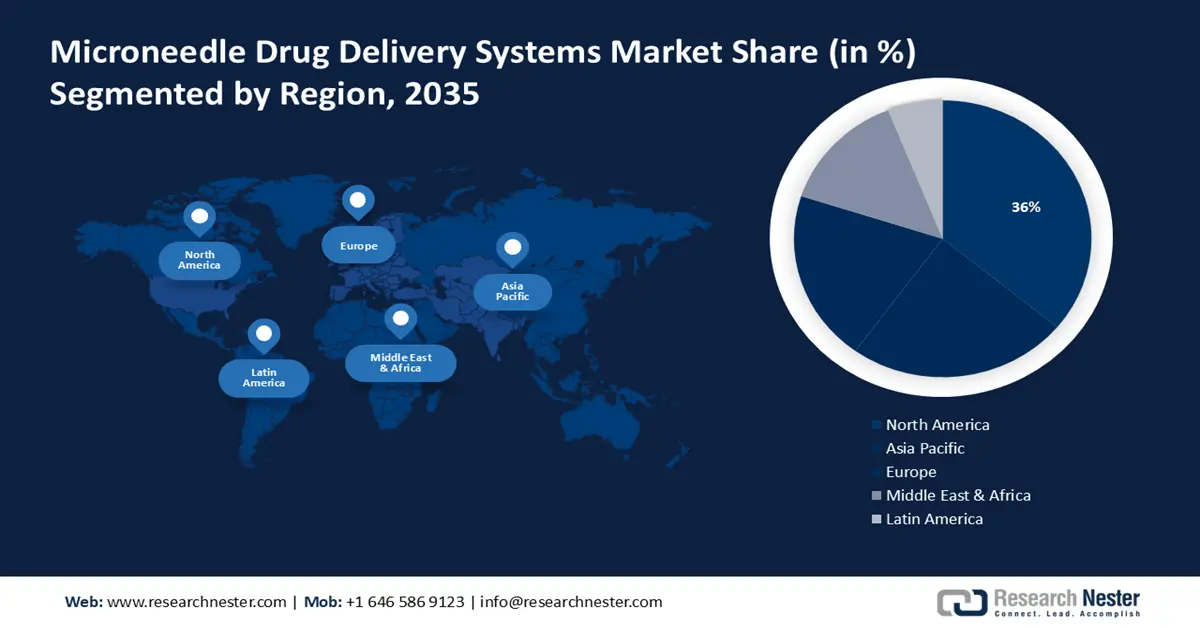
Microneedle Drug Delivery Systems Market Regional Analysis:
North American Market Insights
The North America microneedle drug delivery systems market is anticipated to garner the largest share of 36% throughout the discussed timeframe. The rise in this region is attributable to the wide adoption of highly advanced processes and systems in MN production. The significant growth is also a result of the increased knowledge among the citizens about the existence of such revolutionary medication methods. This can be testified by the projected dominant captivity of North America in the global dermabrasion and microneedling industry, with a share of 40.6% by 2035. Furthermore, the enlarging population with chronic diseases is fostering a wider consumer base for this sector.
The estimated number of habitats in the U.S. with at least 1 chronic illness was 129.0 million in 2024: CDC. This demography signifies the presence of a promising business flow in this country. In addition, the popularity of minimally invasive cosmetic transformations is growing, where the count of similar surgical procedures in this country was 13,281,235 in 2020: American Society of Plastic Surgeons (ASPS). This showcases an accepting culture towards the market, attracting domestic pharma giants to participate. On this note, in May 2020, 3M relaunched its subsidiary business of drug delivery systems under a new brand name, Kindeva Drug Delivery, to possess microneedling technology. This transition was backed by the USD 650.0 million worth of Kindeva acquisition.
APAC Market Insights
Asia Pacific is expected to expand quickly in the microneedle drug delivery systems market, owing to factors such as population growth, changing lifestyles, increased patient awareness, and rising per capita spending. Additionally, developing nations such as China and India are strengthening their healthcare systems, which are backed by economic development and enlargement in the cosmetic industry. Furthermore, the strong emphasis of these nations on manufacturing medical instruments and biotechnology is escalating their global significance in this field. For instance, in 2020, the biotechnology industry in India surpassed USD 70.2 billion; it is further poised to gain USD 150.0 billion by 2025 and up to USD 300.0 billion by 2030 (IBEF).
China, with a large patient population and an emerging medical device industry, is augmenting the regional market. According to WHO statistics, stroke was the top cause of death in this country in 2021, with a rate of 117.8 per 100,000. It also highlighted the worsening mental health condition in China with increasing suicidal mortality. Thus, the country demands large-scale medicine administration, particularly during pandemics, creating scope for advanced delivery systems such as MNs. In addition, the medical device merchandise in this nation is expected to reach USD 48.8 billion by 2026, where diagnostic imaging and consumables acquire 50.0%. The complete scenario represents a lucrative trading opportunity for global pioneers.