Mass Spectrometer Market - Regional Analysis
North America Market Insights
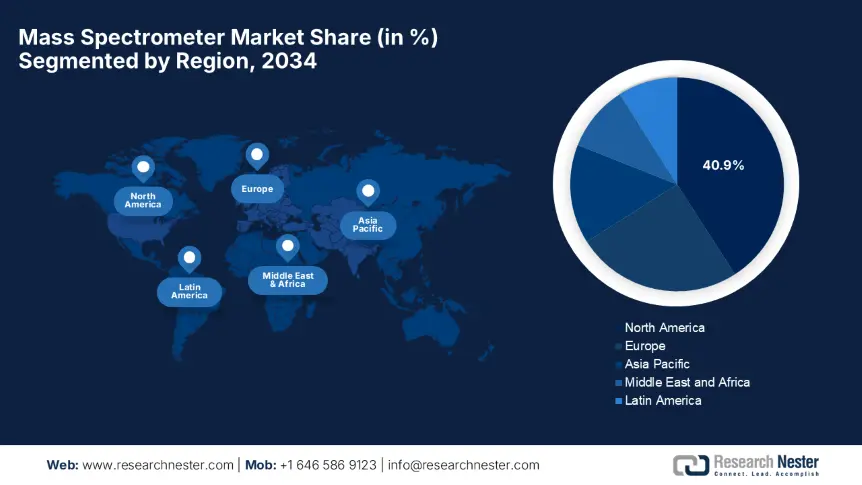
North America market is projected to dominate with the largest share of 40.9% during the forecast tenure. The market’s upliftment in this region is attributed to the presence of strong medical infrastructure and suitable reimbursement policies. The U.S. accounts for 85.8% of regional demand, and Canada contributes the remaining 14.2% of the region’s share owing to the provincial healthcare initiatives and mandates imposed on mass spectrometry adoption. Furthermore, the pioneers such as Pfizer and Merck invested USD 900.4 million yearly on mass spectrometry-based drug development, thus suitable for standard market growth.
The U.S. market is readily dominating the region on account of USD 5.4 billion received through federal funding for precision medicine and proteomics research as of the NIH 2024 report. Besides, the Centers for Medicare & Medicaid Services (CMS) revealed that Medicare is enabling coverage to mass spectrometry-based diagnostics for over 12.6 million seniors, benefiting both patients and service providers. On the other hand, pharmaceutical R&D investments are expanding, wherein 90.3% of the top 20 drug makers use these spectrometers for quality control, according to a 2023 PhRMA report.
There is an immense exposure for the mass spectrometer market in Canada, which is effectively driven by an estimated USD 3.6 billion in federal healthcare spending and provincial investments such as Ontario’s investment of USD 502.5 million towards a mass spectrometry initiative. According to the report from Health Canada, it mandated MS for 70.6% of drug quality control, which in turn boosts the demand. Further, BioteCanada reports a 15.7% increase in the mass spectrometry adoption for environmental testing, thus reinforcing the country’s captivity in this sector.
APAC Market Insights
Asia Pacific is considered to be the fastest-growing region in the market, growing at a CAGR of 8.9%. The market’s upliftment in the region is supported by rising chronic disease burdens, pharmaceutical outsourcing, and government-led healthcare modernization. This landscape is dominated by China with a 45.6% regional share, followed by Japan and India. Besides South Korea’s K-BioHealth 2030 initiative, which prioritizes AI and mass spectrometry integration coupled with Malaysia’s 12th Plan funds lab upgrades for halal pharma compliance, also contributes towards regional growth in this field.
The market in China is showcasing its dominance in the Asia Pacific, which is fueled by massive government investments and pharmaceutical expansion. In this regard, the National Medical Products Administration (NMPA) in 2024 noted that it assigned a total of USD 2.2 billion for MS-based drug quality control, which marks a 15.6% increase from 2022. It further underscored that this grant aligns with the country’s Made in China 2025 initiative, which aims to localize 70.5% of high-end MS production by the end of 2030. Further, the country hosts an estimated 1.7 million patients who currently require MS diagnostics for oncology and infectious diseases.
India is also augmenting its position in the regional mass spectrometer market with the presence of strong administrative support and increasing demand for mass spectrometers. As evidence, the Production Linked Incentive (PLI) scheme resulted in 18.6% spending growth over the last decade, surpassing USD 1.9 billion in 2024. Besides, the country witnessed 2.6 million patients diagnosed with the mass spectrometry in 2023, which is 3 times when compared to the previous decade. Furthermore, from the tenure 2022 to 2024, over 200 new mass spectrometry systems were installed in public hospitals, representing a profitable business atmosphere in the country.
Country-wise Government Provinces
|
Country |
Policy/Initiative |
Funding/Budget (Million) |
Launch Year |
|
Australia |
National Medical Devices Policy |
AUD 150.6 |
2023 |
|
Japan |
PMDA’s SAKIGAKE Fast-Track MS Approval |
USD 135.8 |
2021 |
|
South Korea |
K-BioHealth 2030 Strategy |
USD 375.4 |
2024 |
|
Malaysia |
12th Malaysia Plan (Healthcare Modernization) |
USD 260.6 |
2021 |
Europe Market Insights
Europe mass spectrometer market is poised for robust growth driven by the existence of stringent regulatory standards, rising aging populations, and precision medicine adoption. In this regard, the European Medicines Agency’s (EMA) 2024 guidelines imposed mandates on mass spectrometry for 95.4% of biologic drug approvals, which remarkably fueled the 6.4% CAGR. Simultaneously, the Europe’s Health Data Space made a provision of €2.8 billion for mass spectrometry-based diagnostics, which attracts both domestic and international players to establish their footprint in the region’s market.
Germany dominates the all over regional market, extensively facilitated by its regulatory and industrial powerhouses. The mandates imposed by the country’s Federal Ministry of Health (BMG) on raw material testing and batch release create a €4.3 billion annual demand from the pharmaceutical sector alone. Simultaneously, the leading firms such as Bayer and Boehringer Ingelheim invested €1.6 billion in MS-based drug development for the tenure 2023 to 2025, concentrating on biologics characterization. Further, 80.5% of hospitals in the country are utilizing MS for sepsis and cancer diagnostics as per BAK data, thus positively impacting market expansion.
The U.K. is readily growing in the mass spectrometer market due to the digitalization initiatives and post-Brexit supply chain shifts. NHS allocated a budget of £2.4 billion for the tenure 2024 to 2030 that integrates MS with Electronic Health Records (EHRs), thereby enabling an estimated 15.6 million patients to access precision diagnostics. In response Association of the British Pharmaceutical Industry (ABPI) estimates that this may require 500 new mass spectrometry systems by the end of 2027. The ABPI also implemented a 2025 strategy, which aims to localize 62% of MS manufacturing, whereas it was 30.3% in 2022, thus reducing import reliance.
Government Investments, Policies & Funding
|
Country |
Policy/Initiative |
Funding/Budget (Million) |
Launch Year |
|
France |
Health Innovation 2030 Plan |
€501.2 |
2023 |
|
Italy |
PNRR Healthcare Modernization |
€300.3 |
2021 |
|
Spain |
Strategic Health Technology Plan |
€250.7 |
2022 |