Marketing Calendar Software Market Outlook:
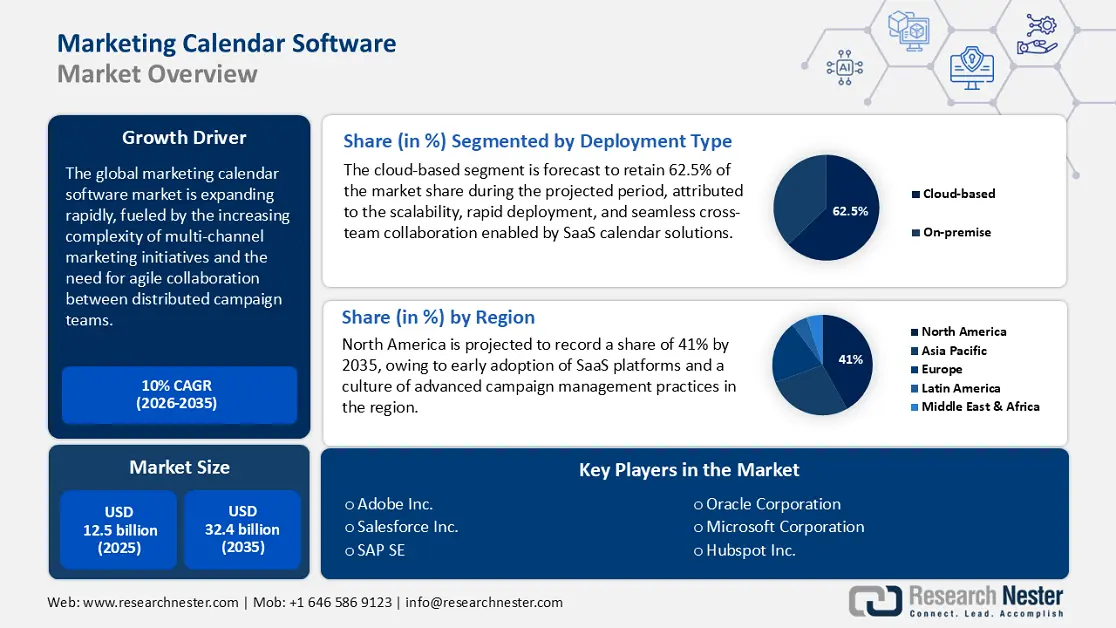
Marketing Calendar Software Market size is valued at USD 12.5 billion in 2025 and is projected to reach a valuation of USD 32.4 billion by the end of 2035, rising at a CAGR of 10% during the forecast period, i.e., 2026-2035. In 2026, the industry size of marketing calendar software is assessed at USD 13.7 billion.
The marketing calendar software market is making the transition from independent scheduling software to seamless, AI-based planning centers that manage the complete campaign journey. A key growth driver is the necessity for an integrated command center to link strategy, content creation, activation, and measurement in one view that can be shared and collaborated on. In September 2024, Adobe unveiled generative AI innovations in Adobe Experience Cloud, including enhancements to Adobe Workfront that utilize AI to create creative briefs and project plans orchestrated in integrated marketing calendars. This represents the industry trend toward putting planning tools inside larger platforms to enhance operational efficiency and give a single source of truth to marketing teams.
This market's expansion is also being influenced by emerging regulatory demands that bake compliance into campaign processes. Central to this is government regulation on data privacy, which is forcing marketing teams to include consent management and data governance processes in their planning calendars. In January 2025, the U.S. government finalized a regulation to block the movement of Americans' sensitive personal data to countries of concern, affecting how data is sourced and utilized for global campaigns by marketers. This means that any campaign booked in a marketing calendar has to factor in data residency and data transfer limitations now, making planning both a governance and scheduling function.