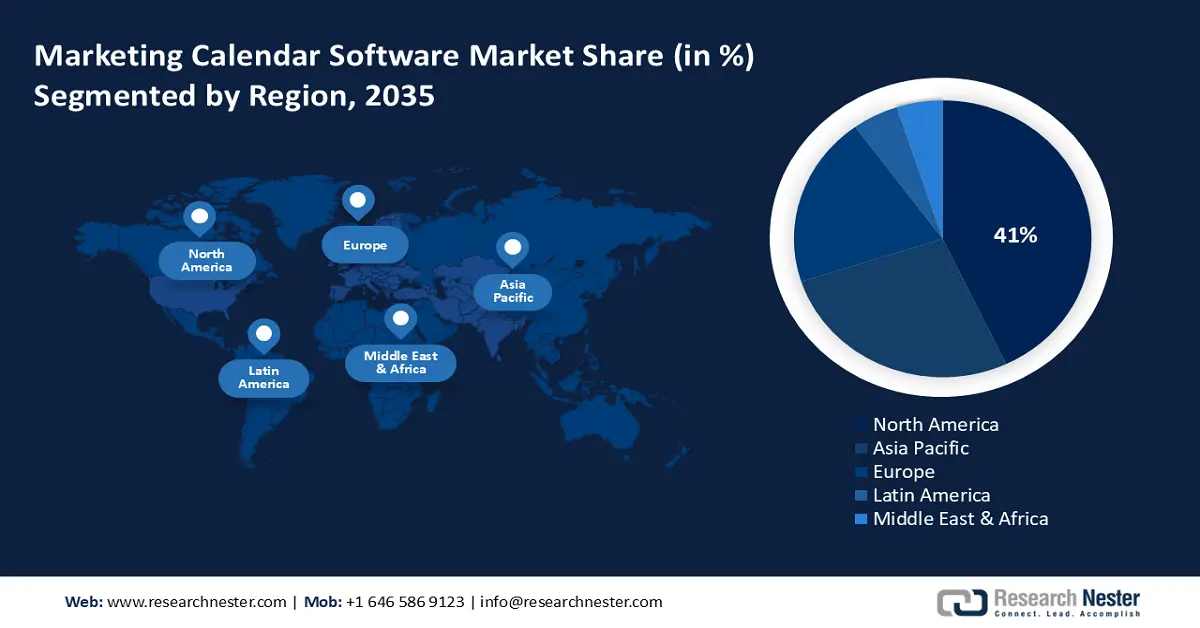
Marketing Calendar Software Market - Regional Analysis
North America Market Insights
North America marketing calendar software market is expected to hold a 41% market share through the forecast period, spurred by an established marketing technology ecosystem and a high focus on data-driven decision-making. The overall growth driver is constant innovation from top software vendors, who are integrating sophisticated AI and automation features into their solutions. North American businesses are thus early adopters of new marketing planning technologies and try to differentiate themselves through this.
The U.S. marketing calendar software market is anticipated to remain a significant market in North America, with a market that compels businesses to optimize their marketing efforts. A strong impetus is the necessity for effective campaign management to squeeze out ROI in a competitive digital marketplace. One of the key policy changes that shapes the market is regulating marketing in certain industries. In 2025, the U.S. Centers for Medicare & Medicaid Services (CMS) released its yearly MARx calendar, which mandates non-negotiable marketing, enrollment, and reporting deadlines for Medicare Advantage plans, compelling healthcare marketers to organize their internal calendars around government-mandated schedules. This indicates the manner in which regulatory systems in critical industries instill a foundational requirement for accurate and compliant marketing planning tools.
Canada market is stable and growing, backed by an innovative technology industry and an emphasis on data protection and privacy. One of the market drivers is the demand for marketing solutions that are regulation-compliant, which is influencing buying behavior. One such policy development is the progress of broad privacy legislation. In 2024, Canada further progressed in its Digital Charter Implementation Act (Bill C-27), which features the Consumer Privacy Protection Act (CPPA) that would oblige businesses to update their data processing routines and include privacy impact assessments in their annual marketing calendars to remain compliant. This regulatory climate fuels the demand for marketing calendar software with strong governance and compliance capabilities, which becomes a differentiator in Canada.
APAC Market Insights
Asia Pacific marketing calendar software market is anticipated to register a CAGR of 9.8% from 2026 to 2035, driven by fast digitalization, an expanding middle class, and an increased use of mobile devices and social media. A prominent trend among rapidly expanding organizations is the adoption of all-in-one marketing platforms, enabling them to scale operations both quickly and efficiently. This presents a key opportunity for software vendors that are able to provide integrated, user-friendly solutions that meet the varying needs of the region.
The marketing calendar software market in China features a distinctive digital ecosystem and firm regulatory regime that necessitates a localized marketing strategy. A critical aspect is to have tools that can manage the country's robust data privacy regulations while reaching consumers on popular local platforms. One of the most crucial policies is the enforcement of data protection regulations that control cross-border data transfers. In 2024, China persisted with the stringent enforcement of the Personal Information Protection Law (PIPL), affecting how international businesses can advertise to Chinese consumers, frequently requiring separate marketing calendars and compliant processes to avoid illicit data transfers. Such regulatory nuance is fueling demand for specialized software and local know-how.
India market is expanding, led by a thriving digital economy and a huge, youthful, and technologically advanced population. One of the key drivers is the demand for scalable and cost-effective marketing options that can get businesses in front of large and varied numbers of people. A pertinent policy initiative is the establishment of a new data protection regime. In February 2025, India released the draft Digital Personal Data Protection (DPDP) Rules, which obligate companies to have rigorous processes for collecting and handling user consent, changing campaign planning processes by inserting a required, compliant consent-collecting step into each marketing calendar item involving personal information. This is driving the deployment of marketing technology that can manage compliant, scalable campaigns.
Europe Market Insights
Europe marketing calendar software market is expected to garner steady growth from 2026 to 2035, influenced by a high emphasis on data protection and consumer privacy. One of the drivers is the requirement for software able to assist marketers with the intricate regulatory environment, specifically the General Data Protection Regulation (GDPR). Subsequently, software with in-built compliance and governance capabilities is in tremendous demand throughout the region.
Germany market is recording growth owing to its high level of B2B business, which is efficiency- and data security-driven. A crucial element is the demand for marketing solutions capable of managing complex, multi-step campaigns while adhering to stringent data protection regulations. A pertinent government initiative in this area is the promotion of secure cloud computing. In 2024, Germany's Federal Office for Information Security (BSI) championed its C5 (Cloud Computing Compliance Controls Catalogue), a publicly backed standard that offers a definitive benchmark for businesses to choose secure SaaS applications for their marketing planning and data handling. This is making buying decisions and inducing the adoption of compliant and secure marketing calendar tools, particularly in the "Mittelstand."
The UK market is competitive and dynamic, with high visibility given to digital marketing and an established technology ecosystem. Key factors include the growing need for flexible, collaborative planning tools that can adapt to rapid marketing campaigns. Additionally, significant policy changes are emerging, particularly new regulations aimed at digital markets and consumer protection. In November 2024, the UK's Digital Markets, Competition and Consumers (DMCC) Act was enacted, adding strict anti-subscription trap rules and fake review prohibition rules, requiring marketers to plan a quarterly compliance review of their checkout and review collection processes into their yearly marketing plans. This is driving the need for agile and compliant marketing planning software that can keep pace with the changing regulatory landscape.