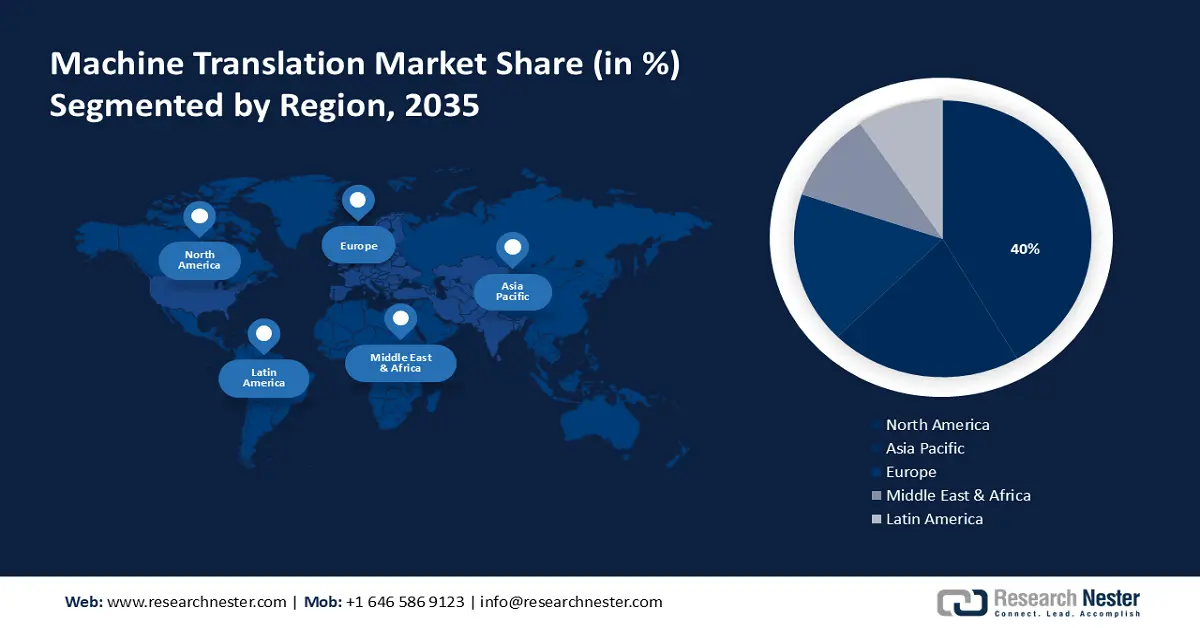
Machine Translation Market Regional Analysis:
North American Market Insights
The North America machine translation market is projected to be the largest with a share of about 40% by the end of 2035. The regional market revenue growth is led by rising investment in advanced technologies such as artificial intelligence and machine learning as a service. In 2019, the United States made USD 37 billion in the market for machine learning applications. Additionally, funding for AI companies in the US has increased significantly in recent years, going from just under USD 300 million in 2011 to over USD 17 billion in 2019. Artificial intelligence is used in machine translation to translate text from one language to another without the need for a human translator.
Europe Market Insights
The European market is estimated to register a share of 25% by 2035. The growth is majorly towing o the rising efforts put by the government to boost the conservation of technology for multilingualism. The EU promotes language technology research, development, and application in order to remove language barriers while conserving and advancing multilingualism. According to European Commission, there are two active programs in Europe to remove the language barrier. For instance, by supporting language technology across sectors, the Horizon Europe Program promotes research and innovation. Moreover, the Digital Europe Program promotes the use of linguistic technology by the public and corporate sectors in Europe.
APAC Market Insights
The machine translation market in the Asia Pacific will hold a significant share of 20% by 2035, impelled by the rising efforts to put natural language processing in use across all sectors. In July 2022, Fronteo Inc. and NTT East Japan formed a partnership to research how digital health will advance after natural language AI is applied to it. It is done to boost Japan natural language processing. On the other hand, growing investment to boost the implementation of AI technology is also expected to boost the market growth in the region. For the implementation of technology that can improve the analysis of massive amounts of data for AI-assisted systems and put it to use in the future, the Japanese government allocated about USD 19 million.