Low Noise Amplifiers Market - Regional Analysis
APAC Market Insights
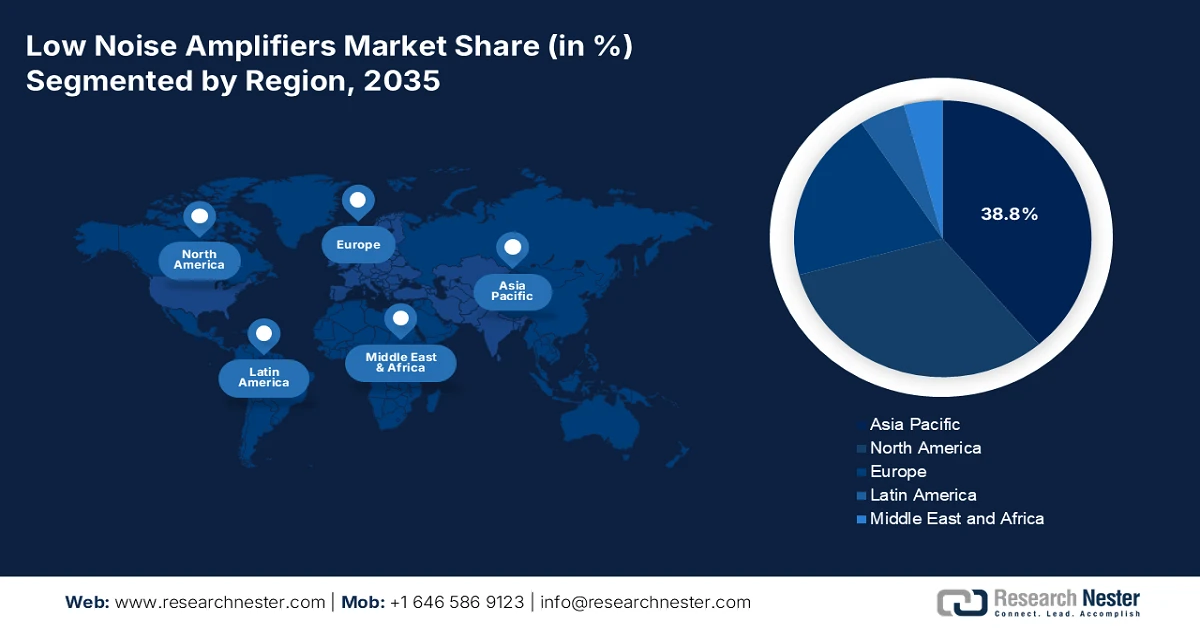
The Asia Pacific low noise amplifiers market is the fastest growing and is expected to hold the revenue share of 38.8% by 2035. The market is driven by the robust consumer electronics manufacturing base, massive investments in telecommunications infrastructure, and expanding national defense budgets. The primary catalyst is the scale of the 5G deployment and research on 6G technologies, which China is leading in base station installations, and India is showing a vast subscriber growth. This telecom expansion creates an immense demand across the network stack. The government initiative programs are boosting the advanced RF component innovation. Geopolitical tensions are also driving the rise in defense spending on space systems, radar, and electronic warfare. The regional trend is the push for semiconductor self-sufficiency and investment to reduce import dependencies and secure the supply chain for critical components.
The rapid expansion of the digital network infrastructure and 5G network is the key driver demanding the low noise amplifiers market in China, which is an essential component in the base stations, small cells, and RF front-end modules. According to the People’s Republic of China data in December 2025, the Ministry of Industry and Information Technology revenues reached 1.61 trillion yuan, indicating a continued investment across the telecom equipment and network deployment. The report also indicates that China has installed nearly 4.83 million 5G base stations and reached 1.19 billion 5G users with over 65% penetration, increasing the RF receiver density per site. Ongoing rollout of 5G gigabit optical networks and IoT infrastructure elevates requirements for low noise, high linearity LNAs to support higher traffic loads, spectrum efficiency, and network reliability, reinforcing China as a major volume-driven LNA demand center.
India’s rapid expansion of the telecom infrastructure is driven by the strong foreign direct investment, and government-led reforms are directly supporting the demand for the low noise amplifiers market in India across the towers, base station and broadband networks. The data from Invest India in September 2022 shows that the telecom sector accounts for the 6.44% of the total FDI inflows, with the investments rising by 150% from USD 8.32 billion to USD 20.72 billion, surging the deployment of the network and cellular equipment that integrates the low noise amplifiers in the RF front ends. The tower expansion and large-scale 5G rollout, BharatNet optical fiber deployment, and the PM WANI public Wi Fi programs are increasing the RF receiver density nationwide. India is emerging as a high-volume growth market for low-noise energy efficiency LNAs supporting IoT, 5G, and broadband infrastructure.
North America Market Insights
The low noise amplifiers market in North America is the fastest growing and is expected to grow at a CAGR of 8.5% during the forecast period 2026 to 2035. The market is driven by the strong technology-led demand from the telecommunications and defense sectors. The primary driver of the market is the significant U.S. Department of Defense spending on modernization, which aims to prioritize the electromagnetic spectrum and next-gen communication systems, which directly propels the need for advanced and ruggedized LNAs in the radar and electronic applications. The regional trend is the transition from the supply chain resilience stimulated by the U.S. Science Act and CHIPS that incentivizes domestic production of compound semiconductors vital for next-gen LNA performance and security of supply.
The U.S. low noise amplifiers market is defined by significant modernization and infrastructure investment. The demand is further driven by the federally funded research and defense-led requirements for the wideband high-performance RF front ends. According to the NLM study in July 2023, the 2.0 GHz to 29.2 GHz wideband LNA design fabricated in a commercial 0.13 µm SiGe BiCMOS process reflects the technical direction favored by the U.S. government programs supporting the multi-band wireless radar and sensing applications. The study results indicate that the LNA has achieved a low noise of 4.16 dB and energy-efficient operation of 23.1 mW at 3.3 V, ideal for compact, wideband applications. Agencies' funding for the next-gen wireless testbed, spectrum sharing research, and radar modernization all of these require LNAs that are capable of multi-octave operation, low noise, and controlled power consumption.
The national sovereignty and connectivity imperatives are driving the Canada low noise amplifiers (LNAs) market. The report from the Government of Canada in July 2022 depicts that the USD 38.6 billion investment is in continental defense and NORAD modernization. This investment is a significant driver for the low noise amplifiers (LNAs) market, mainly in the aerospace radar and secure communications systems. The modernization of the Northern Approaches and Polar Over the Horizon Radar systems requires ultra-sensitive LNAs to detect faint signals from long range and hypersonic threats. Upgrades to the satellite communications NORAD Pathfinder system and satellite communications further increase the demand for the low noise RF front ends capable of operating reliably in remote environments. Further, the initiatives create a long term procurement opportunities for the LNAs optimized for the wideband operations, low noise figures, and compact energy-efficient design.
Canada Defense and NORAD Investments (FY22/23 to FY41/42)
|
Investment Area |
Funding (USD Billions) |
Purpose / Relevance to LNAs |
|
Surveillance Systems |
6.96 |
Northern and Polar Over-the-Horizon Radar, space-based sensors requiring ultra-low-noise amplifiers |
|
Command, Control & Communications |
4.13 |
Modernized digital radios, satellite communications, NORAD Pathfinder RF front ends |
|
Aerospace / Air Weapons |
6.38 |
Air-to-air missile systems and fighter radar systems using LNAs in receivers |
|
Infrastructure & Support |
15.68 |
Fighter bases, Arctic installations, refueling aircraft; radar and comms electronics integration |
|
Science & Technology |
4.23 |
Defence R&D for emerging RF/sensor tech, multi-band LNA development |
|
Internal Services |
1.18 |
Administrative support |
Source: Government of Canada July 2022
Europe Market Insights
The Europe low noise amplifiers (LNAs) market is shaped by the demand in sectors such as telecommunications modernization, aerospace, defense, and automotive innovation, aided by the EU-level funding initiatives. A primary growth driver is the EU’s push for digital connectivity, driven by the Digital Decade policy programme that aims for the gigabit and 5G coverage, necessitating the integration of advanced RF components and widespread network upgrades. The defense spending surges and is stimulated by the geopolitical shifts that are channeled towards the next-gen radar warfare secure satcom systems, all of which rely on the LNA's high performance. Further, the automotive industry is targeting autonomous driving propellign the demand via vehicle-to-everything communication and radar sensors.
The expanded commitment to the European Space Agency is a significant driver for the domestic Low Noise Amplifiers (LNAs) market in Germany, as space satellite and secure communication programs require high-performance RF front ends. According to the German Aerospace Center report in November 2025, the data indicates that the nation is contributing nearly 5.4 billion euros representing about 23% of ESA’s 22.1 billion euros budget, with allocations to lunar exploration, space science, satellite communication, navigation, space safety, and climate monitoring. The investment is exceeding 230 million euros in satellite communications, directly supporting the demand for the low noise and radiation-tolerant LNAs in payload ground stations. Further, the funding for defense-related space security strengthens the requirement for wideband high-reliability LNAs.
The low noise amplifiers (LNAs) market in the UK is experiencing robust growth driven by the escalating demand from the critical sectors such as telecommunications, defense, and satellite communications. The expansion of 5G infrastructure and the expanding space industry, including the satellite constellations are the primary drivers as LNAs are significant for improving the signal clarity in receivers. Government initiatives to strengthen the national connectivity and security further stimulate market investment. According to the UK Parliament March 2024 report, Ofcom, which is a telecoms regulator, has indicated that the 5G coverage in UK premises ranges from 85% to 93%. Further, the investment in the next-gen satellite networks and national defense modernization programs is creating a demand for high-performance LNAs.