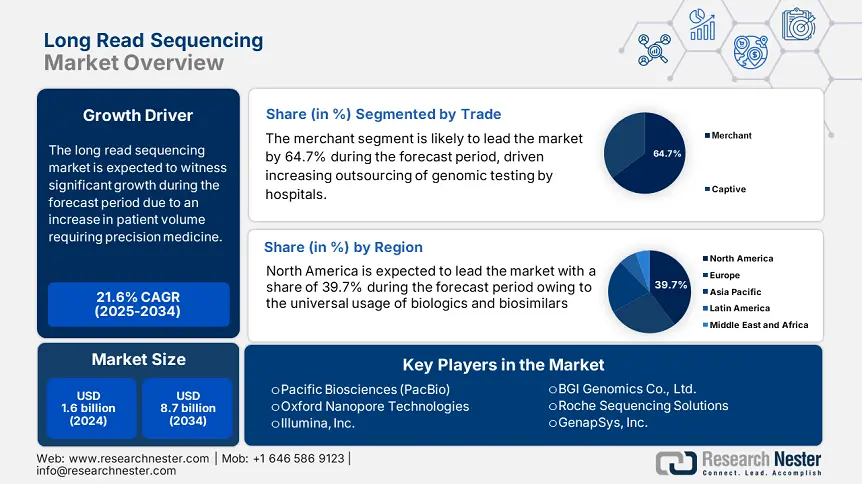
Long Read Sequencing Market Outlook:
Long Read Sequencing Market size was valued at USD 1.6 billion in 2024 and is projected to reach USD 8.7 billion by the end of 2034, rising at a CAGR of 21.6% during the forecast period from, 2025 to 2034. In 2025, the industry size of long read sequencing is estimated at USD 1.9 billion.
The global long read sequencing market is aided by rising patient volume requiring precision medicine, mainly in rare genetic disorders and oncology. As per the National Cancer Institute data, nearly 2.2 million new cases were diagnosed in 2023, with a demand for guided treatment requiring genomic profiling. Further, NIH’s Genetic and Rare Diseases Information Center has stated that above 25.4 million to 30.6 million people in the U.S. are suffering from more than 6950 rare diseases requiring the long read genomic technologies to address repeat expansions and large structural variants that are undetected by short platforms. The European Commission’s Horizon Europe program has funded over €1.6 billion to personalized medicine projects for the years 2021 to 2027 in genomics and personalized medicine.
On the supply chain side, the long read sequencing (LRS) platforms, including SMRT or nanopore technologies, require specialized reagents, custom enzymes, high precision hardware, and sequencing flow cells. These raw materials are sourced and assembled from the UK, the U.S., and some parts of Asia. The U.S. Census Bureau trade data shows that the U.S. has exported nearly USD 4.7 billion nucleic acid diagnostic reagents, which is a 7.7% rise in YoY. Further, the import of precision lab equipment increased to 5.6% strengthening the distribution pipeline. As per the U.S. Bureau of Labor Statistics data, the producer price index increased to 4.6% for medical and diagnostic laboratory services in 2023, while the consumer price index rose to 3.9% for medical care commodities, highlighting the cost to end users such as clinical labs and medical care commodities. The long read sequencing market steadily expands with the rise in trade engagement.