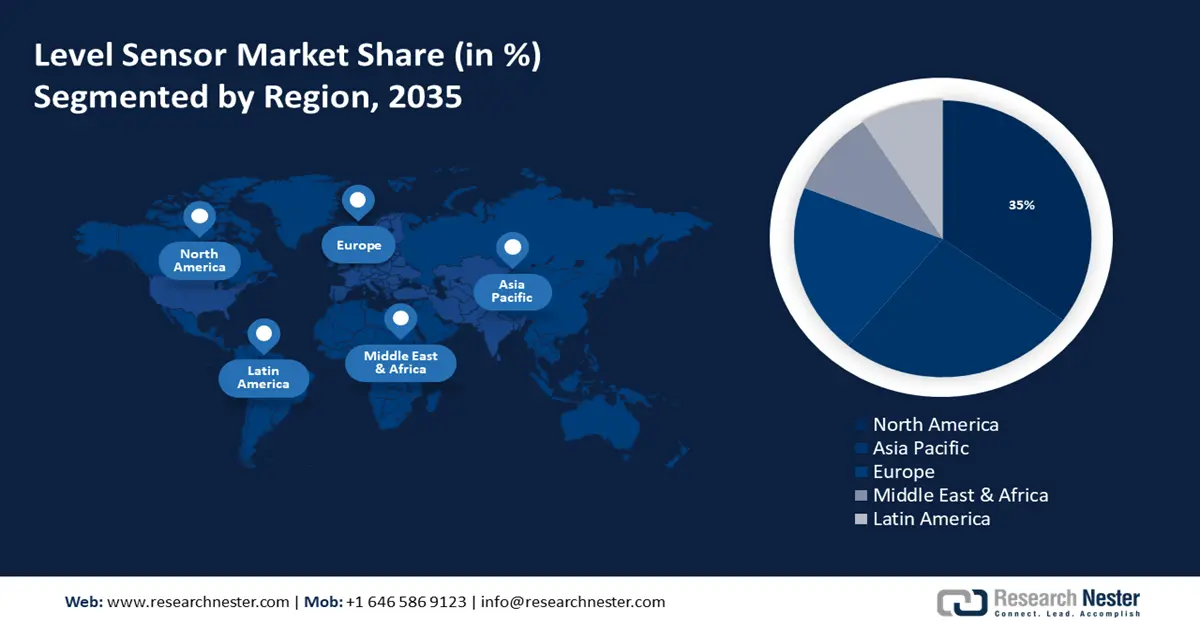
Level Sensor Market Regional Analysis:
North America Market Insights
The North America level sensor market is expected to account for 35% of the global revenue share through 2035. This growth is attributed to the government’s focus on taking effective measures for water preservation and management. The situation regarding water scarcity in drought-prone areas is resulting in an increased emphasis on efficient water use and treatment systems. The level sensors are essential instruments as they help water treatment infrastructure and irrigation operations measure water levels to enhance operational efficiency and cut down on resource usage.
The level sensor sales are also exhibiting rapid growth, owing to the increasing adoption of automation across the manufacturing, pharmaceutical, and chemicals industries. Level sensors are playing a fundamental role in maintaining process reliability and consistent product quality, as companies need them for their operational efficiency objectives and reduced human interaction. Advanced sensors are gaining popularity due to automation trends as they deliver precise real-time information, further fostering the level sensor market growth.
The demand for level sensors in the U.S. is primarily driven by their increasing applications in the renewable energy sector. The use of efficient monitoring systems in solar, wind bioenergy plants is increasing due to sustainability and clean energy initiatives. The U.S. Energy Information Administration (EIA) states that around 4,178 billion kilowatthours (kWh) of energy were produced at utility-scale in 2023, wherein renewable energy sources accounted for 21.0% of the share and nuclear energy 19.0%.
The rising regulatory standards regarding safety and environmental compliance are boosting the applications of lever sensors across multiple industrial sectors. The accurate measurement of levels operates as an essential requirement in the oil and gas industry, the food and beverage sector, and chemicals to prevent hazardous material handling, leaks, and spills. The local companies are using sophisticated level sensors to fulfill tighter environmental regulations and safety guidelines.
Asia Pacific Market Insights
The Asia Pacific level sensor market is also projected to exhibit significant growth in revenue over the forecast period, led by rapid industrial growth and urbanization. The swiftly expanding oil and gas, manufacturing, and chemicals sectors, with increasing need for accurate and reliable level measurement solutions, are creating a lucrative space for level sensor producers. The demand for efficient monitoring systems is continually increasing in China, India, and Japan as these countries require effective systems in their manufacturing plants, water treatment facilities, and energy generation operations. Environmental sustainability and the increasing popularity of smart water management systems are other factors fueling the demand for level sensors. The region is witnessing stricter regulations over water utilization and waste disposal by governments and industries, which is anticipated to fuel the sales of sophisticated level sensing devices.
The rapid advancements in automation and smart manufacturing systems are set to uplift the position of China in the global landscape. The end users are adopting manufacturing standards of Industry 4.0, and creating an expanded requirement for real-time monitoring systems, including level sensors. These sensors are essential components that enhance automated system precision while improving operational efficiency throughout the automotive sectors, electronics production, and food manufacturing facilities.
The country is also actively focusing on renewable energy infrastructure development, which is likely to increase the demand for level sensors during the foreseeable period. Modern solar and wind power plants, as well as hydroelectric power plants, need reliable monitoring systems as they must maximize resource management and prevent critical system breakdowns. The analysis by the IEA highlights that the 14th Five-Year Plan of the country is expected to boost the renewable energy capacity in the years ahead. In 2023, around 350 GW were added to renewable electricity capacity.