Intelligent Apps Market - Growth Drivers and Challenges
Growth Drivers
- Proliferation of AI in enterprise and consumer applications: The large-scale adoption of AI and ML technologies across both enterprise and consumer applications is a major growth driver for the intelligent apps market. In business life, AI is applied to automate processes, improve decision-making, and offer predictive insights. For customers, AI is offering more tailored and interactive experiences, ranging from smart home gadgets to ride-hailing apps. The capacity of smart apps to learn from how they are used by people and tailor their function on that basis is one of the main reasons for their increasing popularity. In March 2025, Baidu, Inc. extended its Apollo Go robotaxi and intelligent transportation applications with expanded fleet management and real-time traffic optimization to enhance the consumer ride-hailing experience across various Chinese cities. This extension reflects the concrete advantages of AI in developing wiser and more efficient consumer services.
- Advances in generative AI and conversational interfaces: Recent advances in generative AI and natural language processing are changing the potential of clever apps. These developments are making it possible to create advanced conversational interfaces, including chatbots and voice assistants, that can comprehend and reply to user questions in a more human way. Generative AI is also being applied to automate content generation, summarize content, and make smart suggestions. In May 2025, Google LLC introduced new Gemini AI capabilities in Workspace, extending generative support to a collection of productivity applications to enable users to write, summarize, and auto-arrange content more effectively. The inclusion of these sophisticated AI capabilities is increasingly powering smarter apps with greater intelligence and ease of use, leading to their increased adoption across diverse usage scenarios.
- Increasing need for tailored user experiences: There is an increasing demand from users for applications that are customized to their specific needs and interests. Smart apps are best at providing a personalized experience through the use of data and machine learning to learn user behavior and offer context-relevant content and suggestions. Such personalization not only improves user engagement but also customer loyalty and retention. Its capability to provide context-based information and services is one of the main differentiators for smart apps. In April 2025, Samsung Electronics Co., Ltd. released SmartThings enhancements that introduce AI-driven automations, which learn customer habits and automatically manage connected devices. This action enhances the smart consumer IoT app experience with a more automated and personalized smart home setting.
AI & ML Impact on the Intelligent Apps Market
The advent of AI and ML have reshaped the global I-Apps market through the streamlining of product development. Major developers in the market now rely on AI for simulation-based design and hyper-personalization. These tools have allowed companies to reduce time-to-market (TTM). The table below highlights the outcome of AI and ML integration in key players:
|
Company |
AI Application |
Impact |
|
Google (DeepMind) |
Data Center Energy Optimization |
The company's AI system directly controlled data center cooling, resulting in a 40% reduction in energy used for cooling, which contributed to a 15% improvement in overall energy efficiency (PUE). |
|
Microsoft (GitHub) |
AI-Powered Software Development |
In company-led research, developers using the AI tool GitHub Copilot completed coding tasks 55% faster than developers who did not. |
|
NVIDIA |
AI for Drug Discovery |
By using NVIDIA's BioNeMo AI drug discovery platform, the biotech company Recursion was able to "expedite their AI model training from months to days." |
|
Amazon |
AI-Powered Drone Delivery |
The company's Prime Air service uses AI for navigation and safety to achieve its goal of flying packages to customers' homes "in less than an hour." |
|
Meta |
Universal Speech Translation |
The company built SeamlessM4T, a foundational AI translation model that supports speech-to-speech translation for nearly 100 input languages and 35 output languages. |
Source: Google, Microsoft (GitHub), NVIDIA, Amazon, Meta
VC Investment in AI by Country (2019-2023)
The U.S. and China lead AI VC investment, with the U.S. peaking at over $114 billion in 2021, driving innovation in intelligent apps for enterprise and consumer use. The EU27 and U.K. show significant growth, reflecting increased focus on AI regulation and scalable SaaS solutions. Emerging hubs like India and Germany highlight global expansion of AI-driven applications in fintech, healthcare, and industrial automation, fueling cross-sector intelligent app development.
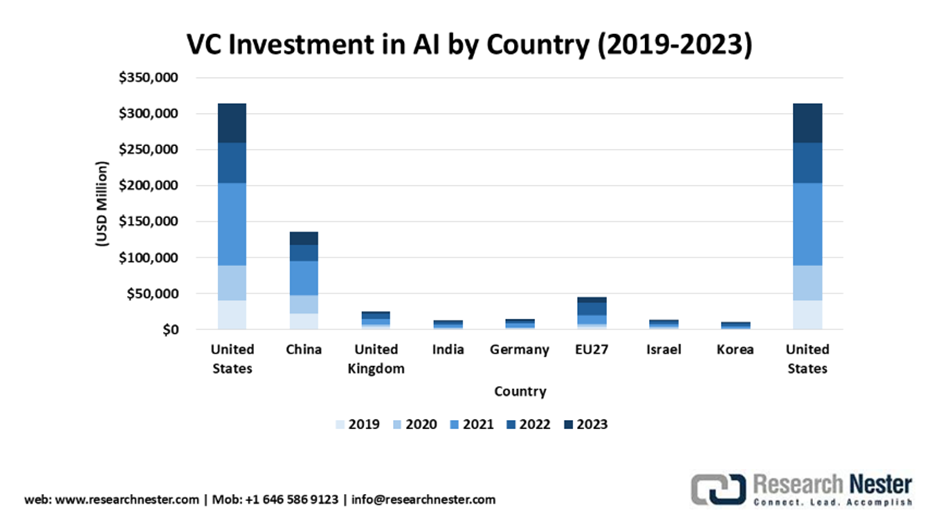
Source: OECD
Challenges
- Data privacy and security concerns: The growing dependence of smart apps on large amounts of data creates pertinent privacy and security issues. User data collection and processing can subject individuals to risks to their privacy if not processed accurately. Maintaining the security of such data is also a big issue, as smart apps can become a target for cyber threats. A single breach of data has serious implications, destroying user trust and causing extensive financial and reputational losses. This underlines the constant threats that organizations face and the value of incorporating solid security mechanisms into intelligent app design and development.
- Difficulty of AI model development and maintenance: The development and upkeep of intricate AI and machine learning models that drive intelligent apps can prove to be a major ordeal. Even training and fine-tuning the AI models can take time and consume resources. Maintaining the accuracy and fairness of these models over time is another key challenge since biased training data can produce unintended and dangerous consequences. In September 2025, the FY2025 Cybersecurity R&D Implementation Roadmap of the U.S. federal government identified agency research programs to develop AI security and critical infrastructure resilience. The roadmap recognizes technical challenges in designing secure and trustworthy AI systems and emphasizes conducting further research and development on these technologies.
Intelligent Apps Market Size and Forecast:
|
Base Year |
2025 |
|
Forecast Year |
2026-2035 |
|
CAGR |
30.2% |
|
Base Year Market Size (2025) |
USD 45 billion |
|
Forecast Year Market Size (2035) |
USD 629.9 billion |
|
Regional Scope |
|

