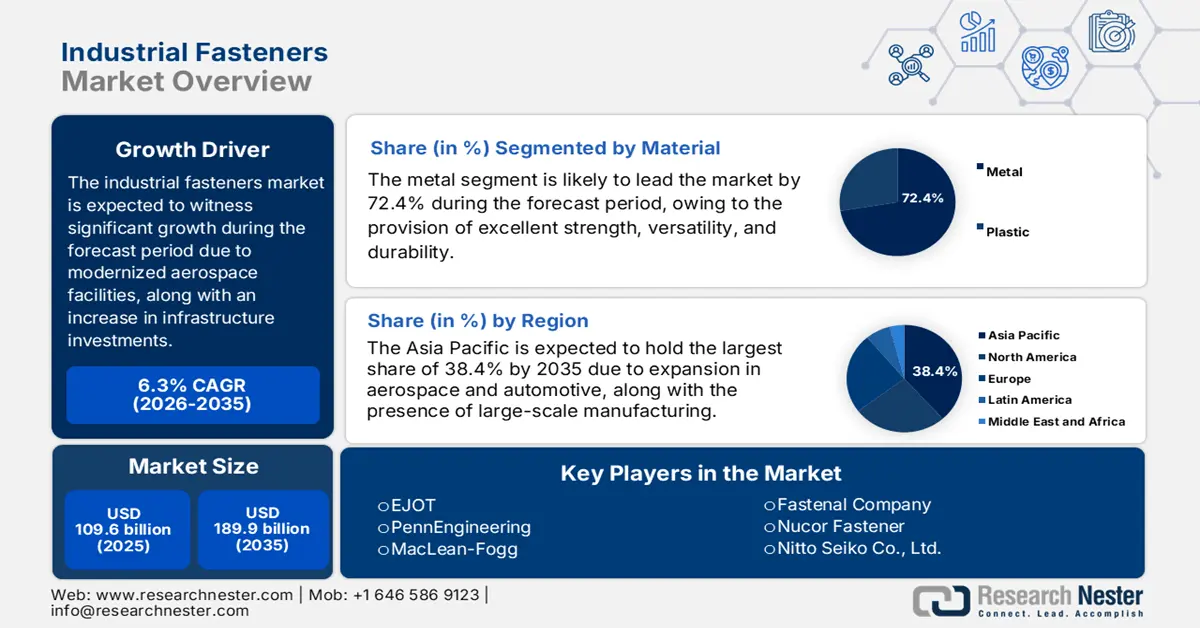
Industrial Fasteners Market Outlook:
Industrial Fasteners Market size was over USD 109.6 billion in 2025 and is estimated to reach USD 189.9 billion by the end of 2035, expanding at a CAGR of 6.3% during the forecast timeline, i.e., 2026-2035. In 2026, the industry size of industrial fasteners is evaluated at USD 116.5 billion.
The international market is steadily expanding, with growth fueled by sustainability initiatives, infrastructure investments, aerospace modernization, and automotive electrification. According to an article published by the World Bank Organization in 2024, the aspect of private participation in infrastructure (PPI) investment reached USD 100.7 billion as of 2024. This has marked a suitable surge of 16% from USD 87.1 billion in 2023, along with 20% from the past 5-year average of USD 83.7 billion. This readily represents an increase in PPI investment, amounting to USD 100 billion, which positively impacts the market’s growth across different nations. Besides, infrastructure investment offers social and economic benefits to both emerging and advanced economies, thus creating an optimistic outlook for the market’s growth in different countries.
Global Infrastructure Investment in Different Countries (2023)
|
Country |
Investment Amount (EURO) |
|
Greece |
111,742,978 |
|
Latvia |
161,000,000 |
|
Ireland |
175,000,000 |
|
Lithuania |
314,000,000 |
|
New Zealand |
394,145,072 |
|
Sweden |
2,313,733,352 |
|
Australia |
9,241,323,121 |
|
Japan |
11,414,900,910 |
|
France |
12,439,679,308 |
Source: OECD
Furthermore, the presence of digitalized and smart fastening solutions, high-strength and lightweight materials, green manufacturing and sustainability, supply chain localization, along with vendor-managed and e-commerce inventory, are other factors driving the market internationally. As per an article published by Alexandria Engineering Journal in April 2025, advanced materials usually comprise a matrix, which is reinforced with particles or fibers, denoting an opportunity to gain weight reductions of almost 50% in comparison to conventional metallic components. Besides, Europe has successfully set a standard target to diminish carbon dioxide emission from newest cars by 37.5% by the end of 2030. Likewise, Corporate Average Fuel Economy (CAFE) standards in the U.S. has also mandated a wide average of 54.5 miles per gallon, thereby making it suitable for boosting the market internationally.