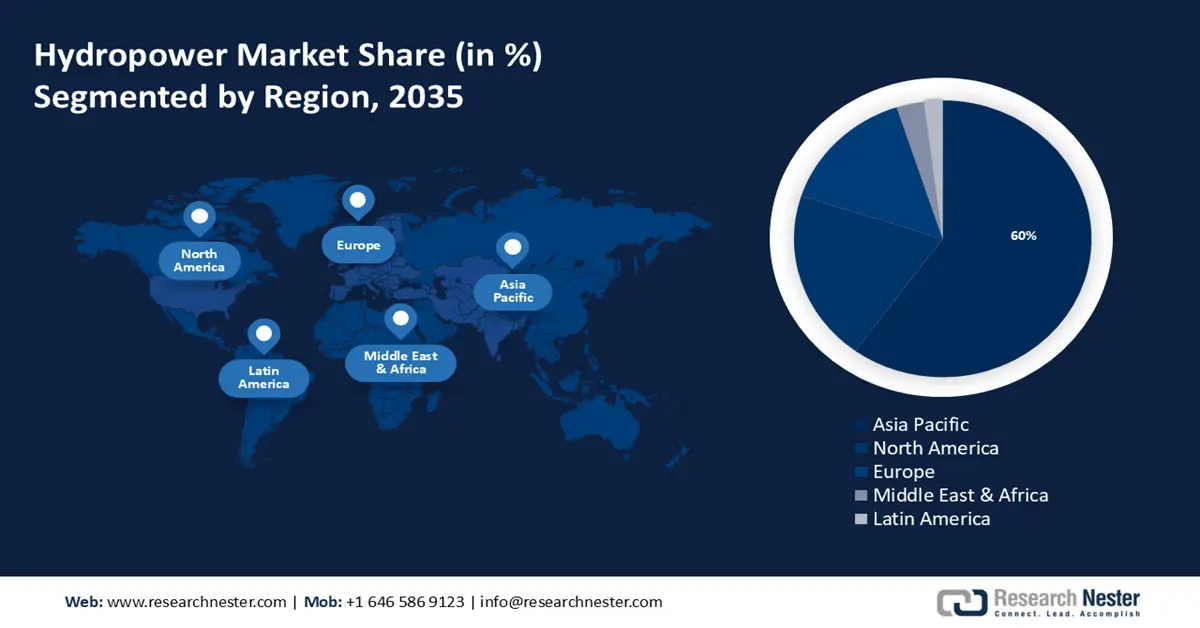
Hydropower Market Regional Analysis:
APAC Market Insights
The market share of hydropower in Asia Pacific is predicted to cross 60% by the end of 2035. The market growth is propelled by presence of China, the largest producer of hydroelectricity in the world. For instance, China produces more than 850 billion kilowatt hours of energy every year. The second major player in the region is India, which produces about 120 billion kilowatt hours of energy every year. India is also aiming to bolster its share in the market in the coming years. The third major player is Pakistan, with many hydroelectric plants running in the country. The region is currently aiming to meet its sustainability as well as energy objectives, with a steady growth in population as well as rise in living standards.
North American Market Insights
The North American hydropower market is estimated to hold 20% share by 2035. With over 100 GW of installed capacity, the US has the biggest hydropower market in North America. The country has a lengthy history of hydropower production, with several current facilities originating from the early twentieth century. The hydropower market in the United States is dominated by large-scale plants, which account for more than 90% of installed capacity. With over 80 GW of generation capacity, Canada is another key hydropower market in North America. Moreover, Canada, such as the United States, has a long history of hydropower production and has numerous large-scale facilities. Yet, there is a large quantity of small and medium-sized hydropower in Canada, particularly in rural and off-grid regions.
Europe Market Insights
The market in Europe is set to observe significant growth till 2035. Several of Europe's extant hydroelectric plants date back to the early twentieth century, revealing how the region has a lengthy history of hydropower development. As part of its aim to decrease greenhouse gas emissions and promote energy security, the European Union (EU) is aggressively pushing the growth of clean energy sources, including hydropower. The EU has set a target of 32% renewable energy by 2030, and hydroelectricity is likely to play a critical role in meeting this aim.