Hydrogen Energy Storage Market Outlook:
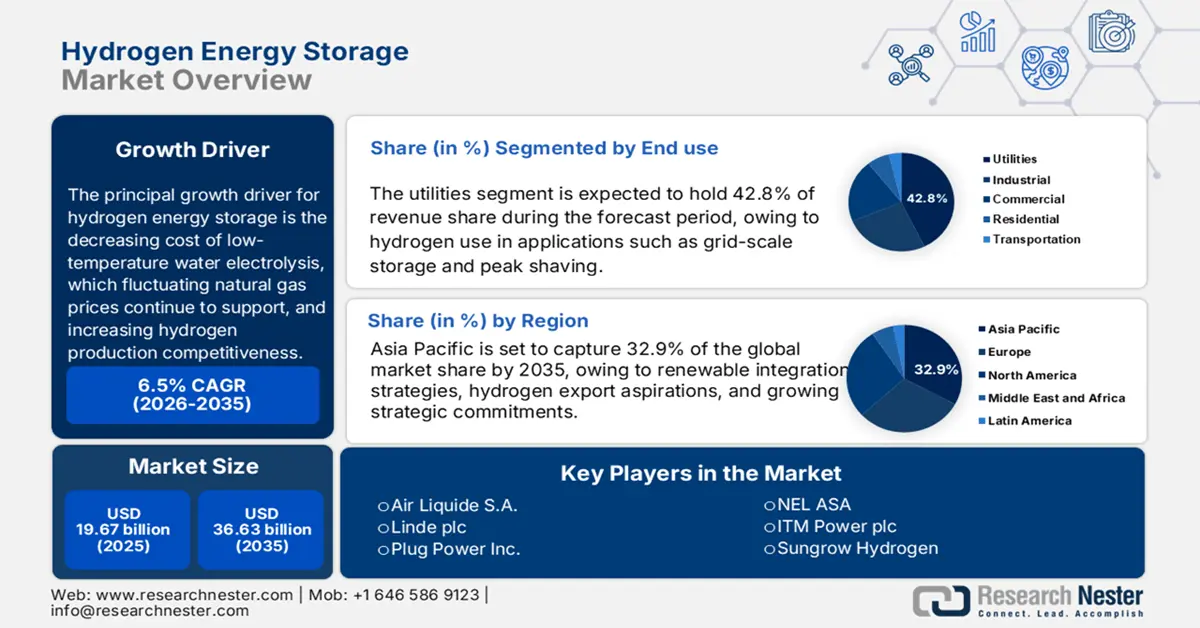
Hydrogen Energy Storage Market size was estimated at USD 19.67 billion in 2025 and is expected to surpass USD 36.63 billion by the end of 2035, rising at a CAGR of 6.5% during the forecast period, i.e., 2026-2035. In 2026, the industry size of hydrogen energy storage is estimated at USD 20.95 billion.
The main growth driver for hydrogen energy storage is the decreasing cost of low-temperature water electrolysis, which, as long as fluctuating natural gas prices continue to support it, along with the increasing competitiveness of hydrogen production. The National Renewable Energy Laboratory (NREL) estimates that the potential for serviceable use of hydrogen in the U.S. is predicted to be 106 MMT/year, a tenfold increase over the existing market size annually, with growth in city loads and demand from metals refining, biofuels, and methanol. Federal R&D budgets fund research on advanced materials mainly to enhance gravimetric and volumetric storage capacity through and for metal hydrides, sorbents, and composites.
In upstream supply chains, commodities such as carbon steel, aluminum, and nonferrous alloys, compressed gas infrastructure is important, with US electric utilities importing pipelines for compressed gases or tanks for storage. The global trade picture of hydrogen storage encompasses missing pieces (large-scale trade of liquid hydrogen and assemblage of storage modules in hydrogen hub sites). In July 2025, the Producer Price Index (PPI) for storage battery manufacturing was 205.657. Federal RDD included much of geology, and the advanced storage systems are still RDD with explicit target modeling for developing reservoir modeling and technologies for compressing material cycling.